Hello! Welcome to your sixth lesson in the Foundations of Business Analysis module.
In our last lesson, you learned how to perform a gap analysis to create a bridge between the current state and a desired future state. We saw that closing this "gap" often involves proposing a project or a significant change. However, no project succeeds in a vacuum. It requires support, input, and buy-in from people across the organization. This is where your skills in managing relationships become paramount.
Building on your experience as a project and account manager, we'll now formalize the process of navigating the human landscape of a project. Your learning outcome for today is to identify key stakeholders and analyze their influence and interests using a stakeholder map.
Mastering this will not only make your projects run smoother but is also crucial for demonstrating the strategic and communication skills required in any BA interview.
What is a Stakeholder and Why is Analysis Crucial?
A stakeholder is any individual, group, or organization that can affect, be affected by, or perceive itself to be affected by a project's decisions, activities, or outcomes. Your job as a Business Analyst is to understand who these people are, what they care about, and how much they can impact your work.
To get a quick overview of this process, known as stakeholder analysis, let's start with a short video.
What is a Stakeholder Analysis? — Leading Successful Projects
The video 'What is a Stakeholder Analysis?' from ProductPlan provides a concise introduction to the three key steps we will cover today: identifying, prioritizing, and understanding stakeholders.
Please watch from 00:31 to 03:38. Pay close attention to the three core steps and the initial introduction to the power-interest grid.
As the video suggests, stakeholder analysis isn't just about making a list of people. It's a strategic process that helps you anticipate challenges, build alliances, and ensure the solution you're working on actually meets the needs of the business. Without it, you risk delivering a perfect solution that nobody wants or, worse, having your project blocked by an influential person you overlooked.
The Stakeholder Analysis Process
Effective stakeholder analysis follows a clear, structured process. We'll break it down into three main phases: Identification, Analysis & Prioritization, and Engagement Strategy.
Step 1: Identify Your Stakeholders
The first step is to brainstorm and list everyone who has a stake in your project. It's better to create a long list and narrow it down later than to miss someone important.
Think broadly across these categories:
- Internal: People inside your organization (e.g., project sponsor, developers, marketing team, finance, legal).
- External: People outside your organization (e.g., customers, suppliers, government regulators, partners).
In your AdTech work, this could include:
- The client whose budget you're managing.
- The internal Ad Operations team that sets up campaigns.
- The sales team that brought in the client.
- The data analytics team that measures performance.
- The external platform partner whose technology you use (e.g., Google, Meta).
- The finance department that processes invoices.
Don't forget "hidden stakeholders"—those who aren't obviously connected but whose domains are impacted. An IT security team, for example, might not be involved day-to-day, but they have huge influence if your project involves new software or data handling.
Step 2: Analyze and Prioritize with the Power-Interest Grid
Once you have your list, you need to figure out where to focus your energy. Not all stakeholders require the same level of attention. The most common tool for this is the Power-Interest Grid, also known as a Stakeholder Map.
This grid plots each stakeholder on two axes:
- Power (or Influence): How much authority does this stakeholder have to influence the project's direction and outcome? Can they stop the project, approve budget, or change requirements?
- Interest: How much is this stakeholder's work or world affected by the project's outcome?
This categorization helps you decide how to engage with them.
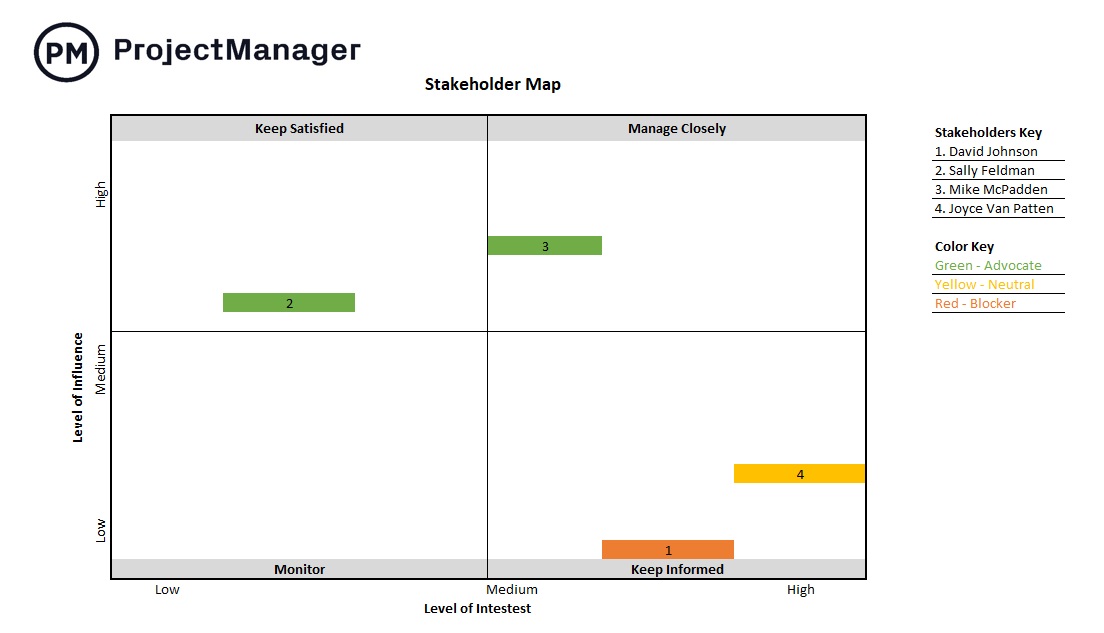
To understand the specific strategies for each quadrant, let's watch a video that dives into the details.
What is Power/Interest Stakeholder Analysis?
The video 'What is Power/Interest Stakeholder Analysis?' by AssistKD provides a detailed explanation of the engagement strategies for each of the four quadrants. This is the 'how-to' part of our analysis.
Watch from 00:36 to 03:42. Focus on understanding the recommended actions for stakeholders in each of the four categories: High Power/High Interest, High Power/Low Interest, Low Power/High Interest, and Low Power/Low Interest.
Step 3: Define the Engagement Strategy
Based on the grid, you can now define your communication and management plan.
-
High Power, High Interest (Manage Closely): These are your key players. You need to fully engage them, collaborate closely, and manage their expectations with care. In an AdTech project, this is likely your main project sponsor (e.g., the VP of Marketing).
-
High Power, Low Interest (Keep Satisfied): These stakeholders have the power to block your project but aren't interested in the daily details. Keep them happy with high-level summaries and targeted updates. Don't overwhelm them. An example might be the Head of Legal or IT Security—you need their sign-off, but they don't care about the campaign's click-through rate.
-
Low Power, High Interest (Keep Informed): These people are often the end-users or team members most affected by the change. They have valuable insights and can be great advocates. Keep them in the loop with regular communications and consult them for feedback. For example, the Ad Operations specialists who will use a new tool you're implementing.
-
Low Power, Low Interest (Monitor): These stakeholders require minimal effort. Monitor them for any changes in their status but don't overload them with communication. This might be a team in another department that is only tangentially affected.
It's critical to remember that this is a dynamic analysis. A stakeholder's position on the grid can change as the project evolves.
From Grid to Action: An AdTech Example
Let's apply this to a scenario. Imagine you are the BA on a project to implement a new automated bidding platform for your agency.
-
Identify Stakeholders:
- Sponsor (Head of Performance Marketing)
- End-Users (PPC Campaign Managers)
- IT Manager (responsible for integration)
- Finance Director (concerned with platform cost)
- Key Client (whose accounts will be migrated first)
-
Analyze and Plot on the Grid:
| Low Interest | High Interest | |
|---|---|---|
| High Power | Finance Director (Keep Satisfied) |
Sponsor, Key Client (Manage Closely) |
| Low Power | IT Manager (Monitor) |
PPC Campaign Managers (Keep Informed) |
(Note: The IT Manager's power could be high if the integration is complex, highlighting how context matters!)
- Define Engagement:
- Sponsor & Key Client: Schedule weekly check-ins, involve them in all major decisions, provide detailed progress reports.
- Finance Director: Provide a clear business case focusing on ROI, give periodic budget updates, but don't bog them down with technical details.
- PPC Campaign Managers: Conduct workshops to gather their requirements, provide training, send bi-weekly updates on progress, and create a feedback channel for them.
- IT Manager: Send occasional email updates on the project timeline and flag any upcoming integration tasks.
Test your understanding!
You are the BA for a project to create a new self-serve analytics dashboard for clients, replacing manual PDF reports. Identify three key stakeholders, place them on the Power-Interest Grid, and briefly state your engagement strategy for each.
Show answer
Here is one possible answer:
-
Stakeholder: A major client's Head of Marketing.
- Placement: High Power, High Interest. They are a key user and their satisfaction is critical for retention. Their feedback can influence other clients.
- Strategy: Manage Closely. Involve them in design mockups, run a pilot with their team, and have frequent one-on-one check-ins.
-
Stakeholder: Your agency's Head of Client Services.
- Placement: High Power, High Interest. They are accountable for overall client satisfaction and retention. The success or failure of the dashboard directly impacts their department's goals.
- Strategy: Manage Closely. Treat them as a primary sponsor. They should be in steering committee meetings and sign off on key milestones.
-
Stakeholder: An internal Account Manager.
- Placement: Low Power, High Interest. Their daily work will change significantly (less report-pulling, more strategic advising). They don't have the power to stop the project, but their adoption is key to its success.
- Strategy: Keep Informed. Involve them in workshops to understand their current pain points, provide them with training, and communicate the benefits for their role. They can become your biggest advocates.
Documenting Your Analysis
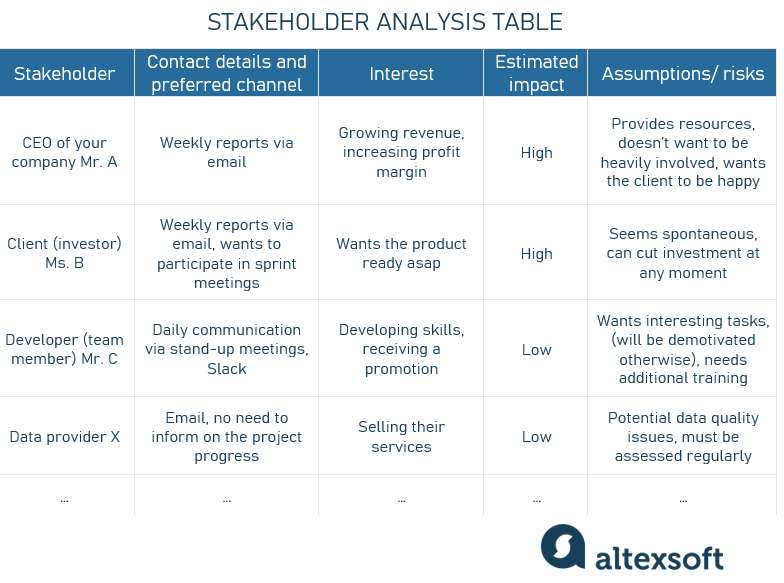
While the grid is great for visualization, a formal BA role requires documenting your findings in more detail. A Stakeholder Analysis Table or Register is a common artifact for this. It captures not just the Power/Interest level but also their specific motivations, expectations, and preferred communication methods.
For a comprehensive guide on this entire process, from identification to documentation, the following article is an excellent resource.
Stakeholder Analysis: A Step-by-Step Guide for PMs
The article 'Stakeholder Analysis: A Step-by-Step Guide for PMs' from Product School provides a very detailed, practical walkthrough of the entire process. It's written from a product management perspective, which is very close to modern BA work.
Please read these two key sections: Start at '2. Prioritize Stakeholders with a Power-Interest Grid'. This provides another clear explanation of the grid and how to use it. Continue to '3. Analyze stakeholder needs, interests, and expectations'. Focus on the distinction between 'Overt Interests' and 'Hidden Interests'. This is a more advanced concept that will set you apart. These sections will give you a robust framework for not just plotting stakeholders, but truly understanding them.
After your analysis, you can create a table like this to keep your findings organized.
Conclusion
You've now learned how to systematically identify and analyze the people who can make or break your project. This isn't about office politics; it's about strategic communication and risk management. By understanding who your stakeholders are, what they care about, and how much influence they have, you can tailor your engagement plan to build consensus and drive your project toward a successful outcome.
Key Takeaways:
- Stakeholder analysis is a core BA competency for managing the human elements of change.
- The Power-Interest Grid is the essential tool for prioritizing stakeholders and defining your engagement strategy.
- The four key strategies are: Manage Closely, Keep Satisfied, Keep Informed, and Monitor.
- A great BA goes beyond the obvious to uncover "hidden interests" and documents their findings in a structured format like a stakeholder register.
- This is a dynamic process; be prepared to re-evaluate your stakeholder map as the project progresses.
Preview of the Next Lesson:
So far in this module, you've learned to define a problem, find its root cause, perform a gap analysis, and analyze your stakeholders. You now have the essential building blocks. In our next and final lesson of this module, we will bring it all together. You will learn how to plan a business analysis approach for a given project scenario, creating a roadmap that outlines which techniques you'll use, when, and why.