Welcome to the first lesson of Module 4, "Building Blocks: Pronouns, Numbers, and Phono-Semantic Characters."
In the previous module, you built a solid foundation by learning the basic strokes, stroke order rules, and the main types of simple characters. You finished by analyzing pictographs for people like 人 (rén) and 女 (nǚ), which will soon become essential radicals. You also encountered your first ideographs with the numbers 一 (yī), 二 (èr), and 三 (sān).
Today, we will complete this fundamental set of numbers. Your learning outcome is to recognize and write the number characters from 四 (sì) to 十 (shí). While some of these might seem simple, their origins are surprisingly complex and will introduce you to a critical concept in character evolution: phonetic loans. Mastering these characters is not just about counting; it's about deepening your analytical understanding of how Chinese characters are formed and how they carry sound and meaning.
1. Recognizing and Pronouncing Numbers 4-10
Before we delve into writing, let's first get familiar with what these characters look and sound like. Pay close attention to the pinyin and the tone for each number.
Learn numbers 1-10 (1 to 10)中文数字 in Mandarin Chinese ❤ Learn Chinese With Emma
The video 'Learn numbers 1-10' by learnchinesewithemma provides clear pronunciation for each number. We will focus on the second half of the video.
Please watch from 00:54 to 02:17. Listen carefully to the native pronunciation and repeat each number aloud, focusing on getting the tone correct.
Here is a summary of the numbers you just heard:
| Arabic | Character | Pinyin | Meaning |
|---|---|---|---|
| 4 | 四 | sì | four |
| 5 | 五 | wǔ | five |
| 6 | 六 | liù | six |
| 7 | 七 | qī | seven |
| 8 | 八 | bā | eight |
| 9 | 九 | jiǔ | nine |
| 10 | 十 | shí | ten |
2. The Story Behind the Numbers: An Introduction to Phonetic Loans
While 一, 二, and 三 are simple ideographs created by stacking lines, the characters from four to ten have more intricate origins. Many are phonetic loan characters (假借字, jiǎjièzì). This means an existing character was "borrowed" to represent a word that had a similar or identical sound. This is a crucial concept that explains the origin of a vast number of Chinese characters.
Your analytical approach to learning will be well-served by exploring these etymologies.
Etymology of the Chinese number characters
The resource 'Etymology of the Chinese number characters' from the Chinese StackExchange forum provides a scholarly but accessible summary of the origins of these number characters. It gives insight into why they look the way they do.
Please read the sections explaining the etymology for each number from four to ten. You don't need to read all the detailed critiques, but focus on the main theories presented: 四 (sì): Start at 'Etymology of 四'. Notice its original form of four horizontal lines (亖) and how the modern character 四 was borrowed from a character meaning 'breathing' or 'snot' that sounded similar. 五 (wǔ): Find 'Etymology of 五'. See how it was borrowed from a character representing the 'crossing' of threads. 六 (liù): Look for 'Etymology of 六'. This character began as a pictograph of a simple hut (廬, lú) and was borrowed because its pronunciation was similar to the word for 'six'. 七 (qī): Find 'Etymology of 七'. Its oracle bone form looked like our modern 'ten' (十) and meant 'to cut'. It was loaned for its sound. 八 (bā): Look for 'Etymology of 八'. Its original meaning was 'to part' or 'divide'. 九 (jiǔ): Find 'Etymology of 九'. The leading theory is that it was borrowed from a character for 'hook' (句, gōu), which sounded similar to 'nine'. 十 (shí): Look for 'Etymology of 十'. The primary theory is that it represents a vertical counting rod, distinguishing it from the horizontal rod for 'one' (一).
Understanding that a character's form may relate to a borrowed sound rather than its current meaning is a significant step in your analytical journey. You've now seen how pictographs (like the hut for 六) and ideographs (like 'to cut' for 七) were repurposed for their sounds.
3. Writing Numbers 4-10: Stroke by Stroke
Now that you recognize the numbers and understand their origins, let's learn to write them. We'll follow the stroke order rules you've already learned. This chart is an excellent static reference for the process.
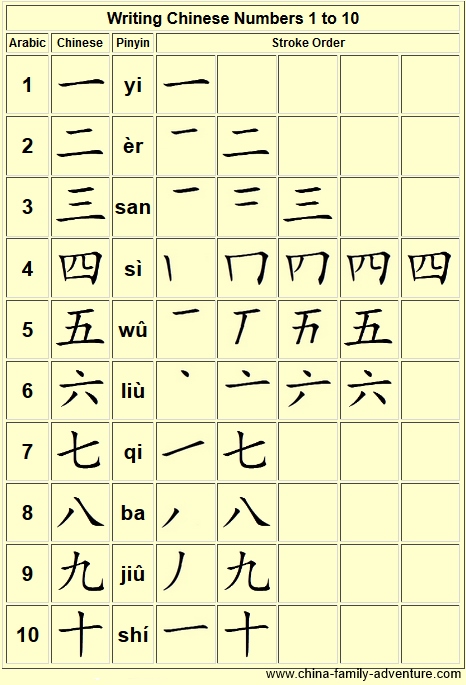
For a dynamic demonstration, let's watch a tutorial for each character.
【Beginner Chinese】How to Write Numbers 1-10 in Chinese | Writing Tutorial with Stroke Order
The video 'How to Write Numbers 1-10' by Wenjun Qin Chinese clearly demonstrates the stroke order for each number. We will watch it in segments.
Watch the following clips, paying close attention to the stroke order and the instructor's tips. Try writing each character on paper as you watch. 四 (sì): Watch from 01:36 to 02:22. Note the 'outside-before-inside' rule for this enclosure character. 五 (wǔ): Watch from 02:22 to 02:52. The stroke order is not intuitive, so watch carefully: top horizontal, then vertical, then the 'L' shape, and finally the bottom closing stroke. 六 (liù): Watch from 02:52 to 03:24. This character is straightforward: top dot, horizontal, then the two dots at the bottom. 七 (qī): Watch from 03:24 to 03:56. A simple two-stroke character: horizontal, then the hooked vertical stroke. 八 (bā): Watch from 03:56 to 04:19. Follow the 'left-falling before right-falling' rule, just like with 人. 九 (jiǔ): Watch from 04:19 to 04:47. Another two-stroke character: the curved left-falling stroke, then the hooked vertical stroke. 十 (shí): Watch from 04:47 to 05:01. Simple and very common: horizontal stroke first, then the vertical stroke.
4. Practice and Consolidation
You now have all the tools to recognize, understand, and write the numbers from one to ten.
Your Task:
Take out a piece of paper. Practice writing each character from 四 to 十 about 20 times. As you write, say its pinyin and meaning aloud (e.g., "sì, four"). Consciously apply the stroke order rules.
For additional practice, you can use the worksheet generator on the Hanzi Stroke website (from Resource LINK) by entering the characters 四五六七八九十.
Conclusion
In this lesson, you have successfully learned to recognize and write the Chinese characters for the numbers four through ten, completing the foundational set from 1-10. More importantly, you've been introduced to the concept of phonetic loans, a key principle that will demystify many characters you encounter in the future.
Key Takeaways:
- You can now recognize, pronounce, and write 四, 五, 六, 七, 八, 九, and 十.
- You understand that many of these characters are phonetic loans, where an existing character was borrowed for its sound, not its original meaning.
- You have reinforced your knowledge of stroke order rules by applying them to these new, more complex characters.
Preview of the Next Lesson:
With numbers under your belt, we will move on to another essential building block: pronouns. In the next lesson, you will learn to recognize and write 我 (wǒ), the character for "I/me." You will analyze its structure and see how it connects to other characters and components you've already learned.