Welcome to the seventh and final lesson of our first major module, "Character Fundamentals."
In our last lesson, you learned to recognize and write your first ideographs—characters that represent abstract concepts like numbers (一, 二, 三), position (上, 下), and size (大, 小). You saw how simple, logical marks can convey complex ideas.
Today, we'll return to pictographs (象形字, xiàngxíngzì), but this time focusing on some of the most essential ones: those related to people and the human body. Your learning outcome is to recognize and write pictographic characters for people: 人, 女, 口, 手. These characters are not only foundational on their own but also serve as critical building blocks—radicals—for a vast number of other characters you will learn.
1. Pictographs of Humanity
Just as you saw with characters for nature like 山 (mountain) and 木 (tree), the characters for people and body parts began as simple drawings. Understanding their visual origins makes them much easier to remember.
This image provides a wonderful overview of how many characters, including the ones for today, evolved from pictures.
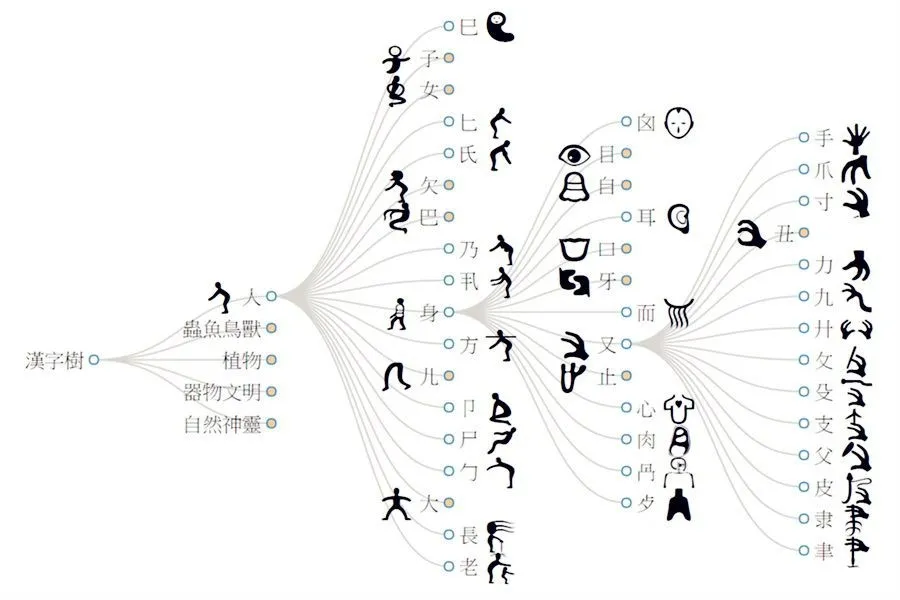
Let's break down each of these four characters.
2. 人 (rén) - Person
The character 人 (rén) is one of the simplest and most common. Its form is a stylized side-view of a walking person.
To see how it evolved and how it's written, please watch the following video.
Basic Chinese Characters: First 100 Chinese Characters You Need Know & Write. Chinese for Beginners
The video 'Basic Chinese Characters' explains the origin of 人 as a bowing person and clearly demonstrates its simple two-stroke order.
Watch from 05:40 to 06:47. Pay attention to the pictographic origin and the stroke order, which follows the 'left-falling before right-falling' rule you've learned.
As you saw, the stroke order is:
- 撇 (piě): A left-falling stroke.
- 捺 (nà): A right-falling stroke, starting from where it connects to the first stroke.
This character is a perfect example of the stroke order rule: left-falling then right-falling.
3. 女 (nǚ) - Woman, Female
The character 女 (nǚ) is another clear pictograph, originating from the image of a kneeling woman, perhaps with her hands folded gracefully.

Now, let's see how to write it.
Basic Chinese Characters: First 100 Chinese Characters You Need Know & Write. Chinese for Beginners
This clip from 'Basic Chinese Characters' will show you the stroke order for 女 and explain its origin.
Watch from 11:09 to 12:34. Notice the three distinct strokes and how they come together to form the balanced character.
The stroke order for 女 (nǚ) is:
- 撇点 (piě diǎn): A combined left-falling stroke and dot.
- 撇 (piě): A left-falling stroke.
- 横 (héng): A horizontal stroke that crosses the other two.
4. 口 (kǒu) - Mouth
The character 口 (kǒu) is perhaps the most straightforward pictograph you'll learn: it's a drawing of an open mouth. It's also used to mean 'opening' or 'entrance'.
Because of its box shape, the stroke order is important to learn correctly. It follows the principles for writing enclosures.
HOW TO WRITE 100 BASIC Chinese Characters with STROKE-BY-STROKE Instructions
The video 'HOW TO WRITE 100 BASIC Chinese Characters' gives a very clear, analytical breakdown of how to write a square shape like 口. It also provides useful tips about how the strokes should be drawn for a balanced look.
Watch the segment from 17:49 to 18:45. The presenter gives excellent advice on the subtle tilt of the vertical strokes, which is key to writing a well-proportioned character.
The stroke order for 口 (kǒu) is:
- 竖 (shù): The left vertical stroke.
- 横折 (héng zhé): The top and right sides, written as a single, continuous stroke.
- 横 (héng): The final closing horizontal stroke at the bottom.
This sequence—left, then top-and-right, then close—is fundamental for all square-like structures in Chinese characters.
5. 手 (shǒu) - Hand
Finally, 手 (shǒu) is a pictograph of a hand, with the strokes representing the palm and fingers. While its modern form is more abstract, the connection is still there.
Basic Chinese Characters: First 100 Chinese Characters You Need Know & Write. Chinese for Beginners
Let's return to the 'Basic Chinese Characters' video to see the origin and stroke order for 手.
Watch from 25:04 to 26:05. This section will show you how to write the character and also notes that it has a different form when used as a radical, a key concept for future lessons.
The stroke order for 手 (shǒu) is:
- 撇 (piě): The first, shorter left-falling stroke.
- 横 (héng): The first horizontal stroke (shorter).
- 横 (héng): The second horizontal stroke (longer).
- 竖钩 (shù gōu): The final vertical stroke with a hook at the end.
6. Reviewing Strokes and Characters
You've now learned four new pictographs. To reinforce your understanding from an analytical perspective, the following text connects each of these characters back to the specific basic strokes that form them.
Writing Chinese Characters - a guide to brush strokes
The Chinasage article 'Writing Chinese Characters' provides a clear, technical explanation of how basic strokes combine to form characters. Reading these short sections will solidify the connection between the strokes you learned in the first lesson and the characters you've learned today.
Please read the following four short paragraphs from the webpage: Find the section describing the diagonal strokes 撇 (piě) and 捺 (nà). It uses 人 (rén) as the primary example. Find the paragraph describing the shù gōu (竖钩) stroke. It uses 手 (shǒu) as its example. Find the paragraph describing the héngzhé (横折) stroke. It uses 口 (kǒu) as its example. Find the paragraph describing the piě diǎn (撇点) stroke. It uses 女 (nǚ) as its example.
7. Summary and Practice
Today you've mastered four essential pictographs related to people. As you've seen, they are not only characters in their own right but are also destined to become radicals—components that give meaning to more complex characters.
| Character | Pinyin | Meaning | Strokes | Pictographic Origin | Key Stroke Rule |
|---|---|---|---|---|---|
| 人 | rén | person | 2 | Side view of a person | Left-falling before right-falling |
| 女 | nǚ | woman, female | 3 | A kneeling woman | Written top to bottom |
| 口 | kǒu | mouth | 3 | An open mouth | Outside before closing the bottom |
| 手 | shǒu | hand | 4 | A hand with fingers | Top to bottom, left to right |
Your Task:
Now it's time to practice. As you did in the last lesson, use the ArchChinese website to create a practice worksheet for these four characters: 人, 女, 口, 手. Write each character about 15-20 times, saying its pinyin and meaning aloud. Focus on the feel of the stroke order until it becomes second nature.
Conclusion
This lesson concludes our foundational module on character fundamentals. You have learned the basic strokes, the rules for combining them, and the three main types of simple characters: pictographs, ideographs, and now, pictographs of people.
Key Takeaways:
- You can now recognize and write four new characters: 人 (rén), 女 (nǚ), 口 (kǒu), and 手 (shǒu).
- You understand their pictographic origins and can connect their forms to the basic strokes they are composed of.
- You are aware that these simple characters will frequently act as radicals in more complex characters.
Preview of the Next Module:
You are now perfectly prepared to begin Module 4: "Building Blocks: Pronouns, Numbers, and Phono-Semantic Characters." In the very first lessons, you will see how the radicals for 'person' (人) and 'woman' (女) are used to construct the characters for "you" (你), "he" (他), and "she" (她). This is where your analytical foundation will truly start to pay off as you begin building a functional vocabulary.