Hello again. Welcome to the fifth lesson in our module on Character Fundamentals.
In the last lesson, we explored the "architecture" of Chinese characters, learning to identify their structural patterns like left-right and top-bottom. We made a key distinction between indivisible single-component characters and the more common compound characters. You learned that understanding a character's structure is the first step to analyzing it.
Today, we transition from theory to practice by learning your first set of characters. We will start with the most intuitive category: pictographs. These are the single-component characters that form the foundation of the writing system.
Your learning outcome for this lesson is to recognize and write pictographic characters for nature: 日, 月, 山, 水, 木, 火. By understanding their origins as simple pictures, you'll find them much easier to remember, which aligns perfectly with the analytical approach you prefer.
1. The Origin of Characters: Pictographs
Before we look at the specific characters, let's formally define what a pictograph is. In Chinese, they are called 象形字 (xiàngxíng zì), which literally means "form-imitating characters." They are one of the six original categories of character formation and represent the historical starting point of the written language.
For a concise explanation of this concept, please read the short section below.
The preface of 'The WAY of CHINESE CHARACTERS' explains the different types of Chinese characters. We will focus on the first category, pictographs.
Please read the paragraph under the heading 'TYPES OF CHARACTERS' that begins with 'Pictographs delineate the shape of certain objects...'. This will give you a clear definition.
As you've just read, pictographs are essentially stylized drawings. Over thousands of years, these drawings became more abstract and standardized for easier writing, but their visual connection to the real world is often still visible.
Today, we'll learn six of the most fundamental pictographs, all representing elements of nature. The image below shows how their ancient forms evolved into the characters used today.

2. The Six Nature Characters
Let's now analyze each character individually. For each one, we will cover its meaning, pronunciation, origin, and most importantly, how to write it. As you practice writing, try to visualize the object the character represents.
日 (rì) - Sun, Day
The character 日 (rì) is a direct representation of the sun. The ancient form was a circle with a dot or line in the middle. Over time, for ease of carving on bone and later writing with a brush, the shape became a rectangle.
- Pinyin: rì (fourth, falling tone)
- Meaning: Sun; Day
- Structure: Single component
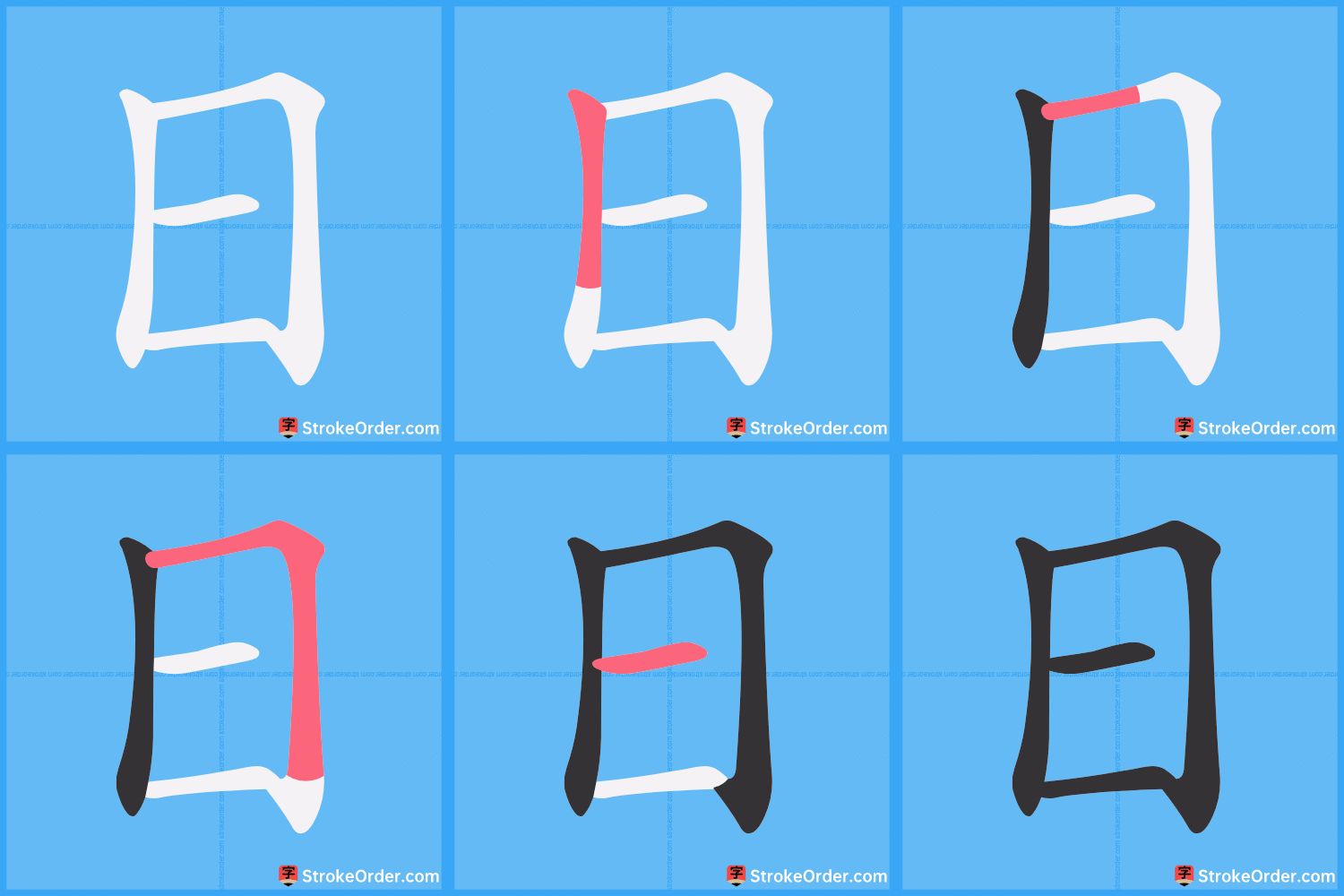
- Stroke Order: The animation below shows the correct stroke order. Notice it follows the rules we've discussed: top to bottom, left to right, and outside before inside, then close the frame.
- shù (竖)
- héngzhé (横折)
- héng (横)
- héng (横)
月 (yuè) - Moon, Month
The character 月 (yuè) is a picture of a crescent moon. The two horizontal lines inside are a later addition and don't have a specific pictorial meaning. Because the ancient Chinese calendar was lunar, this character also came to mean "month."
- Pinyin: yuè (fourth, falling tone)
- Meaning: Moon; Month
- Structure: Single component
- Stroke Order:
- piě (撇)
- héngzhégōu (横折钩)
- héng (横)
- héng (横)
For more insight into this character, the resource '月 Yuè (moon, month)' explains its origin and cultural significance.
Read the first section about the character 月. Pay attention to how its meaning expanded from 'moon' to 'month'.
山 (shān) - Mountain
This is one of the clearest pictographs. The character 山 (shān) is a stylized drawing of a mountain range with three peaks. The central vertical stroke represents the highest peak.
- Pinyin: shān (first, high-level tone)
- Meaning: Mountain
- Structure: Single component
- Stroke Order:
- shù (竖)
- shùzhé (竖折)
- shù (竖)
水 (shuǐ) - Water
The character 水 (shuǐ) originates from a picture of flowing water, with a central line representing the main current and the strokes on either side representing smaller eddies or splashes.
- Pinyin: shuǐ (third, falling-rising tone)
- Meaning: Water
- Structure: Single component
- Stroke Order:
- shùgōu (竖钩)
- héngpiě (横撇)
- piě (撇)
- nà (捺)
This character is also a very common radical. When used as a left-side component, it's written as "氵", often called "three dots water" (三点水). You will see this in countless characters related to liquids, rivers, and washing.
木 (mù) - Tree, Wood
The character 木 (mù) is a picture of a tree. The horizontal stroke represents the branches, the vertical stroke is the trunk, and the two diagonal strokes at the bottom represent the roots.
- Pinyin: mù (fourth, falling tone)
- Meaning: Tree; Wood
- Structure: Single component
- Stroke Order:
- héng (横)
- shù (竖)
- piě (撇)
- nà (捺)
The Chineasy video below offers a very memorable and visual way to see these first few characters.
ShaoLan's Chineasy lesson provides a simple, visual introduction to several pictographs, reinforcing their pictorial nature.
Please watch the segment from 01:06 to 02:30. It will quickly review the characters for mountain, tree, sun, and moon, helping to solidify their shapes in your mind.
火 (huǒ) - Fire
Finally, the character 火 (huǒ) comes from a drawing of a central flame with sparks flying off to the sides.
- Pinyin: huǒ (third, falling-rising tone)
- Meaning: Fire
- Structure: Single component
- Stroke Order:
- diǎn (点)
- piě (撇)
- piě (撇)
- nà (捺)
Like water, fire also has a variant form when used as a radical at the bottom of a character: "灬", known as the "four dots".
3. Practice and Consolidation
You have now analyzed your first six characters. The table below summarizes them.
| Character | Pinyin | Meaning | Pictographic Origin |
|---|---|---|---|
| 日 | rì | Sun, Day | A stylized drawing of the sun. |
| 月 | yuè | Moon, Month | A stylized drawing of a crescent moon. |
| 山 | shān | Mountain | A drawing of a mountain range with three peaks. |
| 水 | shuǐ | Water | A drawing of flowing water in a river. |
| 木 | mù | Tree, Wood | A drawing of a tree with branches and roots. |
| 火 | huǒ | Fire | A drawing of a flame with sparks. |
Your Task:
Take a piece of paper and practice writing each of these six characters 10-15 times. As you write, focus on:
- Correct stroke order.
- Saying the pinyin (with the tone) for each character.
- Visualizing the object it represents (the sun, a mountain, a flame, etc.).
This practice is not about rote memorization, but about internalizing the logic, feel, and look of these fundamental building blocks.
Conclusion
Congratulations on learning your first six Chinese characters! By focusing on their pictographic origins, you've started your journey with an analytical foundation rather than memorization.
Key Takeaways:
- Pictographs (象形字) are characters derived from drawings of physical objects.
- You can now recognize and write six fundamental nature pictographs:
- 日 (rì) - Sun
- 月 (yuè) - Moon
- 山 (shān) - Mountain
- 水 (shuǐ) - Water
- 木 (mù) - Tree
- 火 (huǒ) - Fire
- These characters are not only words themselves but also crucial radicals (components) that will help you decipher more complex characters later on.
In our next lesson, we will continue building our character foundation by learning another category: ideographs. These are characters that represent abstract concepts, such as the numbers one, two, and three (一, 二, 三) and the directions up and down (上, 下).