Hello and welcome back to our course on Mandarin Chinese.
In the last two lessons, we analyzed characters at their most fundamental levels: first by identifying the basic strokes, and then by learning the systematic rules for putting those strokes together. We now have the "bricks" (strokes) and the "architectural plans" (stroke order).
Today, we move up one level of abstraction to explore radicals (部首, bùshǒu). You will learn that most Chinese characters aren't monolithic blocks but are instead assembled from smaller, meaningful components. Understanding these components is the key to unlocking the logic of the writing system. This lesson directly addresses your preference for an analytical approach, giving you a powerful tool to deconstruct and understand new characters rather than simply memorizing them.
Our goal is to explain the concept of radicals as semantic or phonetic components. By the end of this lesson, you'll be able to look at a complex character and start to identify the parts that give you clues about its meaning and its sound.
1. What Are Radicals? A Practical Definition
Before we begin, it's important to clarify what we mean by "radical." The term is often used in two different, though related, ways. For your analytical approach, distinguishing between them is crucial.
- The Dictionary Radical (部首, bùshǒu): Historically, this is the original meaning. It refers to one specific component within a character that was chosen to classify it in a traditional paper dictionary. Think of it as a "section head" for sorting. Each character has only one official dictionary radical.
- The Character Component (部件, bùjiàn or 偏旁, piānpáng): This is a more general and practical term for any of the building blocks that a character is made of. A single character can be made of several components.
For learning purposes, we are far more interested in the components. Many dictionary radicals are also very common components that suggest meaning, which is why the terms are often used interchangeably. However, your focus should be on breaking characters down into all their functional parts, not just identifying the single dictionary radical.
To get a solid grasp of this distinction and the overall structure of characters, please read the following article.
Chinese Radicals: The Basic Unit of Characters
The article 'Chinese Radicals: The Basic Unit of Characters' from Sapore di Cina explains the historical origin of radicals for dictionary indexing and then distinguishes them from components used for learning. It provides the foundational terminology we'll use.
Please read the sections titled 'The radicals', '“radicals for consulting a dictionary”', and '“radicals for learning characters”'. Focus on understanding the difference between a 部首 (bùshǒu) for dictionary lookup and a component for learning.
2. The Two Functions: Meaning and Sound
Now that we have our terminology straight, we can focus on the core of today's lesson: the function of these components. Most components serve one of two purposes: they provide a clue about the character's meaning or its sound.
The following video gives an excellent overview of how characters evolved from simple pictures to complex compounds that combine these meaning and sound elements.
Learn Chinese Characters Fast From Shapes Radicals and Unlock the Secrets to Learn Effortlessly
This video, 'Learn Chinese Characters Fast From Shapes Radicals', illustrates the evolution of characters and clearly explains the concept of phono-semantic compounds.
Watch from 06:38 to 13:40. Pay close attention to two key ideas: How simple characters (like 人 'person' and 木 'wood') are combined to form new meanings (休 'rest'). How most characters combine a 'semantic' part for meaning (like the water radical 氵) and a 'phonetic' part for sound.
As the video demonstrated, we can categorize components into two functional types.
A. Semantic Components (形旁, xíngpáng)
These components suggest the character's general meaning or category. They are your first clue to deciphering an unknown character. For example:
- 氵(shuǐ): This is the "three-dot water" radical. It's a compressed form of the character 水 (shuǐ, water). When you see it, usually on the left side of a character, you can infer the meaning is related to liquid.
- Examples: 河 (hé, river), 湖 (hú, lake), 海 (hǎi, sea), 酒 (jiǔ, alcohol).
- 口 (kǒu): This is the "mouth" radical. It indicates that a character's meaning might be related to speaking, eating, breathing, or sounds.
- Examples: 吃 (chī, to eat), 喝 (hē, to drink), 叫 (jiào, to call), 吗 (ma, question particle).
- 木 (mù): The "wood" radical suggests a connection to trees, wood, or objects made of wood.
- Examples: 树 (shù, tree), 林 (lín, woods), 椅 (yǐ, chair).
B. Phonetic Components (声旁, shēngpáng)
These components suggest the character's pronunciation. This is an incredibly powerful tool, but it comes with a caveat: the pronunciation might be identical, differ only in tone, or be just a close approximation. The sound system of Chinese has evolved over millennia, so some phonetic connections are stronger than others.
-
Example 1: Strong phonetic connection
- The character 马 (mǎ) means "horse."
- It acts as the phonetic component in:
- 妈 (mā) - mother
- 吗 (ma) - question particle
- 骂 (mà) - to scold
- Notice how the semantic radicals (女 for "woman," 口 for "mouth") give the meaning, while 马 provides the
masound.
-
Example 2: Another clear phono-semantic compound
- The character 羊 (yáng) means "sheep."
- The character 洋 (yáng) means "ocean."
- Here, the phonetic component is 羊 (yáng) on the right, giving the exact sound. The semantic component is 氵 (water) on the left, indicating the meaning is related to water.
3. The System: Phono-Semantic Compounds
The vast majority of Chinese characters—over 80%—are phono-semantic compounds (形声字, xíngshēngzì). They are constructed exactly as we've just discussed: by combining a semantic component with a phonetic component.
Mastering this concept is the single most important step you can take toward efficiently learning thousands of characters. Instead of a unique drawing to memorize, each character becomes a solvable puzzle.
Let's look at a clear visual breakdown.
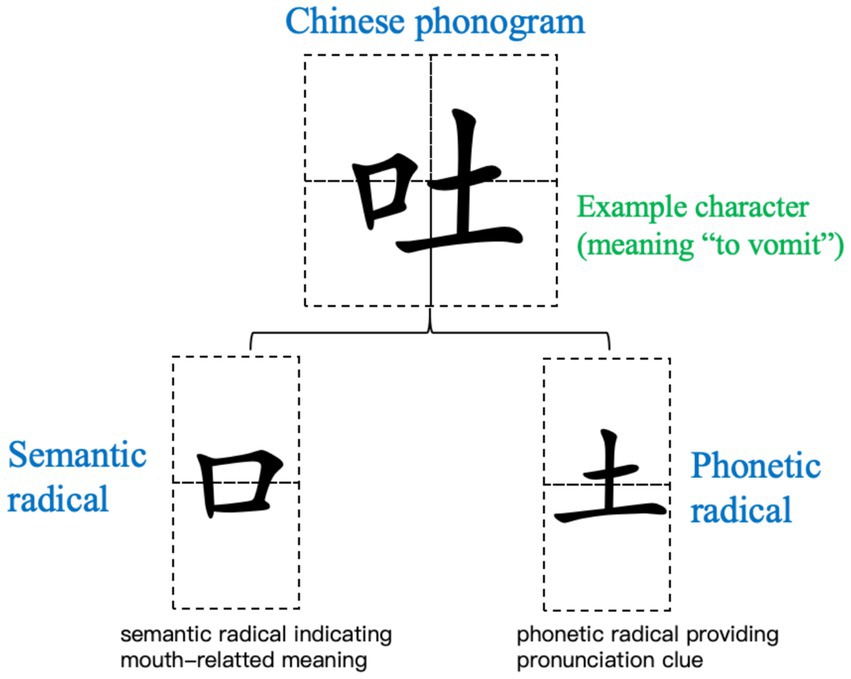
To solidify your understanding of this crucial structure, let's return to the "Sapore di Cina" article and read about these two functions in more detail.
Chinese Radicals: The Basic Unit of Characters
We will now read the sections that explain semantic and phonetic functions with more text-based examples.
Please read the sections titled 'Function 2: suggest the meaning of a character' and 'Function 3: suggest the sound of a character'. As you read, try to spot the phono-semantic pattern in the examples provided, like 语 (yǔ) and 问 (wèn).
Conclusion
Today you have gained a foundational perspective for analyzing Chinese characters. Instead of seeing a complex shape, you can now begin to see its constituent parts and hypothesize about their function.
Key Takeaways:
- Most Chinese characters are compounds built from smaller components.
- These components typically serve one of two functions:
- Semantic: Providing a clue to the character's meaning (e.g., 氵 means it's related to water).
- Phonetic: Providing a clue to the character's sound (e.g., 马 suggests a
masound).
- Over 80% of characters are phono-semantic compounds that combine both types of components. Recognizing this structure is the key to efficient learning.

In our next lesson, we will put this theory into practice. You will begin learning your first set of actual characters. We'll start with pictographs and ideographs—simple characters that often depict objects or abstract ideas directly. Many of these simple characters, like 日 (sun), 月 (moon), and 山 (mountain), frequently serve as semantic or phonetic components in more complex characters later on.