Hello! Welcome back to your study of Mandarin Chinese.
In our last lesson, you did a fantastic job deconstructing and learning your first pronoun, 我 (wǒ), meaning "I/me". We established that it's a phonetic loan, composed of the hand radical (扌) and the spear radical (戈). This process of breaking a character down into its functional components is central to our analytical approach.
Today, we'll build on that foundation by learning the character for "you." The learning outcome for this lesson is to identify the 'standing person' radical (亻) and write the character 你 (nǐ, you). This is not only a crucial vocabulary item but also a perfect example of a different and very common type of character structure.
1. A New Radical: The 'Standing Person' (亻)
Before we look at the full character for "you," we need to learn its most important component. In Module 3, you were introduced to the pictograph 人 (rén), meaning 'person'.
When 人 is used as a component on the left side of another character, it changes its shape to 亻. This component is known as the 'standing person' radical.
- Radical: 亻
- Pronunciation: rén (same as 人)
- Meaning: person
This visual distinction is key. Take a look at this animation which clearly contrasts the full character with its radical form.
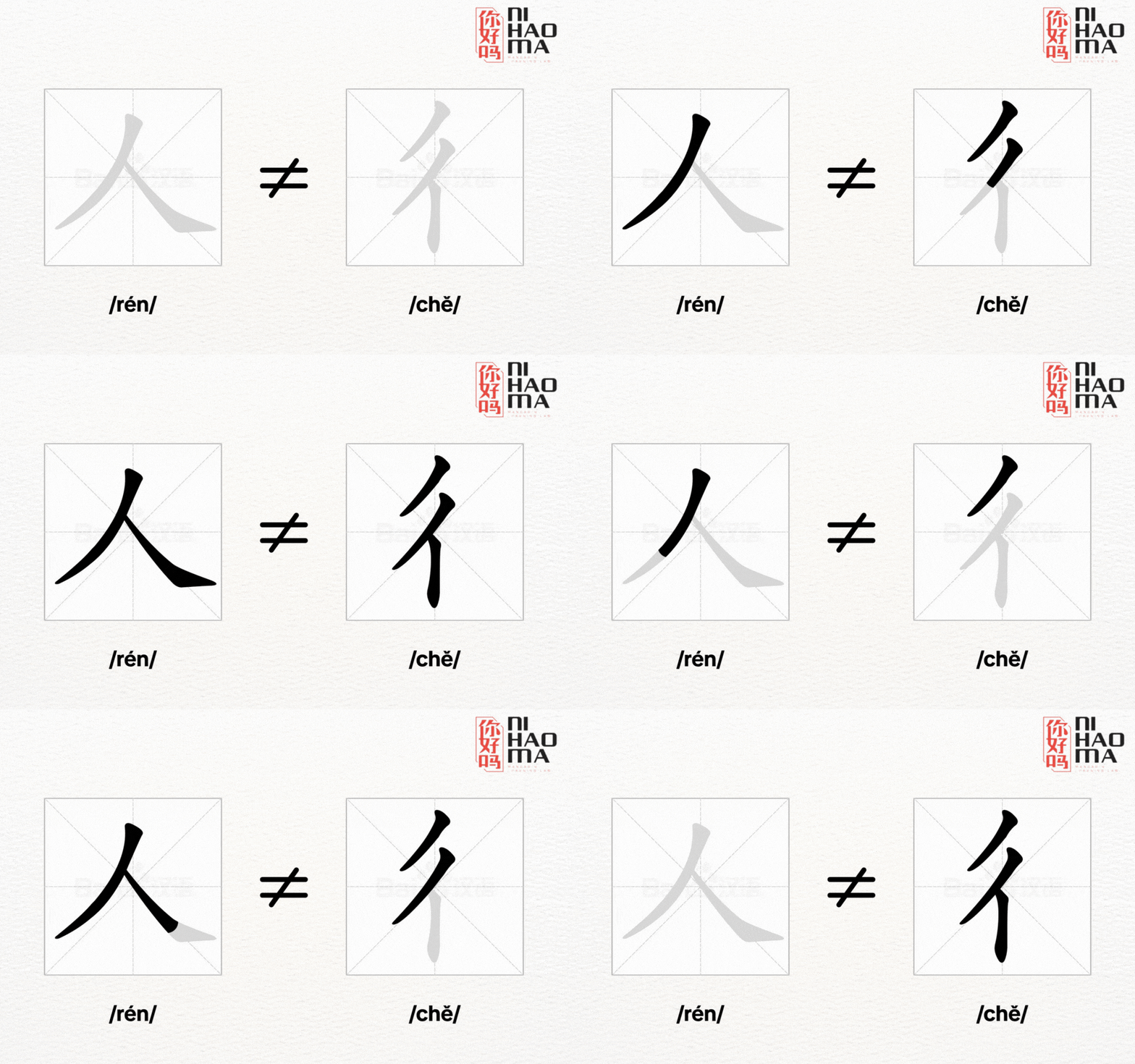
The primary function of the 'standing person' radical is to provide a semantic (meaning) clue. When you see 亻 in a character, it's a strong indicator that the character's meaning is related to a person or human attributes.
To confirm this, let's turn to a quick reading.
The Dong Chinese dictionary provides a very clear and concise explanation of the components of 你 (nǐ). We'll focus on its description of the radical.
In the 'Components' section, find the entry for '亻 Meaning component'. Read the brief explanation, which confirms that '亻 is a component form of 人'.
This concept of a radical changing its form to fit within a larger character is a fundamental principle of character composition, similar to how you learned the hand radical (扌) is a compressed form of 手 (shǒu).
2. Deconstructing 你 (nǐ): A Phono-Semantic Compound
Now we are ready to tackle the full character, 你 (nǐ).
- Character: 你
- Pinyin: nǐ
- Tone: 3rd (falling-rising), the same as in 我 (wǒ)
- Meaning: you (singular, informal)
First, let's listen to the pronunciation.
你nǐ - English Meaning | HSK 1 - Mandarin Temple
The Mandarin Temple page for 你 (nǐ) has a clear audio file for its pronunciation.
Locate the audio player near the top of the page. Listen to the pronunciation of 'nǐ' a few times to familiarize yourself with the sound and the third tone.
Unlike 我 (wǒ), which was a phonetic loan, 你 is a phono-semantic compound. This is the most common type of character construction in Chinese, accounting for over 80% of all characters. It's a logical system that combines meaning and sound.
A phono-semantic compound consists of two parts:
- Semantic Component: A radical that suggests the character's meaning.
- Phonetic Component: Another character or component that suggests the character's pronunciation.
Let's break down 你:
- Semantic Component (Meaning): 亻 (rén). As we just learned, this is the 'standing person' radical. It tells us the character is related to a person.
- Phonetic Component (Sound): 尔 (ěr). This component on the right side provides a clue to the pronunciation.
You might rightly ask: "How does 'ěr' give the sound for 'nǐ'?" This is an excellent question that touches on the historical evolution of the language. In Middle Chinese, the pronunciations of 尔 and 你 were much more similar. Over centuries, pronunciation has shifted, but the character's written form remains, preserving this ancient phonetic link. This is a common phenomenon you will encounter.
The following resource explains this structure clearly.
The Dong Chinese dictionary page for 你 provides an excellent summary of its structure as a phono-semantic compound.
Read the section at the top of the page, starting from 'Phonosemantic compound' down to the 'Definitions'. It explicitly identifies '亻' as the meaning component and '尔' as the sound component, and even notes the historical sound change.
Understanding this phono-semantic principle is a huge step forward. It provides a powerful analytical framework for learning new characters efficiently.
3. Writing 你 (nǐ): Mastering the 7 Strokes
Now, let's put it all together and learn to write 你. The character has 7 strokes, just like 我. We will follow the fundamental stroke order rule: left to right, top to bottom. This means we write the entire left-side radical first, then the right-side component.
Watch this animation to see the stroke order in action.

Let's break down the sequence:
- Component 1: The 亻 radical (left side)
- Stroke 1: piě (丿) - A left-falling stroke.
- Stroke 2: shù (丨) - A vertical stroke.
- Component 2: The 尔 phonetic part (right side)
- Stroke 3: piě (丿) - A short, top-left falling stroke.
- Stroke 4: shù gōu (亅) - A vertical stroke with a hook at the bottom.
- Stroke 5: piě (丿) - A small left-falling stroke in the middle.
- Stroke 6: diǎn (丶) - A small dot to the left.
- Stroke 7: diǎn (丶) - A final dot to the right.
Practice Time:
Take out your notebook. Following the animated GIF and the steps above, write the character 你 at least 15-20 times. With each repetition, say "nǐ" out loud. This will solidify the connection between the character's form, its components, its sound, and its meaning.
Conclusion
Excellent work today. You have successfully learned your second pronoun and, more importantly, have been introduced to the powerful concept of phono-semantic compounds.
Key Takeaways:
- You can now recognize, pronounce, and write the character 你 (nǐ), which means "you".
- You have identified the 'standing person' radical (亻), a variant of 人 (rén), which signifies that a character's meaning is related to a person.
- You understand that 你 is a phono-semantic compound, combining a semantic component (亻) for meaning and a phonetic component (尔) for sound.
- You have mastered the 7-stroke order for 你, applying the left-to-right and top-to-bottom rules.
Preview of the Next Lesson:
With 我 ("I") and 你 ("you") in your vocabulary, the next logical step is to learn the third-person pronouns. In the next lesson, we will learn to distinguish and write 他 (tā, he) and 她 (tā, she). You will see the phono-semantic principle in action again, reinforcing your understanding. You will also see a familiar radical (亻) and be introduced to a new one: the 'woman' radical (女).