Hello! Welcome back to your Chinese studies.
In the last lesson, we took a significant step by learning to analyze and write 你 (nǐ), your first phono-semantic compound character. We saw how the 'standing person' radical (亻) provided the meaning ("person") while the component 尔 (ěr) provided a clue for the sound.
Today, we will continue exploring this powerful character-building principle. Our learning outcome is to distinguish 他 (tā, he) and 她 (tā, she) based on their radicals (亻 vs 女) and write both characters. You'll see how a single phonetic component can be combined with different semantic radicals to create new, distinct characters with the same pronunciation. This is a fundamental pattern in Chinese.
1. The Masculine Pronoun: 他 (tā)
Let's begin with the third-person masculine pronoun, "he" or "him."
- Character: 他
- Pinyin: tā
- Tone: 1st (high and flat). Unlike the 3rd tone in 我 (wǒ) and 你 (nǐ), this tone is sustained at a high pitch.
- Meaning: he, him
As you can see, 他 is another phono-semantic compound. Let's break it down:
- Semantic Component (Meaning): 亻 (rén). This is the 'standing person' radical you learned in the last lesson. Its presence tells you immediately that this character is related to a person.
- Phonetic Component (Sound): 也 (yě). This component on the right side provides the sound clue for the character. While the pronunciation isn't identical (tā vs. yě), you can see the similarity in the final vowel sound. This is a common occurrence due to historical sound shifts.
The structure is Meaning + Sound, just like in 你.
Writing 他 (tā)
The character 他 has 5 strokes. We follow the left-to-right rule, writing the 亻 radical first.
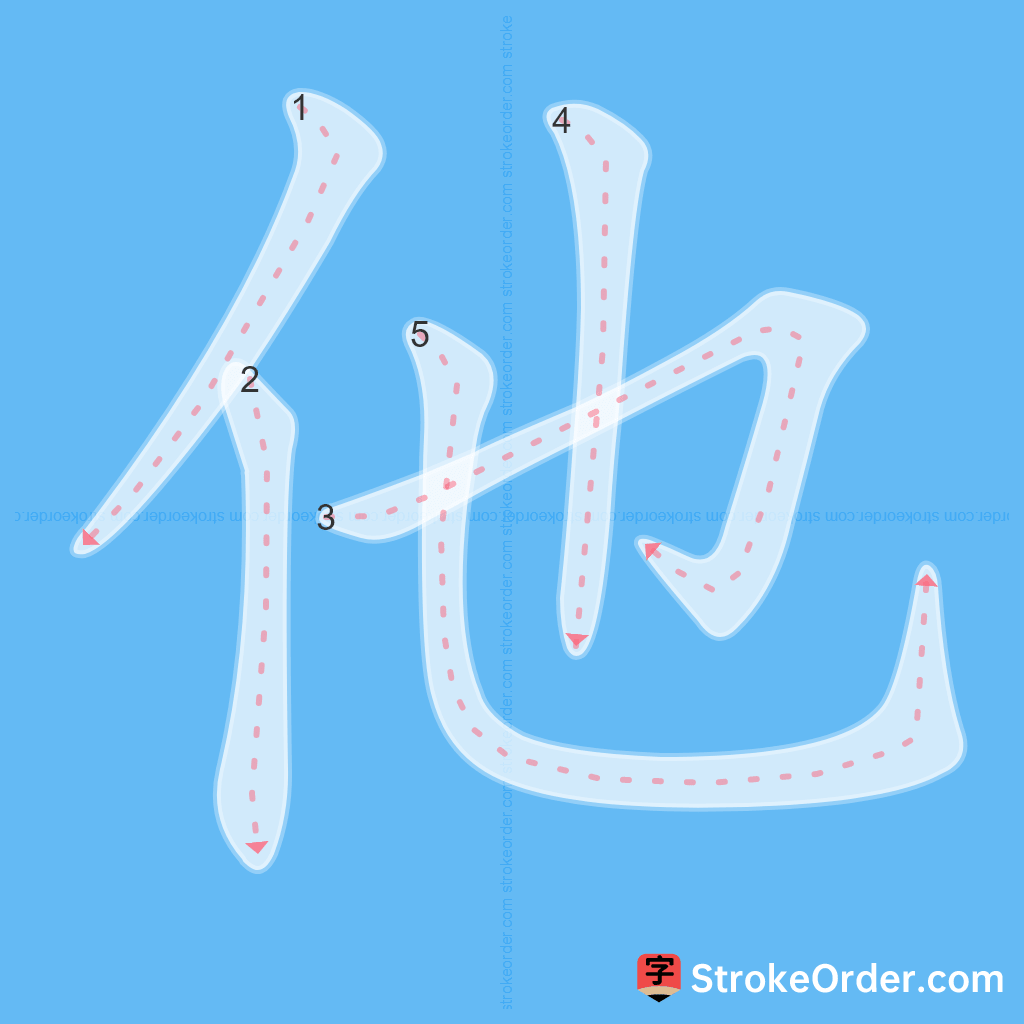
The stroke order is as follows:
- Component 1: The 亻 radical (left)
- Stroke 1: piě (丿) - Left-falling
- Stroke 2: shù (丨) - Vertical
- Component 2: The 也 component (right)
- Stroke 3: shù (丨) - Vertical
- Stroke 4: héng zhé gōu (𠃍) - A horizontal stroke that turns a corner and ends in a hook.
- Stroke 5: shù wān gōu (乚) - A vertical stroke that curves and ends in a hook.
Practice: Take out your notebook and write 他 at least 15 times, saying "tā" with the first tone as you write.
2. The Feminine Pronoun: 她 (tā)
Now, let's learn the third-person feminine pronoun, "she" or "her."
- Character: 她
- Pinyin: tā
- Tone: 1st (high and flat)
- Meaning: she, her
Notice that the pinyin and tone are identical to 他. In spoken Mandarin, "tā" can mean "he" or "she," and the meaning is understood from context. In writing, however, the distinction is perfectly clear, thanks to a different radical.
To understand 她, we first need to learn a new radical.
The 'Woman' Radical: 女 (nǚ)
The character 女 (nǚ) is a pictograph that originally depicted a kneeling or seated woman. It functions as both a standalone character meaning "woman" or "female," and as a crucial semantic radical.
Chinese Radicals: The Basic Unit of Characters
The article 'Chinese Radicals: The Basic Unit of Characters' by Sapore di Cina provides an excellent explanation of how radicals suggest meaning. We'll focus on its description of the 'woman' radical.
Please read the section titled 'Function 2: suggest the meaning of a character'. Pay close attention to the paragraph that begins 'The “three dots” are the “stylized” version...'. It explains how 女 (nǚ) is used in characters like 妈妈 (māma, mom) and 妹妹 (mèimei, little sister) to indicate a feminine connection.
When you see the 女 (nǚ) radical on the left side of a character, it's a strong clue that the character's meaning is related to women, femininity, or family roles traditionally associated with women.
Deconstructing 她 (tā)
Now we can analyze a new character using our new radical.
- Semantic Component (Meaning): 女 (nǚ). The 'woman' radical on the left tells us this pronoun refers to a female.
- Phonetic Component (Sound): 也 (yě). This is the exact same phonetic component we saw in 他. This explains why they are pronounced identically.
Interestingly, the character 她 is a relatively modern invention, created to provide a written counterpart to 他, which originally could refer to any person.
This academic text from MIT provides a concise historical note on the creation of 她.
Find note 'c)' in the first section. It explains that '她 was created in relatively recent times as a counterpart to 他 (a contrast not represented in the spoken language)'.
Writing 她 (tā)
The character 她 has 6 strokes. Again, we apply the left-to-right rule, writing the 女 radical first.
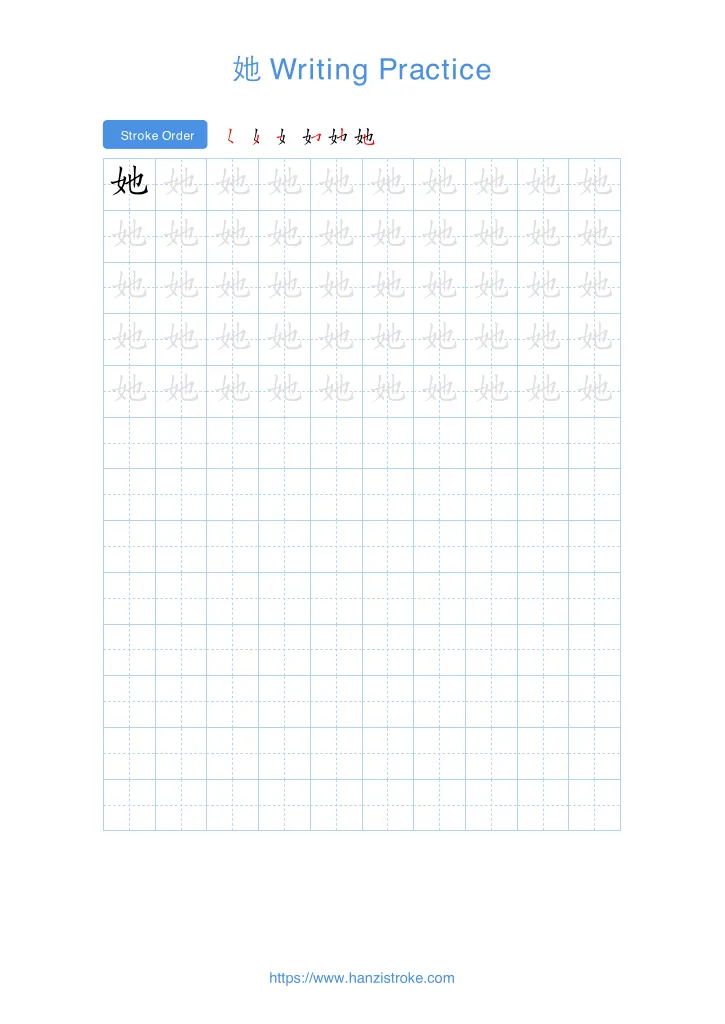
The stroke order is:
- Component 1: The 女 radical (left)
- Stroke 1: piě diǎn (丿丶) - A sweeping stroke that starts as a left-fall and ends with a dot-like press.
- Stroke 2: piě (丿) - Left-falling.
- Stroke 3: héng (一) - Horizontal.
- Component 2: The 也 component (right)
- Stroke 4: shù (丨) - Vertical.
- Stroke 5: héng zhé gōu (𠃍) - Horizontal, turning a corner with a hook.
- Stroke 6: shù wān gōu (乚) - Vertical, curving with a hook.
Practice: Write 她 at least 15 times in your notebook, saying "tā" out loud. As you write, focus on the difference in the left-side radical compared to 他.
3. The Power of Radicals: A Direct Comparison
You have just learned a perfect demonstration of the logic behind phono-semantic compounds. Let's put 他 and 她 side-by-side to make the pattern explicit.
| Character | Radical (Semantic) | Phonetic Component | Pinyin | Meaning |
|---|---|---|---|---|
| 他 | 亻 ('standing person') | 也 | tā | he / him |
| 她 | 女 ('woman') | 也 | tā | she / her |
Both characters share the same sound source (也) and therefore the same pronunciation (tā). The meaning is differentiated solely by the semantic radical on the left. This elegant system allows Chinese to create new characters by recombining existing components.
In spoken Chinese, these radicals are often referred to by descriptive names to distinguish between homophones. The 亻 in 他 is called 单人旁 (dānrénpáng), "single person on the side," while the 女 in 她 is called 女字旁 (nǚzìpáng), "woman character on the side." Knowing these names will be useful later on.
Conclusion
Excellent work. You have not only learned two essential pronouns but also gained a deeper, more practical understanding of how phono-semantic characters are constructed.
Key Takeaways:
- You can now recognize, write, and distinguish the characters 他 (tā, he/him) and 她 (tā, she/her).
- You learned that both are phono-semantic compounds sharing the same phonetic component (也), which gives them the same pronunciation.
- The meaning is distinguished by their semantic radicals: 亻 (rén) for a person/male and the newly learned 女 (nǚ) for a female.
- You understand that while spoken "tā" is ambiguous, the written characters are precise.
Preview of the Next Lesson:
We have now seen the phono-semantic principle in action with 你 and 他. In the next lesson, we will solidify this concept by looking at more examples, including how the 女 radical is used in the character for "mother," 妈 (mā). This will further strengthen your ability to deconstruct and analyze characters, which is the core of our learning strategy.