Hello! Welcome back.
In our last lesson, we analyzed the characters 他 (tā) and 她 (tā). We saw how they share the same pronunciation and the same phonetic component 也 (yě), while their meanings—"he" and "she"—are distinguished by their semantic radicals, 亻 (rén) and 女 (nǚ).
This powerful principle of combining a meaning component with a sound component is the single most important concept for learning Chinese characters efficiently. Today, we will formalize this idea and give it a name.
Our learning outcome is to explain the concept of phono-semantic compounds using examples like 妈 (mā) and 他 (tā). Understanding this will transform character learning from rote memorization into a logical process of deconstruction and analysis, which aligns perfectly with your preferred learning style.
1. The Key to 80% of Chinese Characters
Most Chinese characters are not simple pictographs. Instead, they are sophisticated combinations of components. The most common type, accounting for over 80% of all characters, is the phono-semantic compound.
As the name suggests, these characters have two parts:
- A semantic component, which hints at the meaning. This is often a radical you've already learned.
- A phonetic component, which hints at the pronunciation (or sound).
Let's watch a short video that introduces this core idea.
How Are Chinese Characters Formed? | 3 Major Types Explained
This clip from the Everyday Hanzi channel provides a clear, concise introduction to what phono-semantic compounds are.
Please watch from 06:12 to 07:11. The presenter explains the two fundamental parts of a 'sound-meaning' or 'phono-semantic' character.
This structure is a foundational pattern in Chinese. By learning to recognize the semantic and phonetic parts, you can make highly educated guesses about the meaning and pronunciation of new characters you encounter.
2. Deconstructing 妈 (mā): A Perfect Example
Let's apply this concept to a new, very common character: 妈 (mā), meaning "mother."
At first glance, this character might seem complex. But using the phono-semantic principle, we can break it down easily.
- Character: 妈
- Pinyin: mā (1st tone)
- Meaning: mother, mom
The character is composed of two parts you've already seen:
- Left Side (Semantic): 女 (nǚ). This is the "woman" radical, which you learned in the last lesson with 她 (tā). Its presence here logically points to a meaning related to a female person.
- Right Side (Phonetic): 马 (mǎ). This is a character in its own right, meaning "horse" and pronounced mǎ (3rd tone).
Here, 马 (mǎ) is not used for its meaning ("horse") but for its sound. The pronunciation of 妈 (mā) is nearly identical to the pronunciation of 马 (mǎ), differing only in the tone. This is a classic phono-semantic construction.
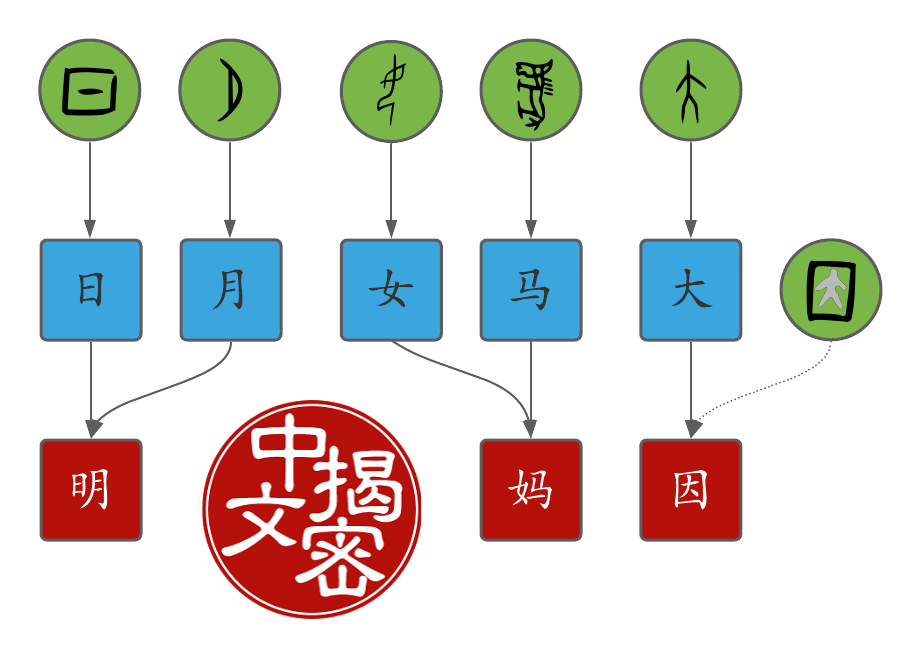
The following video and reading will reinforce this breakdown and show how the component 马 (mǎ) is used in a whole series of characters.
How Are Chinese Characters Formed? | 3 Major Types Explained
The same video we just watched now provides a perfect breakdown of 妈 (mā).
Please watch from 08:08 to 09:05. This part demonstrates exactly how 妈 (mā) is formed from the 'woman' radical (女) and the 'horse' phonetic component (马).
Now, let's read about how this pattern extends to other characters. This illustrates the concept of a phonetic series, where one component provides the sound for multiple characters.
The building blocks of Chinese, part 3: Compound characters
The article 'The building blocks of Chinese, part 3: Compound characters' from Hacking Chinese offers a great explanation of this pattern.
Please read the section titled '妈: Meaning + sound compounds'. It not only explains 妈 (mā) but also lists other characters like 吗 (ma, question particle) and 骂 (mà, to scold) that use 马 (mǎ) for its sound. This is a powerful demonstration of the system at work.

3. An Important Nuance: The Case of 他 (tā)
As we've seen, the phonetic clue can be very strong, as with 妈 (mā) and 马 (mǎ). However, let's revisit the second example from our learning outcome: 他 (tā).
- Semantic Component: 亻 (rén), "person"
- Phonetic Component: 也 (yě), "also"
Here, the pronunciations tā and yě are quite different. Why is 也 (yě) still considered the phonetic component? The answer lies in history. The pronunciations of Chinese have evolved over thousands of years. The sound correspondence between a phonetic component and its compound character was often much closer in Old or Middle Chinese than it is in modern Mandarin.
Therefore, you should treat the phonetic component as a clue, not a guarantee. It can often get you in the right ballpark, but you will still need to learn the exact modern pronunciation and tone.
This video makes this crucial point very clearly.
Chinese Characters Explained Part 4: How most characters work
It is essential to understand that the phonetic 'clue' is not always perfect. This video from Fluent in Mandarin explains this important nuance right at the start.
Watch from 00:20 to 01:31. The speaker gives a critical warning: the phonetic part often relates to a historical pronunciation, so it might not be a perfect guide for modern Mandarin. This explains the relationship between 也 (yě) and 他 (tā).
The Hacking Chinese article you read earlier also highlights this exact example. Realizing that sounds drift over time is key to avoiding confusion when a phonetic component doesn't seem to match perfectly.
Summary: The Logic of Phono-Semantic Compounds
To summarize, here is the analytical framework for phono-semantic compounds:
| Character | Breakdown | Semantic Part (Meaning) | Phonetic Part (Sound) | Analysis |
|---|---|---|---|---|
| 妈 (mā) | 女 + 马 | 女 (nǚ) - woman | 马 (mǎ) - horse | A clear phonetic match (mā/mǎ). The meaning is entirely from the semantic radical. |
| 他 (tā) | 亻 + 也 | 亻 (rén) - person | 也 (yě) - also | A historical phonetic link. The sound has diverged in modern Mandarin. |
| 她 (tā) | 女 + 也 | 女 (nǚ) - woman | 也 (yě) - also | Shares the same phonetic component as 他, hence the same pronunciation. |
This systematic approach of identifying the function of each component is the most effective way to learn and retain Chinese characters.
Conclusion
Congratulations! You have now formally learned the most important structural principle of the Chinese writing system. This analytical skill will serve you in every future lesson.
Key Takeaways:
- Phono-semantic compounds, which make up over 80% of characters, consist of a semantic component (meaning clue) and a phonetic component (sound clue).
- The character 妈 (mā) is a classic example: 女 (woman) provides the meaning, and 马 (mǎ) provides a very close sound clue.
- The character 他 (tā) illustrates an important nuance: the phonetic clue from 也 (yě) is based on historical pronunciation and is not a perfect match in modern Mandarin.
- Recognizing a character as a phono-semantic compound allows you to deconstruct it logically rather than memorizing it as an arbitrary set of strokes.
Preview of the Next Lesson:
Now that you have a solid understanding of the singular pronouns 我, 你, 他, and 她, we are ready to make them plural. In the next lesson, we will learn the character 们 (men), which functions as a plural marker. You will learn to form and use the essential words 我们 (wǒmen, we/us), 你们 (nǐmen, you all), and 他们/她们 (tāmen, they/them).