Hello! Welcome to your next lesson.
In our last session, you learned how to state your location using 在 (zài) with the words 家 (jiā) for home and 学校 (xuéxiào) for school. This gave you the ability to form static sentences like 我在家 (Wǒ zài jiā), "I am at home."
Today, we will add motion to your vocabulary. This lesson introduces two of the most fundamental verbs in Mandarin: 去 (qù), meaning "to go," and 来 (lái), meaning "to come." By mastering these, you will be able to describe movement, transforming your sentences from static statements of location to dynamic descriptions of action. This directly addresses our goal of recognizing and writing these two essential characters.
Let's begin.
1. The Verb of Departure: 去 (qù) - To Go
First, we will focus on 去 (qù), the verb used to express movement away from the speaker's location.
- Character: 去
- Pinyin: qù
- Tone: 4th tone (falling)
- Meaning: to go
Character Analysis: A Person Leaving the Ground
As you prefer, let's break down the character's structure. 去 is a simple character made of 5 strokes, following a top-to-bottom construction.
- The top part, 厶, can be seen as a pictograph of a person.
- The bottom part is the character 土 (tǔ), which means "earth" or "ground."
A helpful mnemonic is to see 去 as a person (厶) leaving the ground (土) to go somewhere. This story is embedded directly in the character's form.
To master its pronunciation and structure, please study the following resource. It also highlights a key pinyin rule you've encountered before.
This article, 'Qù in Chinese (去)', provides an excellent breakdown of the character. We will focus on its pronunciation and written form.
Please read the section titled '1. How to Say and Write 去: Pronunciation, Tone, and Stroke Order.' Pay close attention to two points: Pronunciation: Note the explanation that 'q' is followed by 'u' but pronounced as 'ü' (like the French 'u' in tu). This is a standard pinyin spelling rule for j, q, and x. Stroke Order: Review the 5-stroke sequence. This will prepare you for writing it.
Writing 去 (qù)
Now, let's focus on writing the character correctly. The stroke order is top-to-bottom.
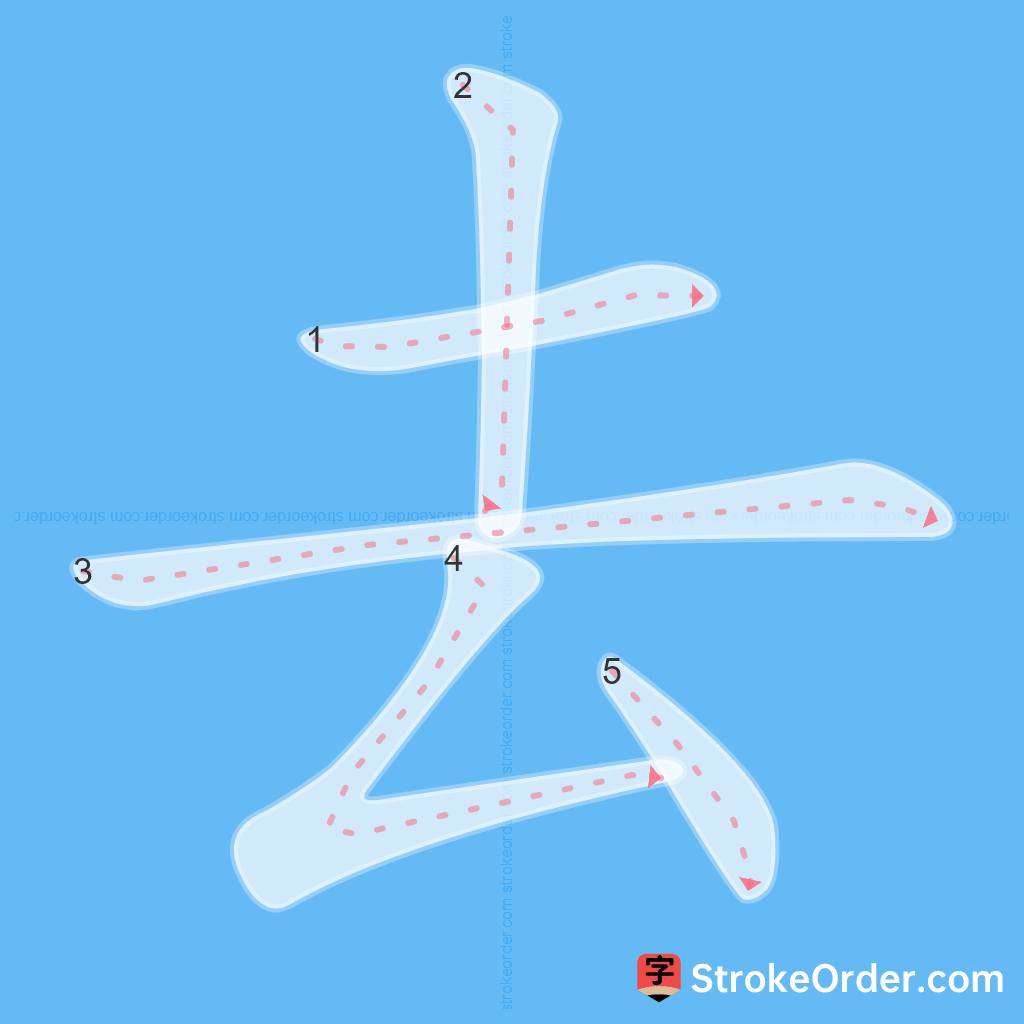
Take a moment to practice writing 去 on paper, following this order. This will build the muscle memory needed for fluent writing.
2. The Verb of Arrival: 来 (lái) - To Come
Next, we will learn the counterpart to 去: the character 来 (lái), which expresses movement towards the speaker.
- Character: 来
- Pinyin: lái
- Tone: 2nd tone (rising)
- Meaning: to come
Character Analysis: A Grain Plant
The character 来 is also one of the most frequently used in Chinese. Its simplified form has 7 strokes. Interestingly, the traditional form, 來, was a pictograph of a wheat or barley plant, signifying a harvest "coming in." While the simplified character is more abstract, knowing its origin can help with memorization.
This next resource will help you with its pronunciation, meaning, and writing.
English translation of 来 ( lai / lái ) - to come in Chinese
This dictionary entry for 来 (lái) contains the key information for learning the character, including a crucial stroke order animation.
Please review the following elements on the page: 'Phonetic script' and 'Listen to pronunciation': Note the pinyin and listen to the second tone. 'English translations': Confirm its primary meaning is 'to come'. 'Chinese character and stroke order animation': This is the most important part. The page includes an animation showing the correct 7-stroke order. Watch it several times to understand how the character is constructed. 'Character complexity': Note that it's composed of 7 strokes and is ranked as the 14th most common character, which highlights its importance.
After watching the animation, practice writing 来 (lái) several times.
3. The Deciding Factor: Speaker's Perspective
The difference between 去 (qù) and 来 (lái) is one of the most fundamental concepts in Chinese directional verbs. The choice depends entirely on the speaker's location or perspective.
- Use 去 (qù) when the movement is away from the speaker.
- Use 来 (lái) when the movement is towards the speaker.
Let's explore this with a clear scenario.
Difference Between 去 (qù) and 来 (lái)
We will now return to the article on '去' to study its comparison with '来'. This section explains the speaker-centric rule very effectively.
Please read the entire section titled 'II. Difference Between 去 (qù) and 来 (lái)'. Focus on the table that contrasts the two verbs and the 'Visual Example'. The core question to ask yourself is always: 'Is the subject moving toward or away from me (the speaker)?'
4. Practice and Application
Now you can combine these verbs with the places you know: 家 (jiā) and 学校 (xuéxiào). The sentence structure is simple and powerful:
Subject + 去 / 来 + Place
Let's put this into practice.
Scenario: You are at home (家). You are talking on the phone to your friend, who is at school (学校).
-
If you want to tell your friend, "I am going to school," the movement is away from you. So you use 去 (qù):
我去学校。(Wǒ qù xuéxiào.)
-
If your friend wants to tell you, "I am coming home," the movement is towards you. So they use 来 (lái):
我来家。(Wǒ lái jiā.)- Note: While
我来你家(I come to your home) is more common,我来家is grammatically correct and uses the structures you've learned.
Your Turn:
Translate the following sentences into Chinese characters and pinyin. Assume the same scenario (you are at home, your friend is at school).
- You say to your friend: "He is going to school."
- Your friend says to you: "She is coming home."
- You say to your friend: "Are you going to school?" (Hint: Add
吗at the end).
Check your answers:
他去学校。(Tā qù xuéxiào.)她来家。(Tā lái jiā.)你去学校吗?(Nǐ qù xuéxiào ma?)
Conclusion
Excellent work today. You have added two essential verbs of motion to your vocabulary, allowing you to describe not just where things are, but where they are going.
Key Takeaways:
- 去 (qù) means "to go" and is used for movement away from the speaker. It is written with 5 strokes.
- 来 (lái) means "to come" and is used for movement towards the speaker. It is written with 7 strokes.
- The choice between
去and来depends entirely on the speaker's perspective. - You can now form dynamic sentences using the structure: Subject + 去/来 + Place.
Preview of the Next Lesson:
You now know how to state that you are at a location (我在家) and how to describe movement to a location (我去学校). The next logical step is to describe what you do at that location. In our next lesson, we will learn the sentence pattern Subject + 在 + Place + Verb, which will allow you to say things like "I read books at home" (我在家看书). This will add another layer of detail and expressiveness to your Chinese sentences.