Welcome back! In our previous lesson, we established the fundamental sentence pattern for stating location using 在 (zài). You learned how to say where someone is, for example, 我在中国 (Wǒ zài Zhōngguó - I am in China).
Today, we will make that structure much more practical for everyday use. We'll add two essential locations to your vocabulary: home and school. This lesson focuses on recognizing and writing the characters 家 (jiā) and 校 (xiào). By the end, you'll be able to form the words for "home" and "school" and use them in sentences to describe your own location.
1. The Character for Home: 家 (jiā)
Let's begin with one of the most important characters in daily life: 家.
- Character: 家
- Pinyin: jiā (first tone, high and level)
- Meaning: home, family, house
Your preference for an analytical approach is perfectly suited for understanding this character, which tells a story through its structure.
Character Analysis: A Roof and a Pig
The character 家 (jiā) is a compound character with a top-bottom structure.
- Top component:
宀(mián). This is known as the "roof" radical. Whenever you see this component at the top of a character, it almost always relates to a building, dwelling, or being under cover. - Bottom component:
豕(shǐ). This character means "pig" or "swine."
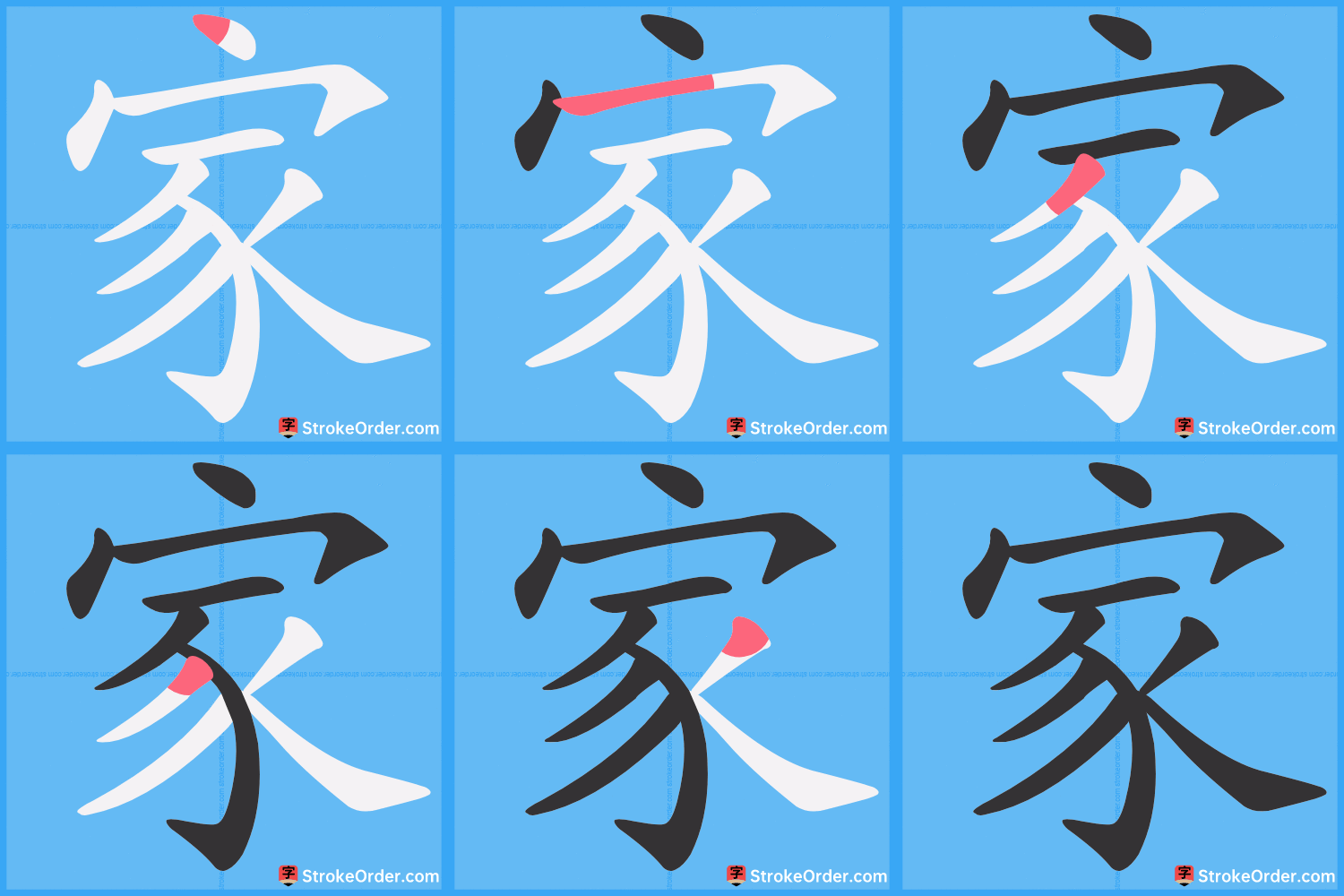
So, why a pig under a roof? In ancient China, pigs were valuable domestic animals often raised inside the home. A pig in the house was a sign of a settled home and sustenance. The character thus beautifully combines the idea of a physical shelter (宀) with the concept of a domestic household (豕) to create the meaning of "home."
Let's explore this character's details and practice writing it.
家 jiā - English Meaning | HSK 1 - Mandarin Temple
This resource from Mandarin Temple provides a comprehensive breakdown of 家 (jiā). It will reinforce the structure we just discussed and give you a chance to practice writing.
Please focus on the following sections: 'jiā Meaning': Read the Pinyin and primary English translations. 'About jiā': Note the number of strokes and the radical 宀. 'Etymology of jiā': This section explains its pictophonetic nature and decomposition into 宀 (semantic) and 豕 (phonetic), matching our analysis. 'Write it!': Use the interactive tool to practice the stroke order. This is a great way to solidify your muscle memory.
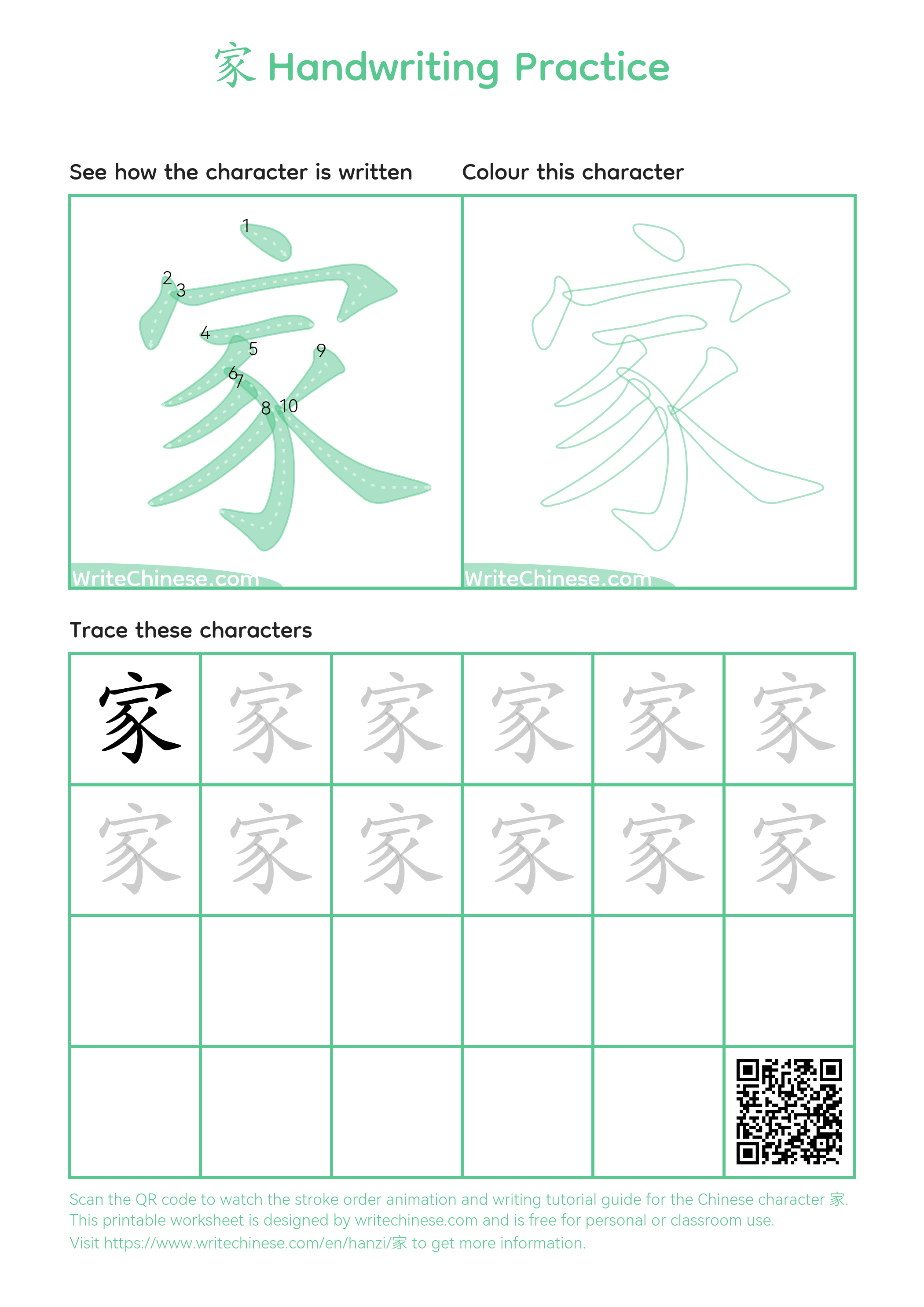
For additional offline practice, you can use this worksheet. Tracing the character first and then writing it freehand is an effective way to improve your writing.
2. The Character for School: 校 (xiào)
Next, let's learn the character that forms the basis of the word "school."
- Character: 校
- Pinyin: xiào (fourth tone, falling)
- Meaning: school, to check/proofread
Character Analysis: Wood and Exchange
校 (xiào) is a phono-semantic compound with a left-right structure, which is very common.
- Left component:
木(mù). You'll recognize this character from a previous module; it means "wood" or "tree" and is also a radical. Its presence here points to the materials used in early schools or, more abstractly, to growth and structure. - Right component:
交(jiāo). This character means "to cross," "to intersect," or "to hand over." In 校, it functions primarily as the phonetic component, giving the character its sound. However, one can also see a semantic connection in the idea of knowledge being "handed over" at a school.
3. Forming the Word: 学校 (xuéxiào)
On its own, 校 means school, but it is almost always paired with another character you know: 学 (xué), which means "to study" or "to learn."
By combining these two characters, we get the common word for "school":
学校 (xuéxiào) = Learn (学) + School (校)
This combination follows the logic you appreciate: building meaningful words from individual character components.
This video and webpage will help you master the pronunciation and structure of the full word.
【NEW HSK1】_#hsk1 _学校/學校/xuexiao/(school) How to Pronounce&Write Chinese Vocabulary/Character/Radical
This short video introduces the pronunciation of 学校 (xuéxiào) and briefly touches on the origin of the character 学 (xué), which you've seen before in the word 学生 (xuésheng, student).
Watch the first 46 seconds of the video. Listen carefully to the pronunciation of 学校 (xuéxiào). The host also shows some related words like 小学 (xiǎoxué, elementary school), which you can note but don't need to memorize yet.
Now, let's use a textual resource to get a detailed breakdown of the word.
学校 xuéxiào - English Meaning | HSK 1 - Mandarin Temple
This Mandarin Temple page is for the full word 学校 (xuéxiào) and provides the etymology for both characters, which is excellent for your analytical learning style.
Please review the following: Under the main heading, check the Pīnyīn Pronunciation and English translation for 学校 (xuéxiào). Scroll down to the 'Etymology of 学校 xuéxiào' section. You'll see breakdowns for both 学 (xué) and 校 (xiào). Focus on the analysis of 校, confirming its components are 木 (meaning) and 交 (sound).
4. Practice: Using Your New Vocabulary
Now you have two new places: 家 (jiā) and 学校 (xuéxiào). Let's combine them with the 在 (zài) structure from our last lesson.
Structure Reminder: Subject + 在 + Place
Try translating these sentences into Chinese. Write both the characters and the Pinyin.
- I am at home.
- She is at school.
- We are not at home. (Remember the negation
不在and the tone change!) - Are you at school? (For this, we will simply use the sentences you know and add
吗 (ma)at the end, which we will formally study later).
Check your answers:
我在家。(Wǒ zài jiā.)她在学校。(Tā zài xuéxiào.)我们不在家。(Wǒmen bú zài jiā.)你在学校吗?(Nǐ zài xuéxiào ma?)
Conclusion
Well done! You have successfully learned two vital characters, 家 and 校, and used them to form words for key locations. You can now express whether you are at home or at school, making your conversational ability more practical.
Key Takeaways:
- 家 (jiā) means "home" or "family." It is composed of the
宀(roof) radical and the豕(pig) component, reflecting ancient domestic life. - 校 (xiào) is a character for "school." It is a phono-semantic compound with the
木(wood) radical providing meaning and交(jiāo) providing the sound. - The word for "school" is 学校 (xuéxiào), a logical combination of
学(to learn) and校(school). - You can use these new nouns with the Subject + 在 + Place pattern to state your location.
Preview of the Next Lesson:
Stating your location is a great start, but language is also about movement. In the next lesson, we will introduce two fundamental verbs of motion: 去 (qù, to go) and 来 (lái, to come). This will allow you to build more dynamic sentences and describe movement to and from the places you now know, such as 我去学校 (I am going to school).