Hello! Welcome to your next lesson on constructing sentences in Mandarin.
In our previous lessons, we've focused on essential building blocks. You've learned how to state your location with 在 (zài), and you've been introduced to the characters for "home" (家, jiā) and "school" (学校, xuéxiào). Most recently, you learned to recognize and write the fundamental verbs of motion: 去 (qù), to go, and 来 (lái), to come, understanding that their use depends on the speaker's perspective.
Today, we will combine these elements to achieve a major milestone: forming complete sentences that describe movement to a location. By the end of this lesson, you will be able to say simple but powerful sentences like "I am going to school." This is a critical step that moves you from using isolated words to expressing dynamic actions.
1. The Core Sentence Pattern for Movement
In English, we say "I go to the school." In Mandarin, the structure is more direct. The verb 去 (qù) often implies "to go to," and 来 (lái) implies "to come to." Therefore, the preposition "to" is not needed.
The basic sentence structure for indicating movement to a destination is:
Subject + Verb (去 / 来) + Location (Object)
Let's break this down with characters you already know:
- Subject: 我 (wǒ), 你 (nǐ), 他 (tā), 她 (tā)
- Verb: 去 (qù), 来 (lái)
- Location: 学校 (xuéxiào), 家 (jiā), 中国 (Zhōngguó)
Using this pattern, we can form sentences like:
-
我去学校。
- (Wǒ qù xuéxiào.)
- I go to school.
-
他去中国。
- (Tā qù Zhōngguó.)
- He goes to China.
Notice the simplicity. The location simply follows the verb of motion.
2. Understanding Destination as the Object
A common point of confusion for new learners is the difference between stating where you are versus where you are going. The key is to understand the grammatical role of the location word.
- When you are going to a place, that place is the destination, which acts as the object of the verb
去. - When you are at a place, that is a prepositional phrase indicating location, using
在.
To clarify this crucial distinction, let's watch a short video segment. The speaker clearly explains why 去 means "to go to" and how this differs from using 在.
Chinese Sentence Structure: How to make sentences in Chinese Mandarin? Word Order in Chinese
In this video from the 'Andy and Sarah Mandarin' channel, the speaker explains a common mistake learners make and clarifies the roles of '去' (qù) and '在' (zài). This will solidify your understanding of the sentence structure we are learning.
Please watch the segment from 09:39 to 10:49. The speaker will analyze the incorrect sentence '我去在上海' (wǒ qù zài Shànghǎi) and explain why '去' (qù) already means 'to go to', making '在' (zài) redundant and incorrect in this context.
As the video explained, you cannot be "going to" a place and "at" it simultaneously. This is why the two patterns are distinct:
-
Movement to a Place (Destination):
我去上海。(Wǒ qù Shànghǎi.) - I go to Shanghai.- (Structure: Subject + Verb + Object)
-
Being at a Place (Static Location):
我在上海。(Wǒ zài Shànghǎi.) - I am in Shanghai.- (Structure: Subject + 在 + Place)
Keeping this distinction in mind is fundamental to forming correct sentences.
3. Practice and Application
Now, let's put this knowledge into practice. We'll use the speaker-perspective rule you learned for 去 and 来 combined with our new sentence structure.
Writing Refresher
First, let's quickly review how to write 去 and 来. Your analytical approach to characters will be well-served by keeping the stroke order fresh in your mind.
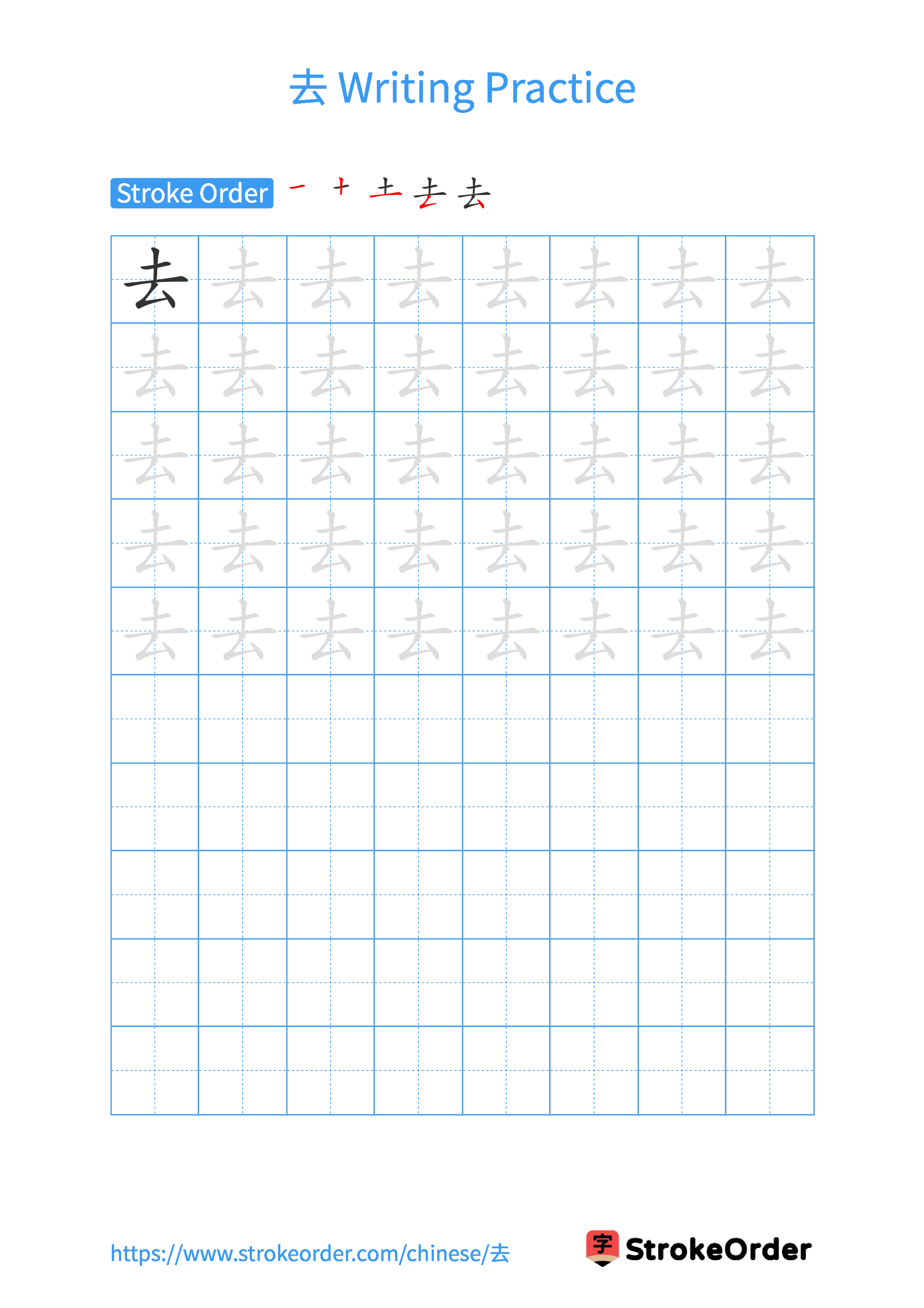
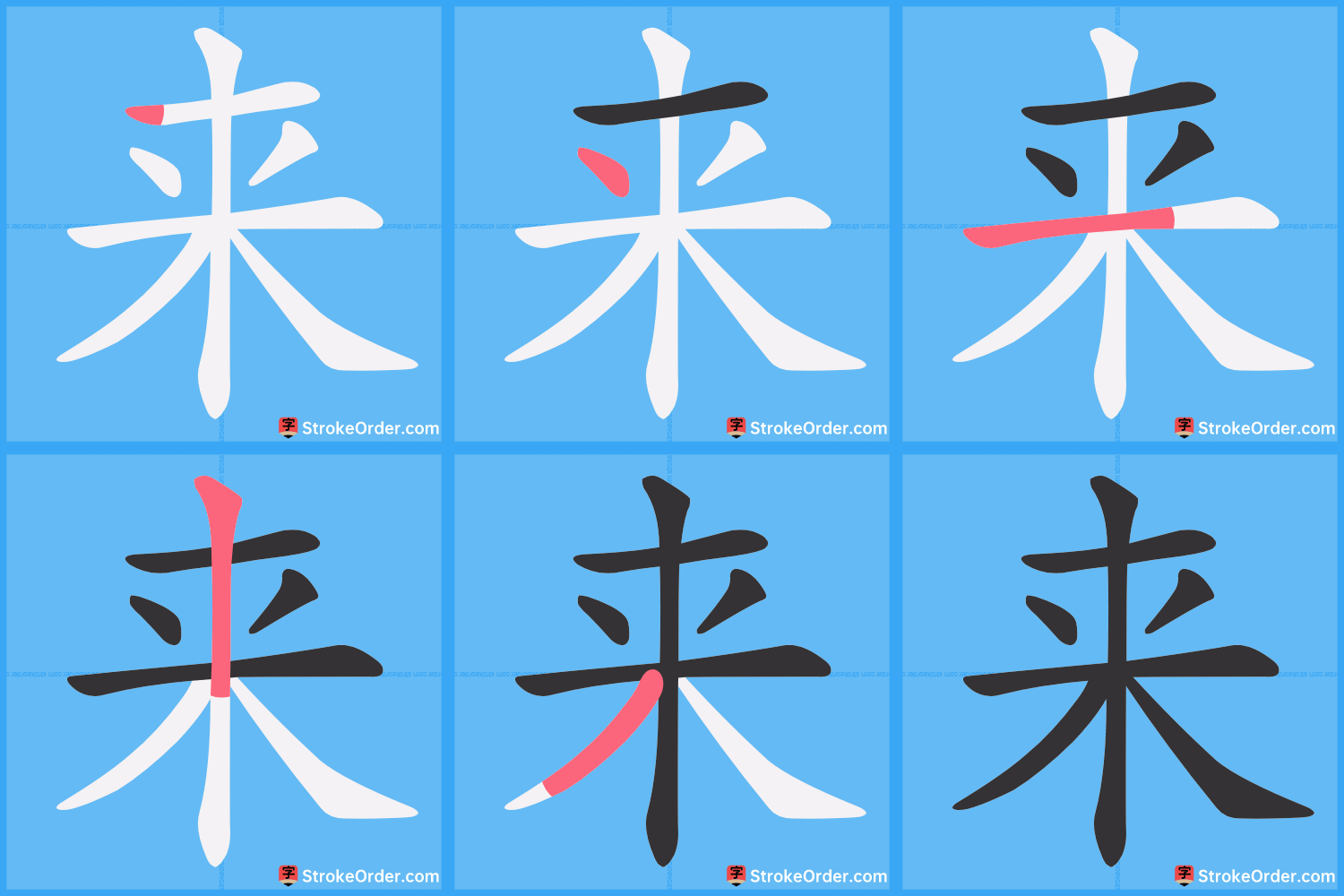
Sentence Building Exercise
Translate the following sentences into Chinese characters and pinyin. Pay close attention to the perspective to choose the correct verb.
Scenario 1: You are at home (家).
- You are telling someone about your friend: "She goes to school."
- Your friend, who is outside, tells you on the phone: "I am coming home."
Scenario 2: You are at school (学校).
- You are telling a classmate: "I am going home."
- You see your friend arriving and say to someone: "He is coming to school."
Think through each one, identifying the subject, the direction of movement relative to the speaker, and the destination.
Check Your Answers:
她去学校。(Tā qù xuéxiào.)- Movement is away from you (at home), so you use
去(qù).
- Movement is away from you (at home), so you use
我来家。(Wǒ lái jiā.)- Movement is towards you (at home), so your friend uses
来(lái).
- Movement is towards you (at home), so your friend uses
我去家。(Wǒ qù jiā.)- Movement is away from you (at school), so you use
去(qù). Note: In daily conversation,我回家(wǒ huí jiā - I return home) is more common, but我去家is perfectly understandable and follows the structure we've learned.
- Movement is away from you (at school), so you use
他来学校。(Tā lái xuéxiào.)- Movement is towards you (at school), so you use
来(lái).
- Movement is towards you (at school), so you use
Conclusion
Congratulations! You have successfully learned how to form one of the most common and useful sentence types in Mandarin. By combining a subject, a verb of motion, and a location, you can now describe where people are going.
Key Takeaways:
- The basic structure for expressing movement to a location is Subject + 去/来 + Place.
- The destination functions as the grammatical object of the verb.
- 去 (qù) is used for movement away from the speaker's perspective.
- 来 (lái) is used for movement towards the speaker's perspective.
- The sentence pattern
我去学校(I go to school) is distinct from我在学校(I am at school), which describes a static location.
Preview of the Next Lesson:
You can now say where you are (我在家) and where you are going (我去家). The next logical step is to describe what you do in a location. In our next lesson, we will learn the structure Subject + 在 + Place + Verb, which will allow you to build even more descriptive sentences, such as "I read books at home."