Hello! Welcome back.
In our last lesson, we built our first two time-words, 今天 (jīntiān, today) and 明天 (míngtiān, tomorrow), by combining the characters you had already mastered. This was a crucial step in moving from single characters to meaningful vocabulary.
Today, we'll address the logical next question: how do we use these words in a sentence? This lesson focuses on a fundamental rule of Chinese grammar: the correct placement of time expressions. Mastering this will allow you to start forming sentences that describe when an action takes place. This concept represents one of the most significant structural differences between Chinese and English, and understanding its logic is key to building a solid grammatical foundation.
1. The Core Principle: Context Before Action
In English, we have a lot of flexibility with time words. We can say "I'm going to the library today" or "Today, I'm going to the library." The time expression can comfortably sit at the end of the sentence.
Chinese grammar operates on a different principle: you must establish the context—such as when or where—before you state the main action (the verb). Think of it as setting the stage before the play begins. The time of the action is part of the stage-setting.
Because of this, a time expression like 今天 (jīntiān) can never be placed at the end of a Chinese sentence.
2. The Two Correct Positions
So, if time words can't go at the end, where do they go? There are two correct and very common positions for a time expression in a Mandarin sentence.
Let's represent a basic sentence as: Subject + Verb + Object.
The two valid structures for adding a time word are:
- Before the subject:
Time + Subject + Verb + Object - After the subject, but before the verb:
Subject + Time + Verb + Object
This is the rule you will apply consistently. Let's look at a visual representation of this rule.
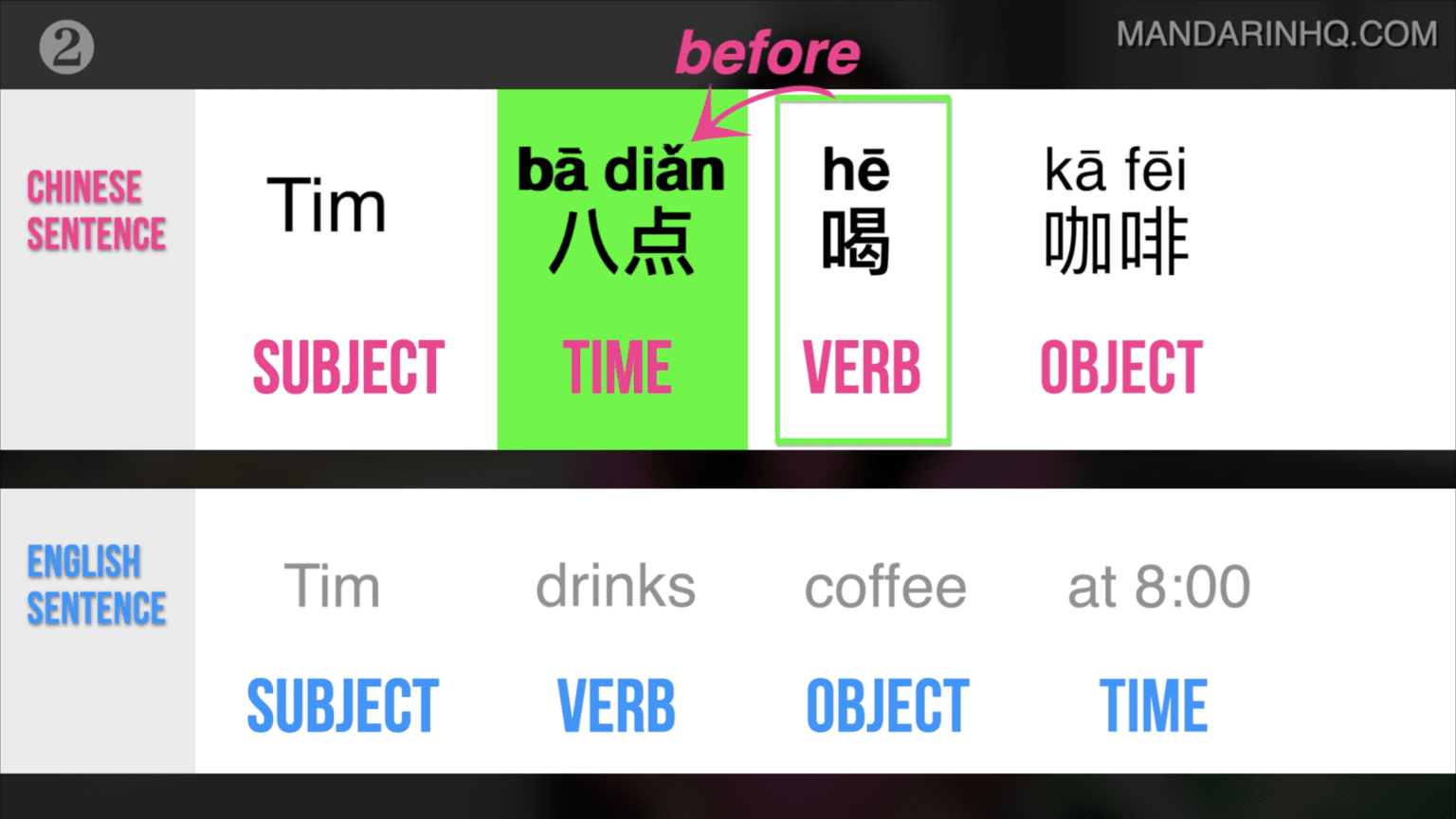
3. Seeing It in Action
Let's use the vocabulary we've learned to form some complete sentences. We'll use the example "I read a book today."
- Characters: 我 (wǒ), 今天 (jīntiān), 看 (kàn), 书 (shū)
- Subject: 我 (wǒ)
- Time: 今天 (jīntiān)
- Verb: 看 (kàn)
- Object: 书 (shū)
Applying our two patterns, we get:
-
Time + Subject + Verb + Object:
今天我看书。
(Today I read a book.) -
Subject + Time + Verb + Object:
我今天看书。
(I today read a book.)
Both of these sentences are grammatically correct and sound perfectly natural in Mandarin. The choice between them is often a matter of emphasis, similar to choosing between "Today, I'm reading" and "I'm reading today" in English.
What is absolutely incorrect is placing the time word at the end:
Incorrect: 我看书今天。 (Wǒ kàn shū jīntiān.)
This is a very common mistake for English speakers, so be mindful to avoid it.
4. Deepening Your Understanding
To reinforce this rule, let's turn to a short video that explains it clearly.
Mandarin Grammar #2: Basic Time Phrases
The video 'Mandarin Grammar #2: Basic Time Phrases' from MVS Mandarin provides a concise explanation of this core grammar point.
Please watch from 00:43 to 02:36. The first part (00:43 - 02:11) explains the two correct placements for time phrases and contrasts them with English. The second part (02:11 - 02:36) clarifies an important point: you should not use the word 在 (zài, at) with time words, as 在 is used for location, not time.
Now, let's solidify this with a quick reading that includes example sentences with audio.
Introduction to Basic Chinese Grammar Rules
This article, 'Introduction to Basic Chinese Grammar Rules' from CLI, provides clear, written examples that reinforce the video's explanation.
Please read the section titled '2. Time and place'. Focus on the first two example sentences using '昨天' (zuótiān, yesterday). The table format clearly shows the two correct sentence structures. You can click on the example sentences to hear the native audio, which is excellent for practice.
5. Practice Exercise
It's time to apply what you've learned. Using the vocabulary you know, translate the following English sentences into Chinese. For each one, please provide both possible correct sentence structures.
Vocabulary you might need:
- 我 (wǒ) - I/me
- 你 (nǐ) - you
- 他 (tā) - he/him
- 我们 (wǒmen) - we/us
- 今天 (jīntiān) - today
- 明天 (míngtiān) - tomorrow
- 去 (qù) - to go
- 学校 (xuéxiào) - school
- 喝 (hē) - to drink
- 茶 (chá) - tea
Sentences:
- He is going to school tomorrow.
- We drink tea today.
(Pause here to formulate your answers before continuing.)
Solutions:
-
He is going to school tomorrow.
明天他去学校。(Míngtiān tā qù xuéxiào.)他明天去学校。(Tā míngtiān qù xuéxiào.)
-
We drink tea today.
今天我们喝茶。(Jīntiān wǒmen hē chá.)我们今天喝茶。(Wǒmen jīntiān hē chá.)
If your answers match these, you have successfully understood and applied today's learning outcome. Excellent work!
Conclusion
In this lesson, you mastered a crucial piece of Chinese syntax. By learning to place time expressions correctly, you've taken a significant step toward constructing natural and grammatically sound sentences.
Key Takeaways:
- The core principle of Chinese sentence structure is context before action. Time is part of the context.
- Time words like
今天and明天can be placed in two positions:- At the very beginning of the sentence, before the subject.
- After the subject, but always before the verb.
- Time words can never be placed at the end of a sentence in Mandarin.
Preview of the Next Lesson:
Now that you can form sentences describing when an action happens, we'll continue expanding your ability to build more complex sentences. In the next lesson, we will learn how to use the conjunction 和 (hé), which means "and," to connect two nouns together (e.g., "you and I," "tea and books").