Hello! Welcome to your next lesson.
In our last session, we focused on placing time words like 今天 (jīntiān) and 明天 (míngtiān) correctly within a sentence. You learned the fundamental principle of Chinese grammar: context (like time) comes before the action.
Today, we will continue expanding your ability to form more detailed sentences by learning to use the conjunction 和 (hé), which translates to "and". This character is essential for connecting ideas, but its usage is more specific than the English "and". Your goal for this lesson is to recognize and write 和 (hé), and use it correctly to connect two nouns.
This will allow you to create more complex subjects (e.g., "My mother and father") and objects (e.g., "books and tea"), making your sentences richer and more descriptive.
1. The Character: 和 (hé)
Let's begin by analyzing the character itself.
- Pinyin & Tone: 和 (hé) - It has a second tone (hé), which is a rising tone.
- Meaning: "and," "with," "harmony." For today's lesson, we will focus exclusively on its use as "and."
Character Structure and Writing
As you prefer an analytical approach, let's break down the character 和. It's a phono-semantic compound, which means it has a part for sound and a part for meaning.
- Phonetic Component (Sound): The left side is 禾 (hé), which means "grain." In this character, its primary function is to provide the pronunciation "hé."
- Semantic Component (Meaning): The right side is 口 (kǒu), which means "mouth." This hints at the character's connection to concepts like speaking, agreement, and harmony.
Now, let's focus on writing it. Follow the stroke order carefully.
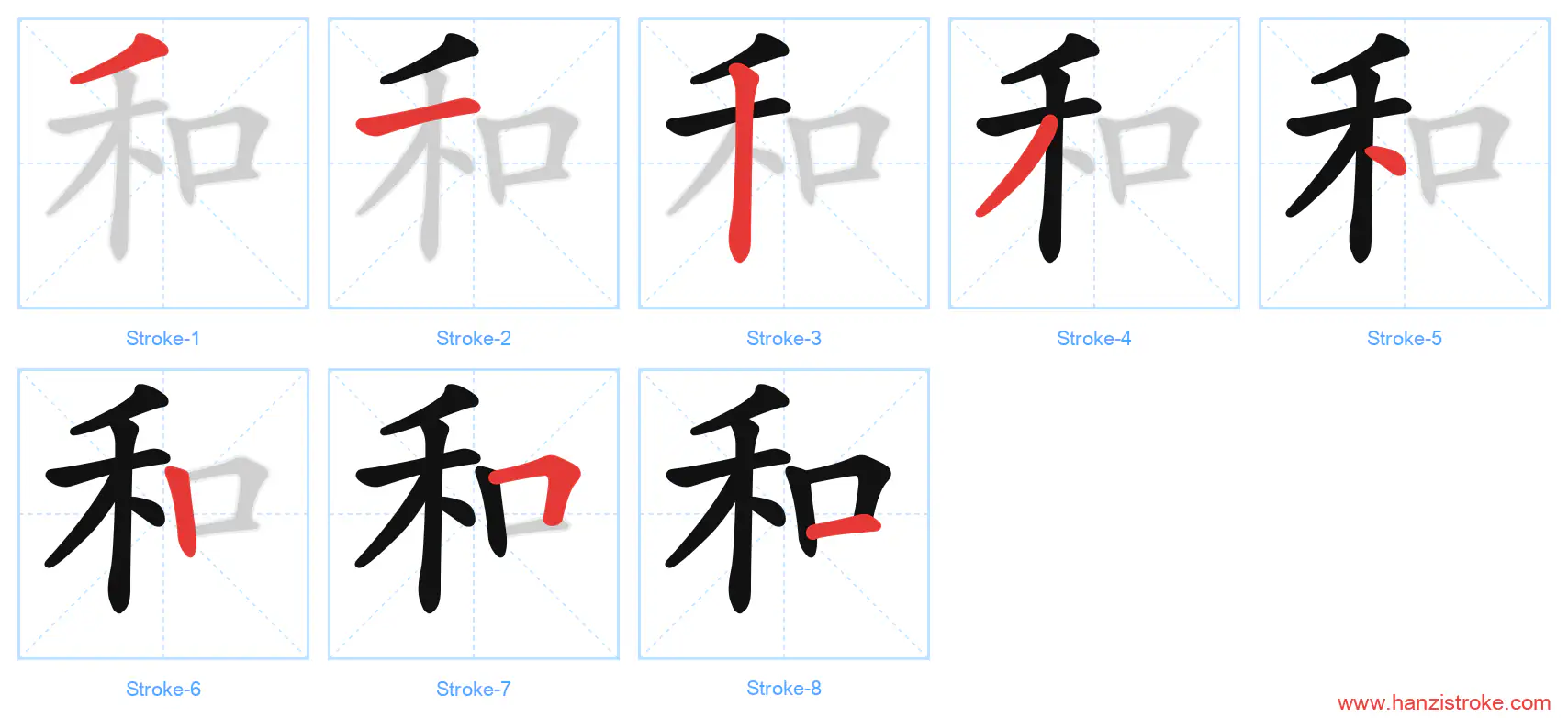
Take a moment to practice writing the character a few times, following the correct stroke order. This will help build your muscle memory.
2. The Golden Rule: Connecting Nouns Only
The most important rule to remember about 和 (hé) is that it is primarily used to connect nouns or pronouns. This is a major difference from English, where "and" can connect verbs ("run and jump"), adjectives ("happy and sad"), or even entire sentences.
Let's start with a brief reading that gets straight to this point.
11 Ways to Say “And” in Chinese
The article '11 Ways to Say “And” in Chinese' from FluentU provides a very clear and concise explanation of this rule. It also includes audio links for the example sentences, which is great for pronunciation practice.
Please read only the first section, titled 'Use 和 (hé) to Connect Nouns'. Notice how it is used to connect subjects (at the beginning of the sentence) and objects (after the verb). Click the links to hear the audio for each example.
As you saw, the structure is simple:
- Noun 1 + 和 + Noun 2
Let's see this in action with vocabulary you already know:
- Connecting two subjects:
爸爸 和 妈妈 在家。
Dad and Mom are at home. - Connecting two objects:
我有书 和 茶。
I have books and tea.
This video from Mandarin HQ provides another clear explanation of this rule.
Differences between 跟 (gēn) and 和 (hé) - Use them Correctly!
The video 'Differences between 跟 (gēn) and 和 (hé)' clearly reinforces the primary function of 和 (hé).
Watch from 00:31 to 01:32. The speaker explains that 和 (hé) is used to connect nouns and provides simple examples like 'tea and coffee'.
3. Common Mistakes to Avoid
Because English is so flexible with "and," English speakers often make predictable mistakes when using 和 (hé). Understanding these pitfalls is key to using it correctly.
Lesson 3 Mandarin Chinese: A Latinum Institute Modern Language Course
The resource 'Lesson 3 Mandarin Chinese' from The Latinum Institute offers a detailed breakdown of the grammar and common errors. This will help solidify your understanding.
Please read the two sections under 'Section D (Grammar Explanation for English Speakers)': 'Grammar Rules for 和 (hé)' and 'Common Mistakes'. Focus on what 和 cannot do, such as connect verbs or sentences.
The key takeaway from that reading is to actively stop yourself from using 和 (hé) to connect actions.
- Incorrect: 我看和写。 (Wǒ kàn hé xiě.) - I read and write.
- Incorrect: 我去学校和看书。 (Wǒ qù xuéxiào hé kàn shū.) - I go to school and read books.
In Mandarin, sequences of actions are often just listed, separated by a pause (represented by a comma in writing), or use other grammatical structures you will learn later. For now, just remember: 和 is for nouns.
4. Practice and Consolidation
Let's put your knowledge to the test. Translate the following sentences into Chinese characters. Try to use the vocabulary you've accumulated.
Vocabulary you may need:
- 我 (wǒ), 你 (nǐ), 他 (tā), 她 (tā)
- 爸爸 (bàba), 妈妈 (māma)
- 学生 (xuéshēng)
- 中国 (Zhōngguó), 人 (rén)
- 是 (shì), 去 (qù), 喝 (hē)
- 茶 (chá), 水 (shuǐ)
- 学校 (xuéxiào)
- 也 (yě) - also, too
- 都 (dōu) - both, all (often used when the subject is "A 和 B")
Sentences to Translate:
- He and I are students.
- I drink tea and water.
- My father and mother are Chinese.
(Take a few minutes to write down your answers before checking the solutions below.)
Solutions:
-
He and I are students.
我和他都是学生。
Note: When you connect subjects with 和, it's very common to add 都 (dōu) before the verb to mean "both" or "all." For example, "We both are students." -
I drink tea and water.
我喝茶和水。
This is a straightforward example of connecting two objects. -
My father and mother are Chinese.
我爸爸和妈妈是中国人。
Here, "my" (我) applies to both "father" and "mother". You don't need to say 我爸爸和我妈妈 (wǒ bàba hé wǒ māma).
Excellent work! If you were able to construct these sentences, you have successfully met the learning goal.
Conclusion
In this lesson, you've added a fundamental conjunction, 和 (hé), to your toolkit. You analyzed its structure, learned how to write it, and mastered its single most important grammatical rule.
Key Takeaways:
- 和 (hé) is the Chinese word for "and" but is used almost exclusively to connect nouns and pronouns.
- The character 和 is a phono-semantic compound: 禾 (hé) for sound and 口 (kǒu) for meaning.
- The correct structure is Noun A + 和 + Noun B.
- Avoid the common mistake of using 和 to connect verbs, adjectives, or full sentences.
Preview of the Next Lesson:
We've just learned how to connect two nouns. In the next lesson, we will learn about the adverb 也 (yě), which means "also" or "too." This will allow you to express that different subjects perform the same action (e.g., "I am a student. He is also a student."), adding another layer of complexity and nuance to your sentences.