Hello! Welcome to your next lesson.
In our last session, you learned how to use the conjunction 和 (hé) to connect nouns, such as in the phrase 我爸爸和妈妈 (wǒ bàba hé māma). This was a crucial step in building more complex sentence subjects and objects.
Today, we shift from connecting nouns to adding parallel information about actions or states. We will focus on the adverb 也 (yě), which means "also" or "too." Your goal for this lesson is to recognize and write the adverb 也 (yě) and place it correctly before the verb.
Mastering 也 is essential. While 和 connects things, 也 connects actions or descriptions, allowing you to say that someone also does something or something is also a certain way (e.g., "He is a student. I am also a student.").
1. The Character: 也 (yě)
Let's begin by analyzing the character itself, following your preferred analytical approach.
- Pinyin & Tone: 也 (yě) - This is a third tone, the falling-rising tone.
- Meaning: "also," "too," "as well," "either."
- Part of Speech: Adverb (副词 fùcí). This is a critical piece of information that will dictate its place in a sentence.
也Yě - English Meaning | Mandarin Temple
The Mandarin Temple dictionary page for 也 (yě) provides a good overview of the character's basic properties. Let's use it to examine its structure.
Please read the sections titled 'About 也 Yě' and 'Etymology of 也 Yě'. Focus on the number of strokes, the radical, and its classification as an adverb.
From that reading, you'll note that 也 is a very simple character with only 3 strokes. Its etymology is interestingly unclear, with theories ranging from pictographs of objects to ideographs for speech. For our purposes, its function as an adverb is the most important takeaway.
Writing 也 (yě)
Now, let's focus on writing it. The stroke order is straightforward but crucial to learn correctly.
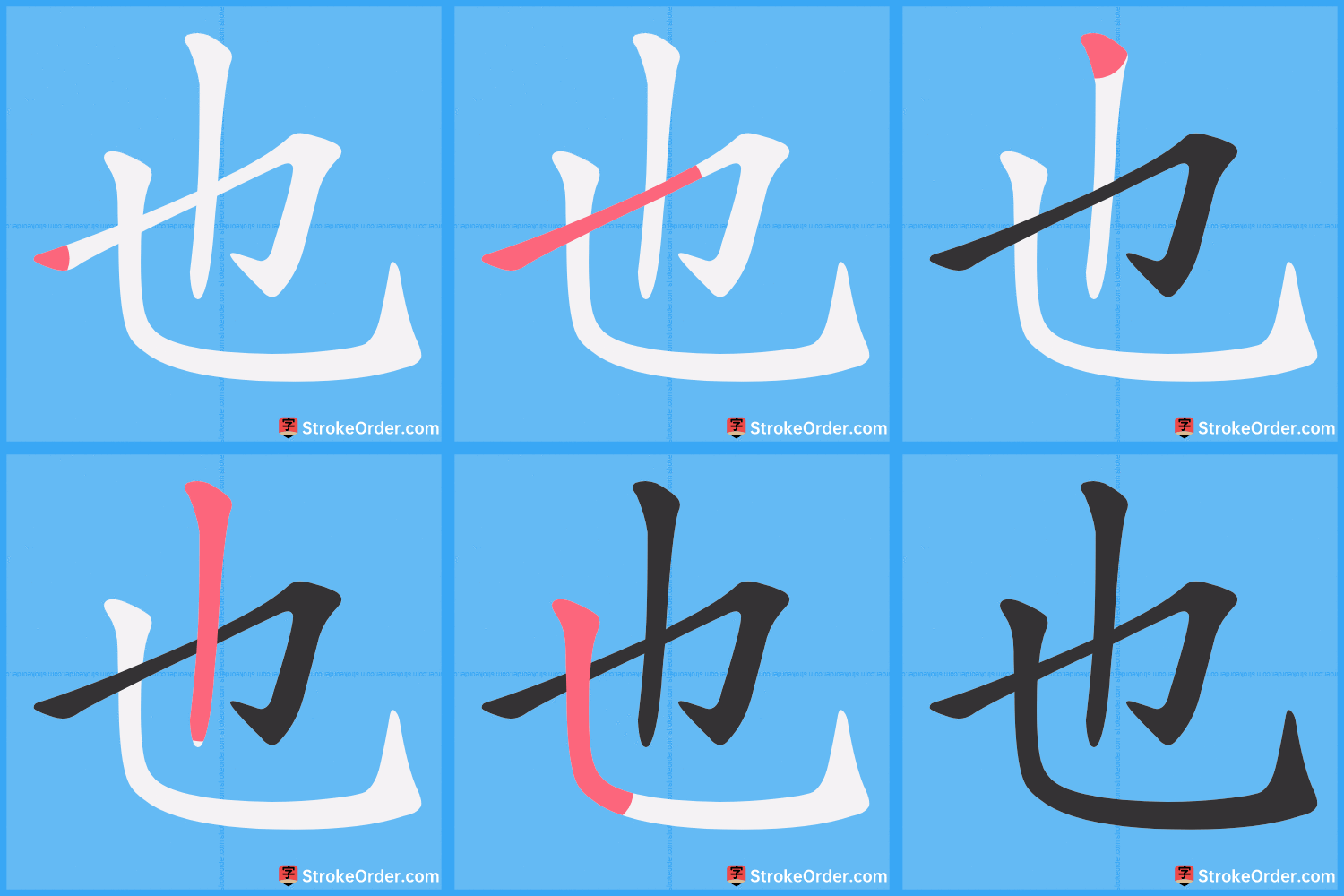
Take a moment to practice writing the character several times on paper. Trace the strokes in the air if it helps. The resource from Mandarin Temple also includes an interactive writing tool under the "Write it!" section if you'd like more practice.
2. The Golden Rule of Adverbs: Placement
In English, "too" and "also" can appear in different parts of a sentence ("I also like tea," "I like tea, too"). In Mandarin, the rule is much stricter. As an adverb, 也 (yě) is always placed immediately before the verb or verb phrase it modifies.
The basic structure is:
Subject + 也 + Verb
Let's explore this rule in detail.
Lesson 1 Grammar - The Adverb 也 (yě)
This page from Humanities LibreTexts provides an excellent and clear explanation of the grammar for 也 (yě), with many useful examples. It directly addresses the common pitfalls for English speakers.
Please read the introduction and the first section, '也 (yě) with Verb Phrases'. Pay close attention to the sentence structure and the 'GOOD vs. BAD EXAMPLE' comparison, as this highlights the most important rule.
As you just read, placing 也 after the verb is a common error for beginners. Let's reinforce this with examples using vocabulary you already know.
-
Positive Statement:
他是学生。
He is a student. -
Adding a Parallel Statement:
我也是学生。
I am also a student. / I am a student, too.
Notice 也 is placed right before the verb 是 (shì).
Here is another example:
-
Statement:
她有书。
She has a book. -
Parallel Statement:
我也有书。
I also have a book.
3. Using 也 in Negative Sentences
In English, we switch from "too" to "either" in negative sentences ("I don't like it either"). In Mandarin, 也 is used for both positive and negative contexts.
The rule for placement remains consistent: 也 comes before the negation word (不 or 没).
The structure is:
Subject + 也 + 不 / 没 + Verb
Lesson 1 Grammar - The Adverb 也 (yě)
Let's return to the Humanities LibreTexts resource to see how this works in practice.
Please read the short section titled 'A Note on the Negative Form'. Notice the word order in the example sentences.
Let's apply this with our own examples:
-
Negative Statement:
他不是中国人。
He is not Chinese. -
Parallel Negative Statement:
我也不是中国人。
I am not Chinese either. -
Another Negative Statement:
她没有家。
She doesn't have a home. -
Parallel Negative Statement:
我也没有家。
I don't have a home either.
4. Practice and Consolidation
Now let's practice forming sentences. Complete the second sentence in each pair using 也 and the information provided.
Practice Set
-
Context: 你去学校。 (Nǐ qù xuéxiào. - You are going to school.)
- Your Task: Write "I am also going to school."
-
Context: 我爸爸是好人。 (Wǒ bàba shì hǎo rén. - My dad is a good person.)
- Your Task: Write "My mom is also a good person."
-
Context: 他不喝茶。 (Tā bù hē chá. - He doesn't drink tea.)
- Your Task: Write "I don't drink tea either."
-
Context: A: 我是学生。(Wǒ shì xuéshēng. - I am a student.)
- Your Task: How would you respond with the short phrase for "Me too"?
(Take a few minutes to write down your answers before checking the solutions below.)
Solutions
-
我也去学校。
-
我妈妈也是好人。
-
我也不喝茶。
-
我也是。
- As explained in the final section of the LibreTexts resource ("Expressing 'Me Too' with 也"),
我也是is the correct, complete way to say "Me too." Simply saying我也is grammatically incomplete.
Conclusion
Great work today! You've learned how to use the versatile adverb 也 (yě) to create more nuanced and connected sentences.
Key Takeaways:
- 也 (yě) means "also," "too," or "either" and is an adverb.
- It is a simple 3-stroke character:
丨,一,丨. - The most important rule is its placement: always before the verb.
- In negative sentences, it comes before the negative particle:
也不(yě bù) or也没(yě méi). - The common phrase "Me too" is expressed as
我也是(Wǒ yě shì).
Preview of the Next Lesson:
In the next lesson, we will continue expanding your vocabulary by learning the characters 看 (kàn), meaning "to look," "to see," or "to read," and 书 (shū), meaning "book." This will allow you to form sentences about reading, such as 我也看书 (I also read books), putting today's grammar into immediate practice.