Hello! Welcome to your next lesson.
In our last session, we focused on the adverb 也 (yě), learning that it means "also" or "too" and is always placed directly before the verb. This was a key step in linking parallel ideas in different sentences.
Today, we will learn two new, high-frequency characters that will allow you to describe a common and important activity: reading. The learning outcome for this lesson is to recognize and write 看 (kàn, to look/see/read) and 书 (shū, book). By learning these two characters, we can immediately form the word 看书 (kàn shū), "to read," and put the grammar you've just learned into practice.
1. The Verb: 看 (kàn)
Let's begin with the verb 看 (kàn). This versatile character can mean "to look," "to see," "to watch," or, in our focus today, "to read."
- Pinyin & Tone: kàn (4th tone, falling)
- Part of Speech: Verb
- Meaning: to look; to see; to watch; to read
Character Analysis: 看 (kàn)
As you prefer, let's deconstruct the character to understand its logic. 看 has a top-bottom structure, and its composition is quite intuitive.
看kān - English Meaning | HSK 1 | Mandarin Temple
The Mandarin Temple page for 看 (kàn) will give us the foundational details for our analysis. Pay close attention to its structure and components.
Please read the sections 'About 看 kān' and 'Etymology of 看 kān'. Focus on the number of strokes and the character's decomposition. (Note: The resource incorrectly lists the pinyin as kān in the title, but the correct pronunciation for 'to see/read' is kàn.)
The character 看 is a beautiful example of an associative compound. It's composed of two parts:
- The top part is a variation of 手 (shǒu), which means "hand."
- The bottom part is 目 (mù), which means "eye."
So, the character pictographically represents a hand (手) held over an eye (目), as if someone is shielding their eyes from the sun to get a better look at something in the distance. This vivid image directly connects the character's form to its meaning of "to look" or "to see."
Writing 看 (kàn)
Now, let's practice writing it. The character has 9 strokes. The stroke order follows the top-to-bottom rule.
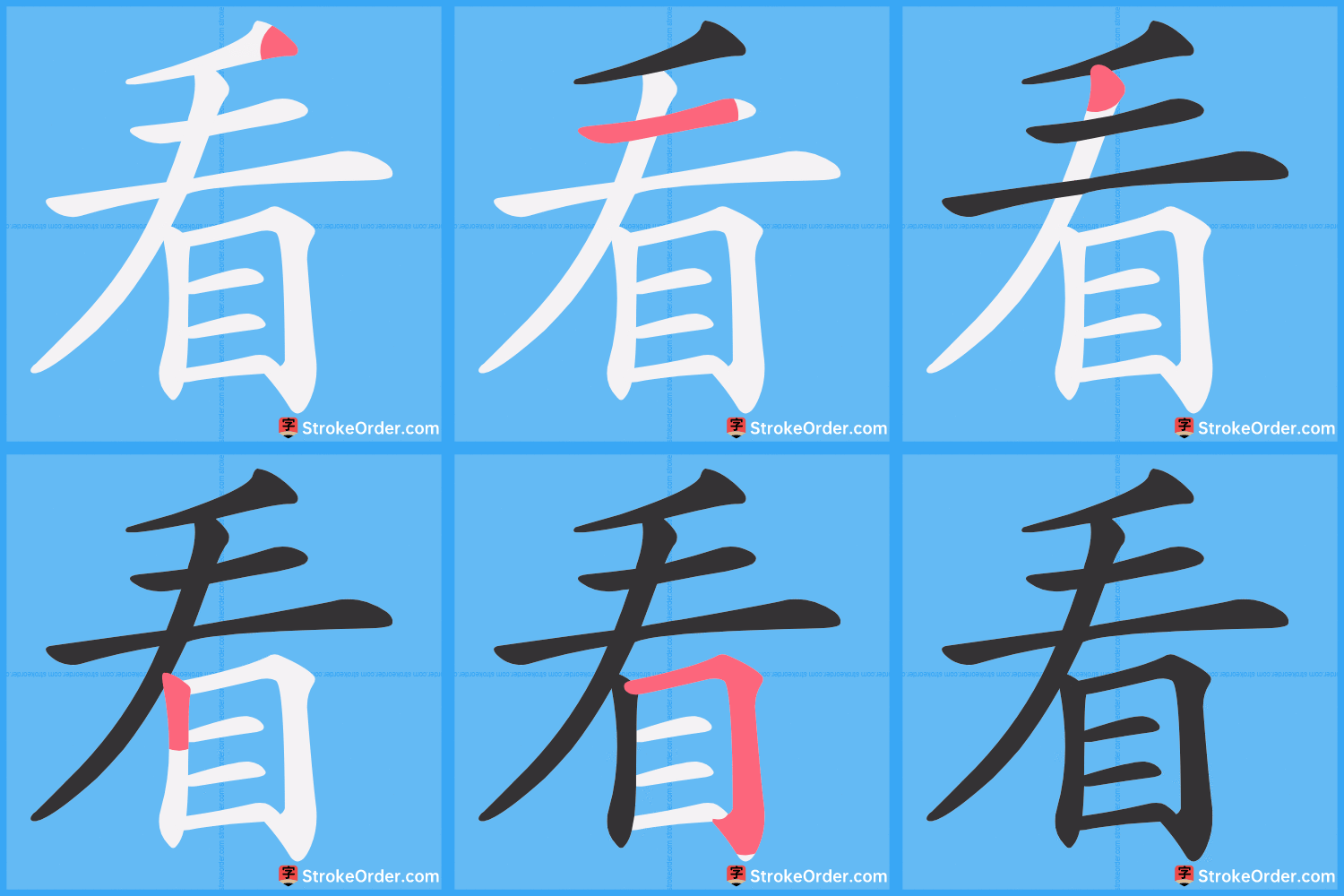
Please take a moment to practice writing the character on paper, following this stroke order. The "Write it!" section on the Mandarin Temple page you just reviewed also provides an interactive tool for more practice.
2. The Noun: 书 (shū)
Next, we will learn the character for what is often read: 书 (shū).
- Pinyin & Tone: shū (1st tone, high and level)
- Part of Speech: Noun
- Meaning: book
Character Analysis: 书 (shū)
The simplified character 书 is very simple, but its origin is more complex and interesting.
书Shū - English Meaning | HSK 1 - Mandarin Temple
Let's use the Mandarin Temple page for 书 (shū) to understand its properties and history.
Please read the 'About 书 Shū' and 'Etymology of 书 Shū' sections. Note its traditional form and classification.
As you saw, 书 (shū) is the simplified form of the traditional character 書. The traditional character is a phono-semantic compound:
- The top part, 聿 (yù), originally depicted a hand holding a brush, providing the meaning related to writing.
- The bottom part, 者 (zhě), provided the sound.
While the modern simplified character 书 is harder to break down visually, knowing its origin as a depiction of writing helps connect it to the concept of a "book."
Writing 书 (shū)
Writing the simplified character is straightforward, involving only 4 strokes.
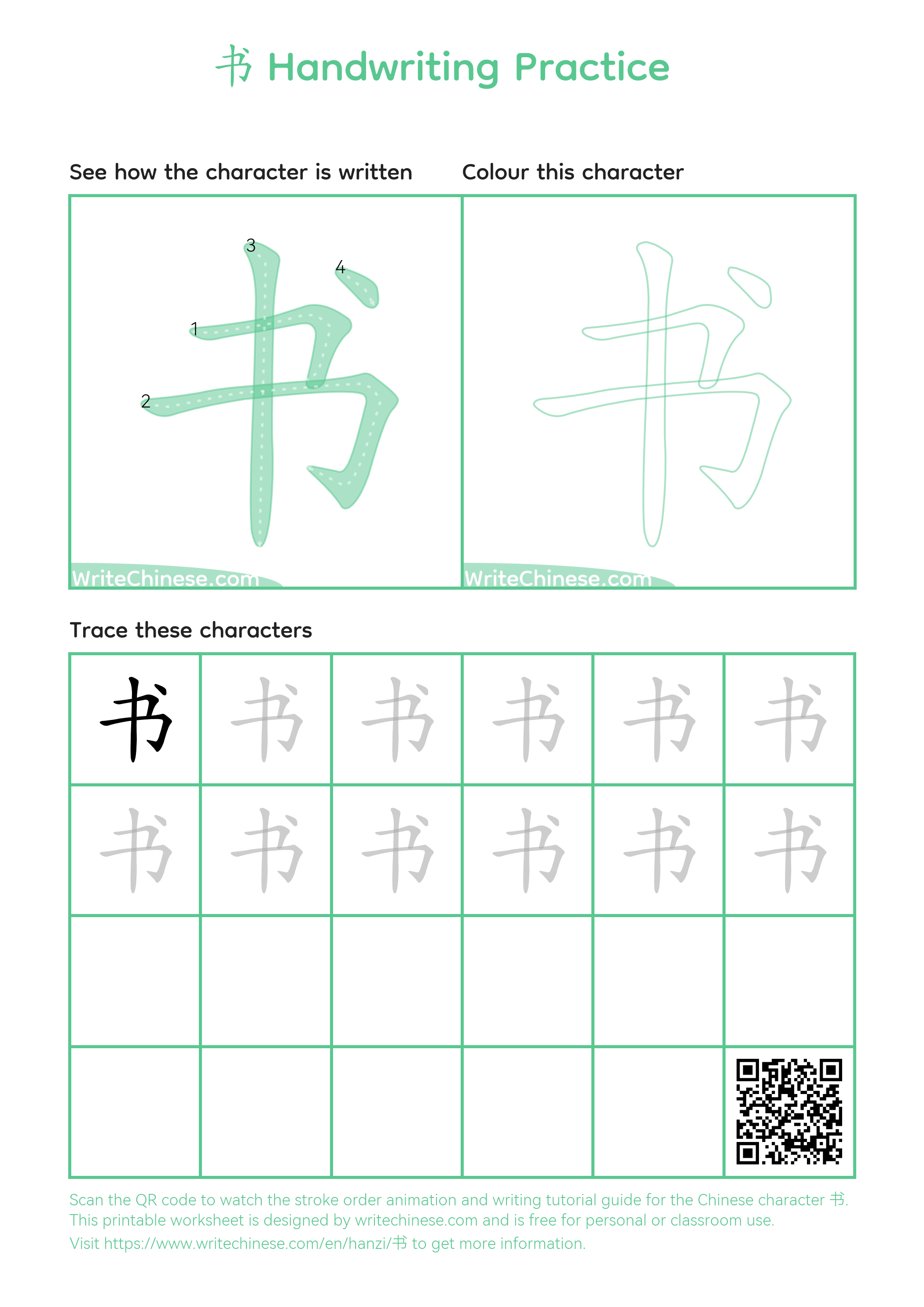
Take your time to practice writing 书 (shū). The simple form makes it easy to write but also easy to get the proportions wrong, so pay attention to the relative size and position of each stroke.
3. Forming a Word: 看书 (kàn shū)
Now that you can recognize and write both characters, we can combine them to form a high-frequency word, following your preferred "characters before words" method.
看 (kàn) + 书 (shū) → 看书 (kàn shū)
看书 (kàn shū) literally means "to look at a book." It functions as a single verb phrase meaning "to read" or "to do reading."
Let's use this new word in sentences with grammar and vocabulary you already know. This is where your systematic learning pays off, as you can immediately integrate new words into meaningful contexts.
-
Simple statement:
我看书。
I read books. / I am reading. -
Connecting with the previous lesson (也):
他看书,我也看书。
He reads books, and I also read books. -
Using a time word (今天):
我今天看书。
I am reading today. -
Negation with 不 (bù):
我爸爸不看书。
My dad doesn't read books. -
Using location with 在 (zài):
我在家看书。
I read books at home. -
Asking a question with 吗 (ma):
你看书吗?
Do you read?
Conclusion
Excellent work. In this lesson, you've learned two essential characters by analyzing their structure and practicing their stroke order.
Key Takeaways:
- 看 (kàn): A verb meaning "to look," "to see," or "to read." Its structure is a hand (手) over an eye (目).
- 书 (shū): A noun meaning "book." It is the simplified form of the traditional character 書.
- 看书 (kàn shū): A common verb phrase meaning "to read (books)."
- You can immediately use 看书 in various sentence patterns you have already mastered, demonstrating the power of building your knowledge step-by-step.
Preview of the Next Lesson:
You are now at the final step of this module. In our next lesson, we will put everything together. The goal will be to read and translate a short paragraph composed of learned characters and grammar. This will be a great opportunity to consolidate all the characters, words, and grammar patterns you've learned in the past eleven lessons and see how they work together to convey a complete message.