Hello! Welcome to the start of a new module.
In our previous lessons, we focused on expanding your ability to ask questions, culminating with the question word 几 (jǐ), "how many." You now have a solid set of tools for inquiry. Today, we shift our focus to a new and essential topic: time. Being able to situate events in time is fundamental to communication, and we'll begin by learning the foundational characters for this.
This lesson addresses the first learning outcome of our new module: to recognize and write the time-related characters 今 (jīn), 天 (tiān), 明 (míng), and 年 (nián). In line with your preference for an analytical approach, we will examine the origin, structure, and stroke order of each character before combining them into words in our next lesson.
1. 天 (tiān) - Sky / Day
Let's begin with one of the most common characters in the language.
- Pinyin: tiān (first tone)
- Meaning: Its primary meaning is "sky," but it is also used to mean "day."
Character Analysis and Writing
The character 天 is a simple pictograph. Its ancient form depicted a person with a large head, emphasizing the space above them—the sky.
To learn more about its origin and see how to write it, let's look at a couple of resources.
【NEW HSK1】_#hsk1 _明天/mingtian/(tomorrow) How to Pronounce & Write Chinese Vocabulary/Character Story
This video from E's Chinese Class will first explain the origin of the character 天.
Please watch from 01:47 to 02:15. The video explains how the character evolved from a picture of a person looking at the sky.
Now, let's focus on writing it. 天 (tiān) has four strokes.
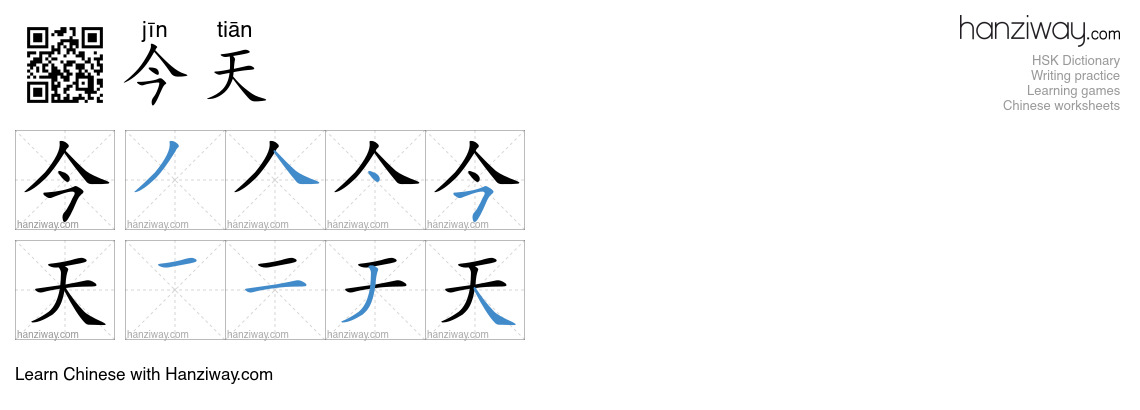
The stroke order follows the top-to-bottom rule you've learned:
- First horizontal stroke (横, héng).
- Second, longer horizontal stroke (横, héng).
- A left-falling stroke (撇, piě) that starts from the center of the top stroke.
- A right-falling stroke (捺, nà) that starts from the center of the bottom stroke.
Please take a moment to practice writing 天 in your notebook, focusing on the correct stroke order and proportions.
2. 明 (míng) - Bright / Next
Next is a character whose structure is a beautiful example of Chinese logographic principles.
- Pinyin: míng (second tone)
- Meaning: Its core meaning is "bright." In time-related words, it takes on the meaning of "next," as in "the next day."
Character Analysis and Writing
明 (míng) is a compound character, and its logic is very intuitive. To understand what makes things bright, ancient Chinese combined two of the brightest objects they knew: the sun and the moon.
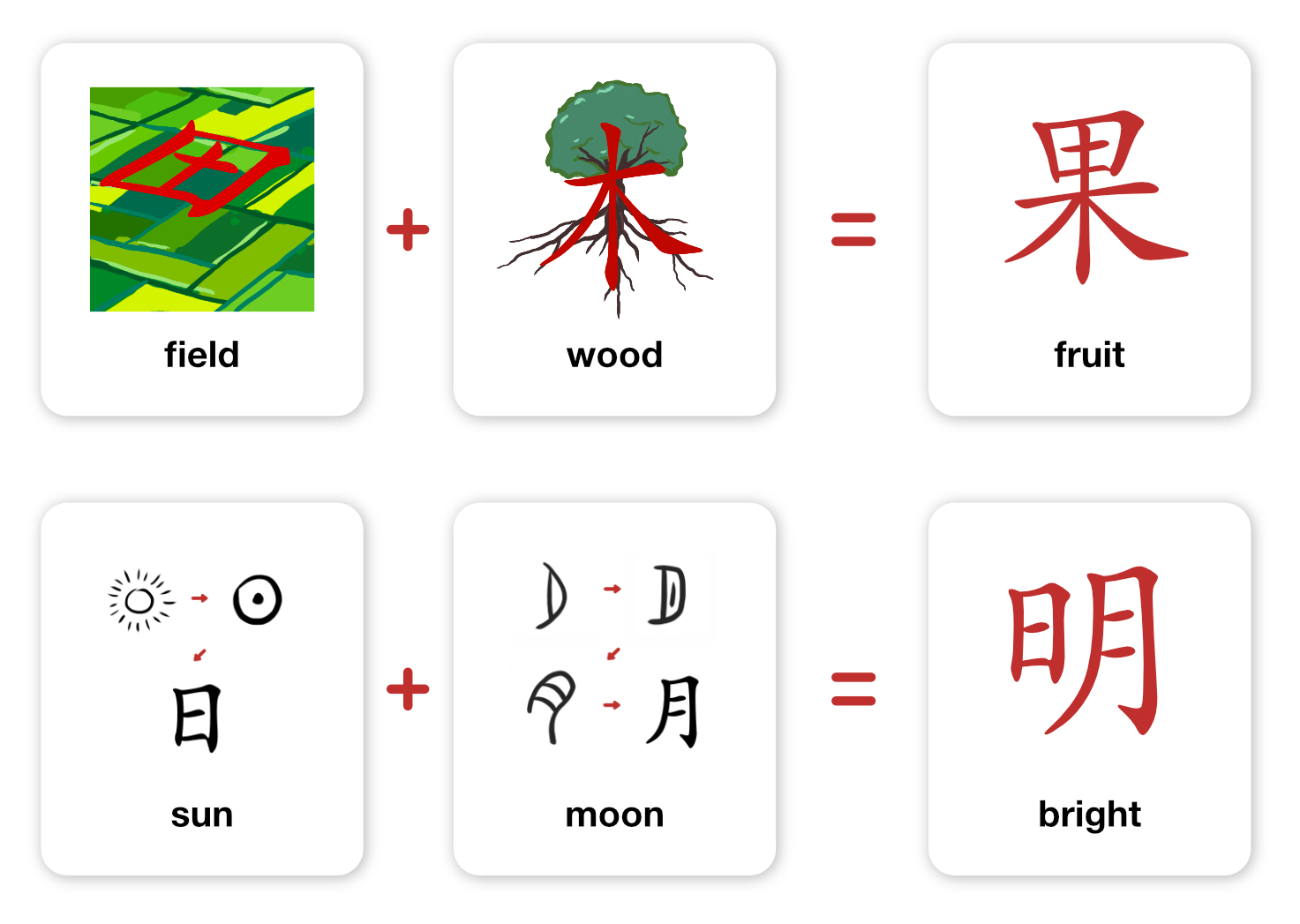
This combination of semantic components to form a new meaning is a key principle in character formation.
【NEW HSK1】_#hsk1 _明天/mingtian/(tomorrow) How to Pronounce & Write Chinese Vocabulary/Character Story
The same video provides an excellent explanation of 明, connecting its components to its meaning.
Now watch from 00:52 to 01:25. This part details how 日 (sun) and 月 (moon) combine to mean 'bright' and how that extends to concepts like 'tomorrow' or 'next year'.
To write 明 (míng), you apply the left-to-right rule:
- First, write the left component, 日 (rì), using its four strokes.
- Then, write the right component, 月 (yuè), using its four strokes.
You learned both 日 and 月 in Module 3. Take a moment to write 明 a few times, reinforcing the structure of combining these two radicals.
3. 今 (jīn) - Now / Present
This character allows us to talk about the current moment.
- Pinyin: jīn (first tone)
- Meaning: "now" or "the present."
Character Analysis and Writing
The character 今 (jīn) is also a compound character, though its etymology is less transparent than that of 明. Its modern form consists of a component at the top (人, a form of 'person' or 'gather') and a single stroke at the bottom. Think of it as representing a person at the present moment.
Let's refer back to the stroke order image to see how to write it.
今 (jīn) is written in four strokes, following the top-to-bottom rule:
- A left-falling stroke (撇, piě).
- A bent stroke (横撇, héng piě).
- A vertical stroke with a hook (竖钩, shù gōu).
- A dot stroke (点, diǎn).
Practice writing 今 in your notebook.
4. 年 (nián) - Year
Finally, let's learn the character for the largest unit of time we'll cover today.
- Pinyin: nián (second tone)
- Meaning: "year."
Character Analysis and Writing
The character 年 (nián) has a fascinating agricultural origin. It was originally a pictograph of a person carrying a sheaf of harvested grain on their back, representing the annual harvest cycle.
The website China Sage provides a concise overview of 年, including its etymology and a very helpful stroke order animation.
First, read the brief text at the top which states its meaning and original form ('a representation of man carrying a sheaf of harvested grain'). Then, scroll down to the animated GIF under the 'Pronunciation' section to see the correct stroke order. It is also a good opportunity to listen to the audio pronunciation.
As you saw in the animation, 年 (nián) has six strokes. Let's break them down:
- A left-falling stroke (撇, piě).
- A horizontal stroke (横, héng).
- Another horizontal stroke.
- A vertical stroke (竖, shù) that passes through the second horizontal line.
- A final long horizontal stroke at the bottom.
- A central vertical stroke that closes the character at the bottom. Note the rule of writing the "closing" stroke last. However, in this specific character's standard order, the final horizontal stroke is often written before the final vertical one. For simplicity, let's follow the animation: 撇, 横, 横, 竖, 横, 竖.
Practice writing 年 several times. Its structure is a bit more complex, so getting the stroke order right is key to making it look balanced.
Conclusion
Excellent work today. You've analyzed and learned to write four crucial characters for discussing time. This methodical, character-by-character approach is essential for building a strong and lasting foundation.
Key Takeaways:
- 天 (tiān): "day" or "sky," a 4-stroke pictograph of a person under the heavens.
- 明 (míng): "bright" or "next," a logical compound of 日 (sun) and 月 (moon).
- 今 (jīn): "now" or "the present," a 4-stroke character representing the current moment.
- 年 (nián): "year," a 6-stroke character derived from the image of an annual grain harvest.
Preview of the Next Lesson:
Now that you have mastered these individual characters, we are perfectly positioned to start building words. In our next lesson, we will combine them to form some of the most common words in Chinese: 今天 (jīntiān, today), 明天 (míngtiān, tomorrow), and 今年 (jīnnián, this year). We will also learn the rules for where to place these time words in a sentence.