Hello! Welcome back.
In our last lesson, we learned how to use the question word 哪 (nǎ), "which." The most important takeaway was the grammatical rule that 哪 must be followed by a measure word, as in 哪个人 (nǎ ge rén).
Today, we'll learn our final question word for this module: 几 (jǐ), which means "how many." You'll find that it follows a very similar pattern to 哪, which will help reinforce the grammar you've already learned. Our goal is to recognize and write this simple but essential character and use it correctly to ask about small quantities.
1. The Character 几 (jǐ): "How Many"
Let's start by analyzing the character itself. It is one of the simplest characters in Chinese.
Pronunciation and Meaning
The character is 几, and when used to ask "how many," it is pronounced jǐ, with a falling-then-rising third tone. It is used to ask about a small number of things, typically a number you expect to be under ten.
To understand its meaning and stroke count, please have a look at the following resource.
This page from WriteChinese.com provides a good overview of the character 几.
Please find the section titled 'Meaning of 几'. Focus on the Pinyin (jǐ), the stroke count (2), and the definition that includes 'how many / how much'. Note that there is another pronunciation, 'jī', which has different meanings like 'small table' or 'almost'. For today, we are only focusing on the 'jǐ' pronunciation for asking questions.
Writing 几 (jǐ)
As you saw, 几 is a very simple character with only two strokes. Because you prefer an analytical approach, let's break them down:
- Stroke 1: A left-falling stroke (撇, piě).
- Stroke 2: A hook stroke that moves horizontally and then curves down (横折弯钩, héng zhé wān gōu).
Watch this animation to see the correct stroke order and direction.
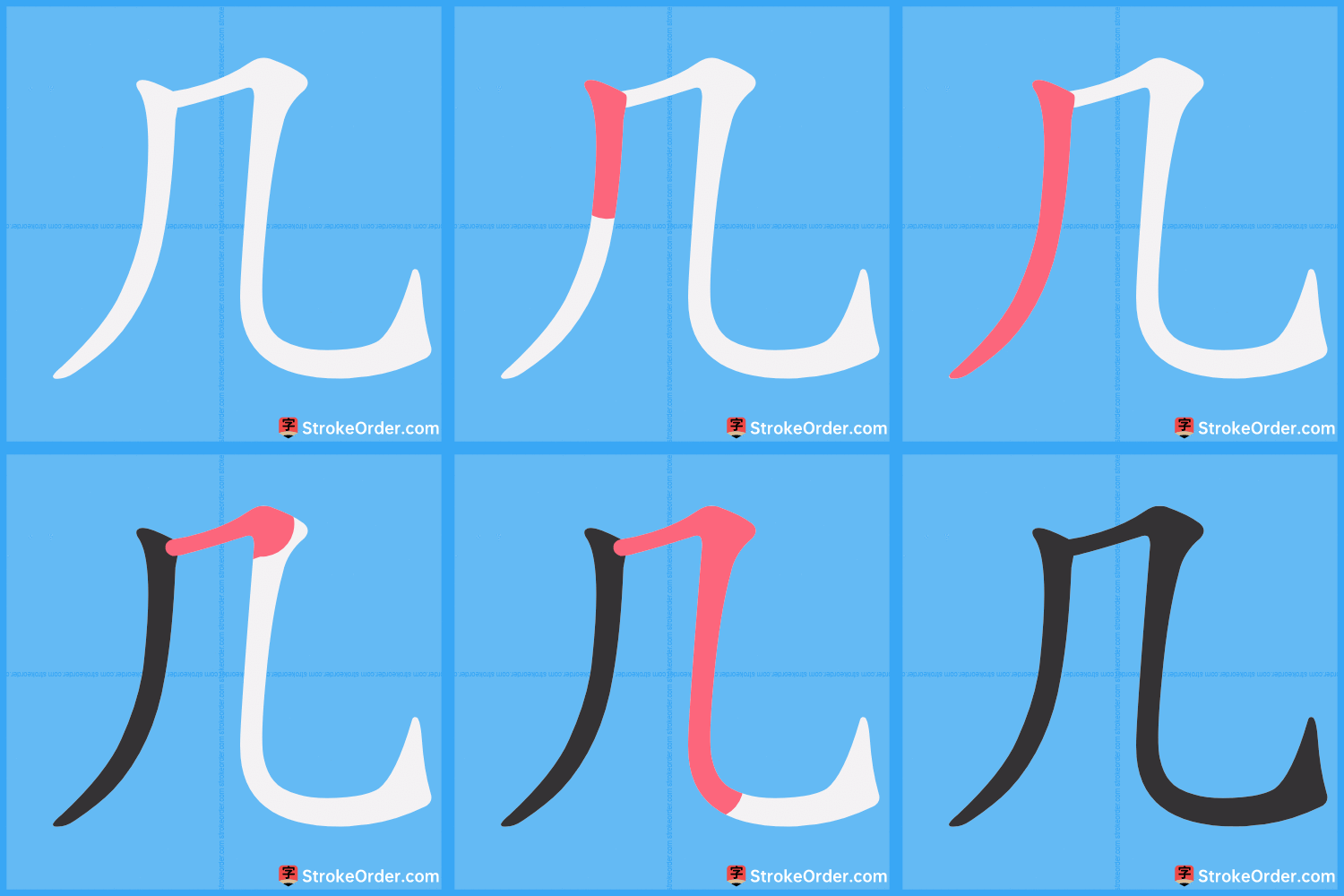
Take a moment to practice writing 几 in your notebook. Its simplicity is a good reminder that not all characters are complex.
2. The Grammar of "How Many"
The grammar for using 几 (jǐ) is straightforward and consistent with what you learned in the last lesson.
The "Small Quantity" Rule
The most important rule for 几 (jǐ) is that it's used to ask about quantities you expect to be less than 10. For asking about larger or unknown quantities, a different word, 多少 (duōshao), is used.
This image provides a very clear comparison.
The Sentence Pattern
Just like 哪 (nǎ), the question word 几 (jǐ) must be followed by a measure word. The structure is identical:
Let's read a brief explanation to solidify this pattern.
How to Use 几 || Basic Chinese Grammar
This article from Flexi Classes gives a direct and clear explanation of the grammar pattern for using 几.
Read the introduction and the first section, 'HOW TO USE 几 AS “A FEW”'. Pay close attention to the pattern '几 + Measure Word' and the example given.
3. Forming Questions with 几 (jǐ)
Now let's combine the character and its grammar to build full sentences. The process is the same as with other question words: you simply replace the number and measure word in a statement with 几 + measure word.
Let's use vocabulary you are familiar with.
Example 1: Asking about people
- Statement: 我家有三个人。(Wǒ jiā yǒu sān ge rén.) - My family has three people.
- Question: 你家有几个人?(Nǐ jiā yǒu jǐ ge rén?) - How many people are in your family?
Example 2: Asking about students
- Statement: 他有五个学生。(Tā yǒu wǔ ge xuéshēng.) - He has five students.
- Question: 他有几个学生?(Tā yǒu jǐ ge xuéshēng?) - How many students does he have?
Example 3: Asking about things you want
- Statement: 我要一个。(Wǒ yào yī ge.) - I want one.
- Question: 你要几个?(Nǐ yào jǐ ge?) - How many do you want?
Notice how 几 (jǐ) and the measure word 个 (gè) simply replace the number and the measure word in the original statement. The sentence order does not change.
4. Practice
Let's apply what you've learned. Translate the following questions into Chinese characters. Remember to use the 几 + Measure Word + Noun structure.
- How many good people? (Reminder:
好人- hǎorén) - Your school has how many students? (Reminder:
学校- xuéxiào,学生- xuéshēng) - How many teachers do you have? (You may not have learned the word for teacher,
老师lǎoshī, but see if you can construct the question part of the sentence.)
Answers:
- 几个好人? (jǐ ge hǎorén?)
- 你学校有几个学生? (Nǐ xuéxiào yǒu jǐ ge xuéshēng?)
- 你有几个老师? (Nǐ yǒu jǐ ge lǎoshī?)
Conclusion
Well done. You have now learned the last of the core question words for this stage of your learning. Mastering 几 (jǐ) is a significant step, as it allows you to ask about quantities in many different situations.
Key Takeaways:
- The character 几 (jǐ) means "how many" and is written with just two strokes.
- It is used specifically for asking about small quantities, typically those expected to be under 10.
- The grammar follows a familiar and crucial pattern: 几 + Measure Word + Noun.
Preview of the Next Lesson:
You've built a strong foundation in forming basic statements and questions. In our next module, we will start talking about a new dimension: time. We'll begin by learning the characters for "today" and "tomorrow"—今天 (jīntiān) and 明天 (míngtiān)—and how to place them correctly in a sentence to describe when an action happens.