Hello! Welcome back to your Mandarin course.
In our last lesson, we mastered the question word 谁 (shéi), "who," and learned the fundamental principle of forming questions in Chinese: replacing the answer in a statement with the question word, keeping the sentence structure the same.
Today, we'll continue expanding your questioning abilities by focusing on 哪 (nǎ), which means "which." This word is essential for asking for specific information, but it comes with a crucial grammatical rule. Our goal is to recognize and write the character 哪 and, most importantly, to use it correctly with a measure word to ask questions like, "Which person is a student?"
1. The Character 哪 (nǎ): "Which"
Let's begin, as always, with an analysis of the character itself.
Pronunciation and Meaning:
The character is 哪, pronounced nǎ with a falling-then-rising third tone. It means "which." Let's hear it pronounced.
Learn Chinese:What, Who, Where,Which, When, Why, Whose, What time in Mandarin WH Questions
The video from Andy and Sarah Mandarin provides a clear pronunciation of 哪 (nǎ).
Please watch from 00:43 to 01:08 to hear the pronunciation of 'which' and 'what'. Focus on the sound and third tone of 哪 (nǎ).
Character Anatomy:哪 is another phono-semantic compound, just like 谁 (shéi). It consists of two parts:
- Left side: 口 (kǒu). This is the "mouth" radical. You'll remember this from characters like
吃(chī) and喝(hē). Its presence here as the semantic component suggests a connection to speaking or asking. - Right side: 那 (nà). This character means "that." Here, it serves as the phonetic component. The pronunciations
nà(fourth tone) andnǎ(third tone) are very similar, making it a strong clue for the sound. This relationship is very similar to what we saw with 谁 (shéi) and its phonetic component 隹 (zhuī).
Writing 哪 (nǎ):
The character has 9 strokes. Following the left-to-right rule, you write the 口 radical first, then the 那 component.
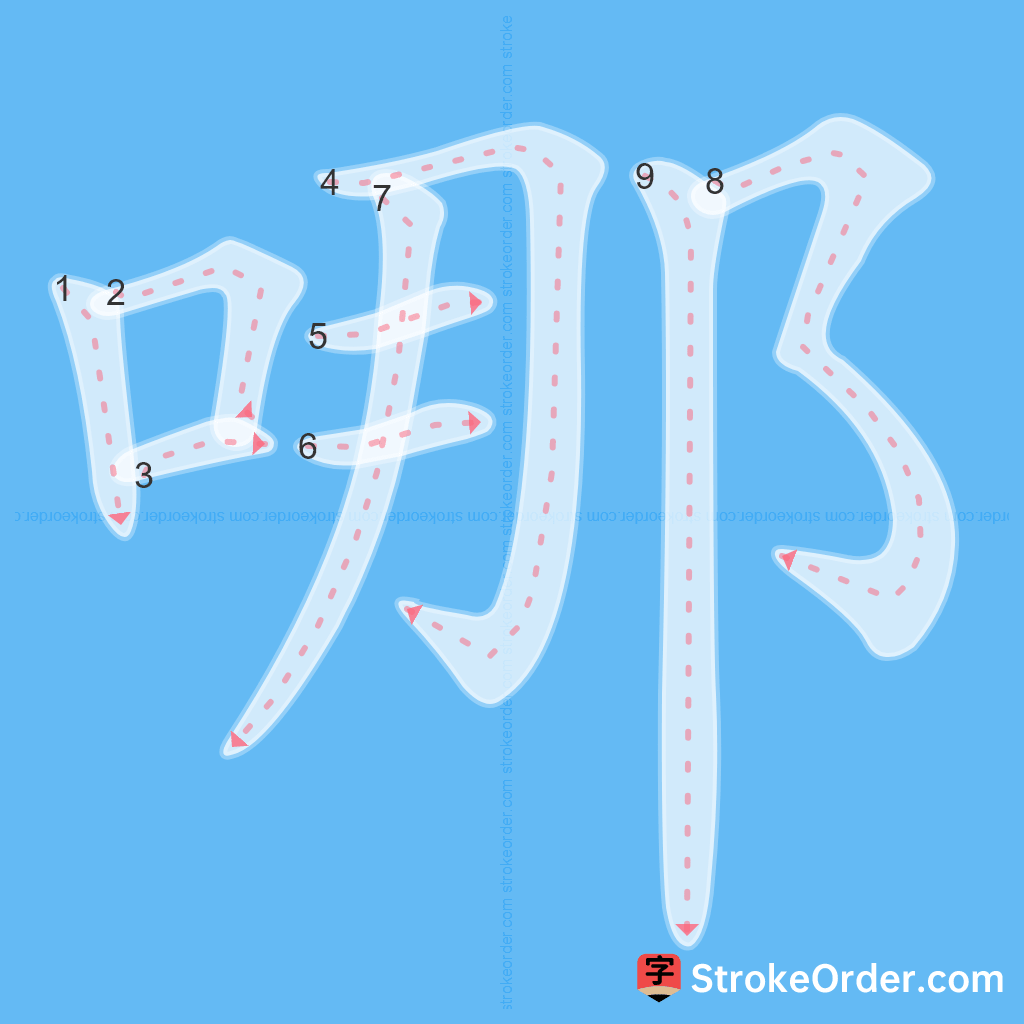
Take a few minutes to practice writing the character in a notebook, paying close attention to the stroke order. This will help you commit its structure to memory.
2. The Golden Rule: Using 哪 with a Measure Word
This is the most important concept for this lesson. Unlike in English where you can say "which book," in Mandarin, you cannot simply say 哪书. The question word 哪 must almost always be followed by a measure word.
The core structure is:
Let's read a clear explanation of this rule.
Ask Which in Chinese | Measure Word in Chinese
The website ChineseFor.Us has a concise article that explains this essential grammatical structure.
Read the sections 'Grammar 1: Ask Which in Chinese' and 'Grammar 2: Measure Word in Chinese (III)'. Focus on the core structure '哪 + Measure Word + Noun' and look at the examples provided in the table.
As you just read, this structure is mandatory. Let's build an example with vocabulary you know.
- You know the word for person: 人 (rén)
- You know the general measure word: 个 (gè)
- To ask "which person?", you combine them: 哪个人 (nǎ ge rén)
Now, let's watch a video that reinforces this concept with more examples.
How to Use 这zhè (this)/那nà (that)/哪nǎ (which) in Chinese Grammar (2024)
This video from Eli Mandarin is excellent for hearing the '哪 + Measure Word + Noun' structure used in practice.
Watch from 02:11 to 03:15. The speaker introduces the structure and gives examples like '哪本书' (which book) and '哪支笔' (which pen), explaining the role of the measure word.
3. Forming Questions with 哪 (nǎ)
The grammatical principle for forming a full question with 哪 is the same one you learned for 谁: you simply replace the specific information in a statement with the 哪 phrase. The rest of the sentence structure stays the same.

Let's apply this.
- Statement: 我要那个。(Wǒ yào nà ge.) - I want that one.
- Question: 你要哪个?(Nǐ yào nǎ ge?) - Which one do you want?
Here are some more examples with vocabulary you've learned:
-
To ask about a person:
- Statement: 那个人是学生。(Nà ge rén shì xuéshēng.) - That person is a student.
- Question: 哪个人是学生?(Nǎ ge rén shì xuéshēng?) - Which person is a student?
-
To ask about a nationality:
- Statement: 他是中国人。(Tā shì Zhōngguó rén.) - He is a Chinese person.
- Question: 他是哪国人?(Tā shì nǎ guó rén?) - He is which country's person? (i.e., What is his nationality?)
- Note: Here,
国 (guó)acts like a measure word for countries, so you can ask哪国directly.
-
To ask about wanting something:
- Statement: 我想喝中国茶。(Wǒ xiǎng hē Zhōngguó chá.) - I want to drink Chinese tea.
- Question: 你想喝哪国茶?(Nǐ xiǎng hē nǎ guó chá?) - Which country's tea do you want to drink?
4. Practice
Time to put your knowledge to the test. Translate the following English questions into Chinese characters.
- Which student is good? (Reminder:
学生- xuéshēng,好- hǎo) - You want to go to which school? (Reminder:
去- qù,学校- xuéxiào) - Who has which book? (This is a bit more complex, combining two question words! Reminder:
书- shū)
Answers:
- 哪个学生好? (Nǎ ge xuéshēng hǎo?)
- 你要去哪个学校? (Nǐ yào qù nǎ ge xuéxiào?)
- 谁有哪本书? (Shéi yǒu nǎ běn shū?)
- For "book" (书, shū), the correct measure word is 本 (běn), which you saw in the video and reading resources. This is a good example of how different nouns require different measure words. For now,
个is your reliable general-purpose tool.
- For "book" (书, shū), the correct measure word is 本 (běn), which you saw in the video and reading resources. This is a good example of how different nouns require different measure words. For now,
Conclusion
Excellent work today. You have added another powerful question word to your vocabulary and, more importantly, have solidified your understanding of the crucial role of measure words in Mandarin.
Key Takeaways:
- The character 哪 (nǎ) means "which" and is a phono-semantic compound of the mouth radical 口 (kǒu) and the phonetic component 那 (nà).
- The non-negotiable grammar rule is to use the structure: 哪 + Measure Word + Noun.
- To form a question, the entire
哪phrase replaces the specific item in a statement, while the rest of the word order remains unchanged.
Preview of the Next Lesson:
We will continue our exploration of question words and measure words. In the next lesson, we will learn 几 (jǐ), which is used to ask "how many" for small quantities. You will see that it follows a very similar grammatical pattern to 哪, further reinforcing what you've learned today.