Hello! Welcome back to your next lesson.
In our last session, we delved into the characters for China, 中国 (Zhōngguó). You learned to write 中 (zhōng) and 国 (guó), and explored their fascinating origins, connecting their meanings to the historical concept of the "Middle Kingdom"—a topic relevant to your interest in international relations.
Today, we move from identifying things to describing them. This is a crucial step in building expressive sentences. Our lesson will focus on three fundamental adjectives that you will use constantly.
Today's goal: You will learn to recognize and write three basic adjectives: 好 (hǎo - good), 多 (duō - many), and 少 (shǎo - few).
Following your preference for an analytical approach, we will deconstruct each character to understand its structure, origin, and stroke order.
1. The Character 好 (hǎo) — Good
The first adjective is 好 (hǎo), meaning "good". It is one of the most common and versatile characters in Mandarin. Its structure beautifully reflects a core value in traditional Chinese culture.
The character is a compound of two parts:
- 女 (nǚ) on the left, which you'll recall from Module 3 means "woman" or "female".
- 子 (zǐ) on the right, which is a pictograph of a "child" or "son".
The combination of "woman" and "child" to mean "good" evokes a powerful image of maternal love and family harmony. To see this explained visually and hear the correct pronunciation, please watch the following video segment.
女 好 母 每 美 Chinese Characters for Beginners - Etymology, Meaning, Culture and Stroke Orders 和“女”有关的汉字
This clip from the 'Chinese Characters for Beginners' series by Chinese Characters 3000 explains the etymology and stroke order of 好 (hǎo).
Please watch the segment from 00:59 to 02:17. Pay close attention to how the presenter explains the combination of 女 and 子 to form 好.
Writing 好 (hǎo)
The character 好 (hǎo) consists of 6 strokes. You write the left component (女) first, then the right component (子). This follows the fundamental left-to-right stroke order rule.
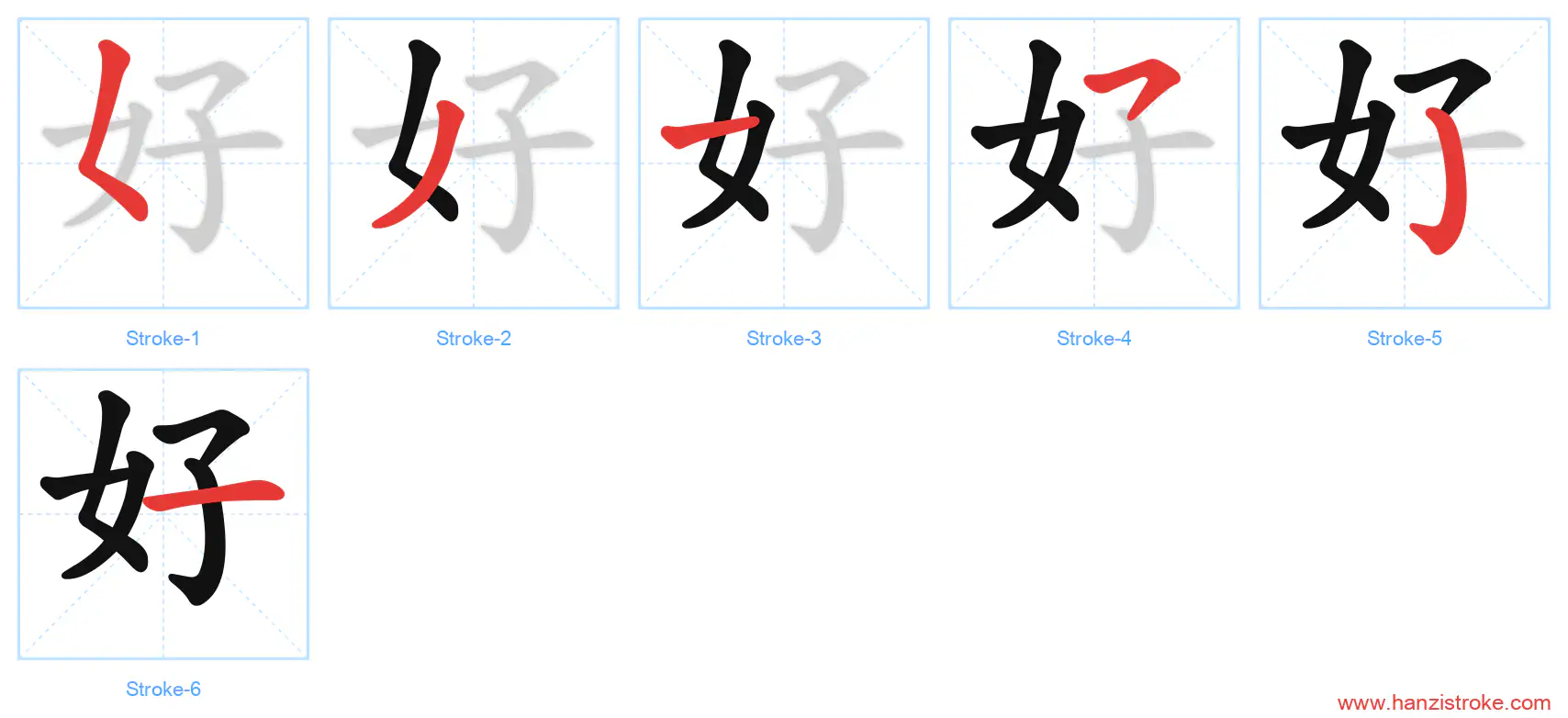
Here is the stroke-by-stroke sequence:
女 (nǚ) radical:
- 撇点 (piē diǎn): A diagonal stroke that curves slightly into a dot.
- 撇 (piē): The long, left-sweeping diagonal stroke.
- 横 (héng): The final horizontal stroke.
子 (zǐ) component:
4. 横撇 (héng piē): A short horizontal line that turns into a left-sweeping diagonal.
5. 竖钩 (shù gōu): A vertical stroke ending in a small hook.
6. 横 (héng): The final, long horizontal stroke across the middle.
Practice: Take a sheet of paper and write the character 好 ten times, focusing on the sequence and the proportion of the two components.
2. The Character 多 (duō) — Many / Much
Next, we have the adjective 多 (duō), which means "many" or "much". Its structure is another example of logical composition, this time using repetition to convey meaning.
The character 多 is formed by stacking two 夕 (xī) characters on top of each other. The character 夕 (xī) is a pictograph of a crescent moon, meaning "evening" or "sunset". By duplicating it, 多 creates the sense of "many evenings" or the passage of a long time, which by extension means "many" or "a lot".
To learn more about this character and see its stroke order, let's consult the following resource.
The Chinasage website provides a concise explanation of the character 多 (duō).
Please read the section at the top of the page that begins with '# 多 duō many'. Focus on the explanation of its composition from two '夕' characters. You can also click the audio link under 'Pronunciation' to hear the sound.
Writing 多 (duō)
多 (duō) is a 6-stroke character. You simply write the top 夕 (xī) component, and then repeat the same strokes for the bottom one.

Here is the stroke-by-stroke sequence for one 夕 (xī), which you will write twice:
- 撇 (piē): A diagonal stroke from top-right to bottom-left.
- 横撇 (héng piē): A horizontal stroke that curves down into a left-sweeping diagonal.
- 点 (diǎn): A final dot.
Repeat these three strokes for the bottom half.
Practice: Write 多 ten times. As you write, think of the concept: "evening after evening... many evenings."
3. The Character 少 (shǎo) — Few / Less
Finally, we have the logical opposite of 多, which is 少 (shǎo), meaning "few" or "less".
This character builds upon one you already know from Module 3: 小 (xiǎo), meaning "small". The character 少 is composed of 小 plus a single falling stroke 丿 (piě) on the top right. The logic is that you are taking a small piece away from something that is already small, making it even less.
- 小 (xiǎo): "small"
- 小 + 丿 (piě) = 少 (shǎo): "few, less"
Writing 少 (shǎo)
少 (shǎo) has 4 strokes. You write the character 小 first, then add the final stroke.
- 竖钩 (shù gōu): The central vertical stroke with a hook.
- 撇 (piē): The left-side dot/stroke.
- 点 (diǎn): The right-side dot.
- 撇 (piě): The final short, left-falling stroke that crosses over the top right.
Practice: Write 少 ten times, paying attention to how it is derived from 小.
A Common Pairing: 多少 (duōshǎo)
An excellent example of how characters combine to create new meanings is the word 多少 (duōshǎo). By placing "many" and "few" together, you form a question word that means "how much?" or "how many?".
You will see this pairing used frequently to ask about quantity or price. This demonstrates the building-block nature of Chinese that we have discussed.
Conclusion
In this lesson, you have added three essential descriptive words to your vocabulary. By understanding their internal logic, you are not just memorizing shapes but are learning the system behind the language.
Key Takeaways:
- 好 (hǎo): "good", composed of 女 (woman) and 子 (child), symbolizing harmony.
- 多 (duō): "many", composed of two 夕 (evening) characters, symbolizing the passage of many days.
- 少 (shǎo): "few", built from 小 (small) with an additional stroke, symbolizing reduction.
- These characters can combine to form new words, such as 多少 (duōshǎo), meaning "how many/much".
Preview of the Next Lesson:
Now that you can write these adjectives, the next step is to use them in sentences. In our next lesson, you will learn to recognize and write 很 (hěn - very) and use it to connect subjects with these adjectives (e.g., "She is good"). We will also introduce the indispensable particle 的 (de), which is used to show possession and link adjectives to nouns. This will unlock the ability to form much more descriptive and nuanced sentences.