Hello! Welcome back.
In our last lesson, we explored the crucial distinction between the negation words 不 (bù) and 没 (méi). You learned that 是 (shì) is always negated with 不, while 有 (yǒu) is always negated with 没, and you grasped the core principle of using 不 for static states and 没 for dynamic actions.
Today, we shift our focus from grammar back to building your vocabulary with two of the most important characters in the language. As previewed, we will learn to recognize, write, and understand the characters 中 (zhōng) and 国 (guó). By combining them, we form the word for China, 中国 (Zhōngguó), a name central to your interest in international relations and diplomacy. This lesson will equip you with the building blocks to soon form sentences about nationality and geography.
Following your preference for an analytical approach, we won't just memorize these characters. We'll deconstruct them, exploring their pictographic origins, logical structure, and the rules governing their stroke order.
1. The Character 中 (zhōng): Center
The first character is 中 (zhōng). Its primary meaning is 'middle' or 'center'. This concept is fundamental, and its origin is beautifully pictographic.
To see how this character evolved and to hear its pronunciation, let's start with a short video.
Basic Chinese: First 100 Chinese Characters You Need Know and Write. Chinese Lesson for Beginners
The video 'Basic Chinese: First 100 Chinese Characters' will show you the ancient form of 中 and demonstrate how to write it.
Please watch from 03:39 to 05:09. Pay close attention to the explanation of its original form—a flag planted in the center of a settlement.
As the video explains, the earliest form of 中 depicts a flagpole with banners, planted in the center of a camp or territory to mark its central point. The modern character is a simplification of this image: a box representing the area, with a vertical line passing straight through its center.
Structure and Stroke Order
The character 中 is composed of four simple strokes. Writing it correctly involves a key stroke order rule you've seen before.
- 竖 (shù): The first stroke is the left vertical line of the "box".
- 横折 (héngzhé): The second is the top and right side of the box, written as one continuous stroke.
- 横 (héng): The third is the horizontal line inside the box.
- 竖 (shù): The final, central vertical stroke that "crosses" the box.
Notice that the final vertical stroke is written last. This follows the "crossing strokes last" rule, which states that strokes that cut through several other strokes are typically drawn at the end. You can review this principle in the "Chinese Characters Stroke Order Guide" (Resource ID: LINK) under the heading "Crossing strokes last".
Practice: Take a moment to write 中 five times, focusing on the correct stroke order.
2. The Character 国 (guó): Country
Our second character is 国 (guó), which means 'country', 'state', or 'nation'. Given your background in governance and history, you will find the evolution of this character particularly interesting. It tells a story about how the concept of a "state" has been perceived in Chinese culture.

The simplified character 国 we use today consists of an enclosure radical 囗 (wéi) surrounding the character for jade, 玉 (yù). This composition suggests the idea of "a treasure within a boundary."
However, the traditional form, 國, tells a different story. It contains the component 或 (huò) inside the enclosure. This component is a pictograph of a weapon (a dagger-axe, 戈 gē) defending a territory (represented by a line) and its people (represented by a mouth, 口 kǒu). Therefore, the traditional character 國 vividly depicts a "territory defended by force."
The shift from 國 (a defended territory) to 国 (a treasured land) reflects a fascinating evolution in symbology. To dive deeper into this history, please watch the next video segment and read the provided text.
Basic Chinese: First 100 Chinese Characters You Need Know and Write. Chinese Lesson for Beginners
This segment from the 'Basic Chinese' video explains the difference between the traditional and simplified forms of 'guó' and demonstrates its stroke order.
Watch from 01:14:45 to 01:17:08. Notice how the presenter explains the meaning of both 國 and 国.
Now, for a more detailed historical account that touches upon the evolution from oracle bone script to the simplified character used today, please read the following material.
What is the history of the Chinese character 国?
The Quora discussion 'What is the history of the Chinese character 国?' offers a rich, multi-faceted look at the character's long history, perfect for your interests.
Please read the following sections from the webpage. Focus on how the character's components and meaning changed over time: Start with the second answer by Chen Zhigong. Read the parts titled 'In the 甲骨文 Oracle Bone Script' and 'in the 金文 Chinese Bronze Inscriptions' to see the earliest forms. Next, read the first answer's section on 'Simplification to 国 (20th century)' to understand the modern change. Finally, read the concise summary in the fourth answer from Eddie Schodowski, which neatly contrasts the compositions of 國 and 国.
Structure and Stroke Order
The character 国 (guó) has 8 strokes. Writing it correctly involves the rules for enclosed characters: outside before inside, and seal the box last.
- 竖 (shù): Left vertical wall.
- 横折 (héngzhé): Top and right wall in one stroke.
- 横 (héng): First horizontal stroke of the inner 玉 (jade).
- 横 (héng): Second horizontal stroke of 玉.
- 竖 (shù): The vertical stroke connecting the strokes of 玉.
- 点 (diǎn): The small "dot" stroke for 玉.
- 横 (héng): The bottom horizontal stroke that closes the box. This stroke is written after the contents are complete.
Practice: Following the stroke order in the image above, write the character 国 five times.
3. Forming the Word 中国 (Zhōngguó): China
Now, we combine our two new characters to form one of the most important words in the language:
Literally, 中国 translates to "Middle Kingdom." This name originates from the ancient Chinese worldview of their civilization being at the center of the world. For anyone studying international relations, understanding this historical self-perception is key to comprehending many aspects of Chinese foreign policy and national identity.
This new word is a perfect example of how Chinese builds complex ideas from simpler character components.
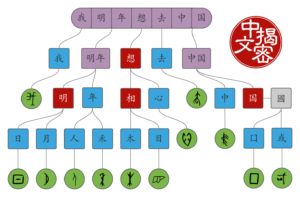
With the grammar you already know, you can now form basic sentences:
- 这是中国。(Zhè shì Zhōngguó.) - This is China.
- 他不是中国人。(Tā bú shì Zhōngguó rén.) - He is not a Chinese person.
Conclusion
In this lesson, you have moved from abstract grammar to concrete vocabulary that is highly relevant to your goals. You've not only learned to recognize and write two essential characters but also delved into their rich history and cultural significance.
Key Takeaways:
- 中 (zhōng) means "center" or "middle," originating from a pictograph of a central flagpole. Its stroke order follows the "crossing strokes last" rule.
- 国 (guó) means "country." The simplified form (国) represents "jade within a boundary," while the traditional form (國) represents a "territory defended by weapons." Its stroke order follows the "outside before inside, close last" rule.
- 中国 (Zhōngguó) is the word for China, literally meaning "Middle Kingdom," a term with deep historical and political significance.
Preview of the Next Lesson:
Now that you can identify people and places, the next logical step is to describe them. In our next lesson, we will learn our first set of adjectives: 好 (hǎo - good), 多 (duō - many), and 少 (shǎo - few). We will also learn the indispensable particle 的 (de), which is used to show possession. This will allow you to form phrases like "my country" (我的国) and sentences like "Chinese people are numerous" (中国人很多).