Hello! Welcome back to your study of Mandarin.
In our last lesson, we focused on the verb 有 (yǒu) and its specific negation, 没有 (méiyǒu). You learned the critical rule that to say you "do not have" something, you must use 没 (méi), and that 不有 is always incorrect.
This naturally leads to a broader question: when do we use 不 (bù), and when do we use 没 (méi)? Today, we will answer that question by exploring the fundamental differences between these two essential negation words. Understanding this distinction is a major step in mastering Chinese grammar and will clarify why we say 不是 (bú shì) but 没有 (méiyǒu).
Introduction: Two Sides of "Not"
In English, we primarily use "not" to negate verbs and adjectives. In Chinese, this function is split between 不 (bù) and 没 (méi). Grasping their distinct roles is key to speaking and writing accurately.
Let's start with a simple visual.
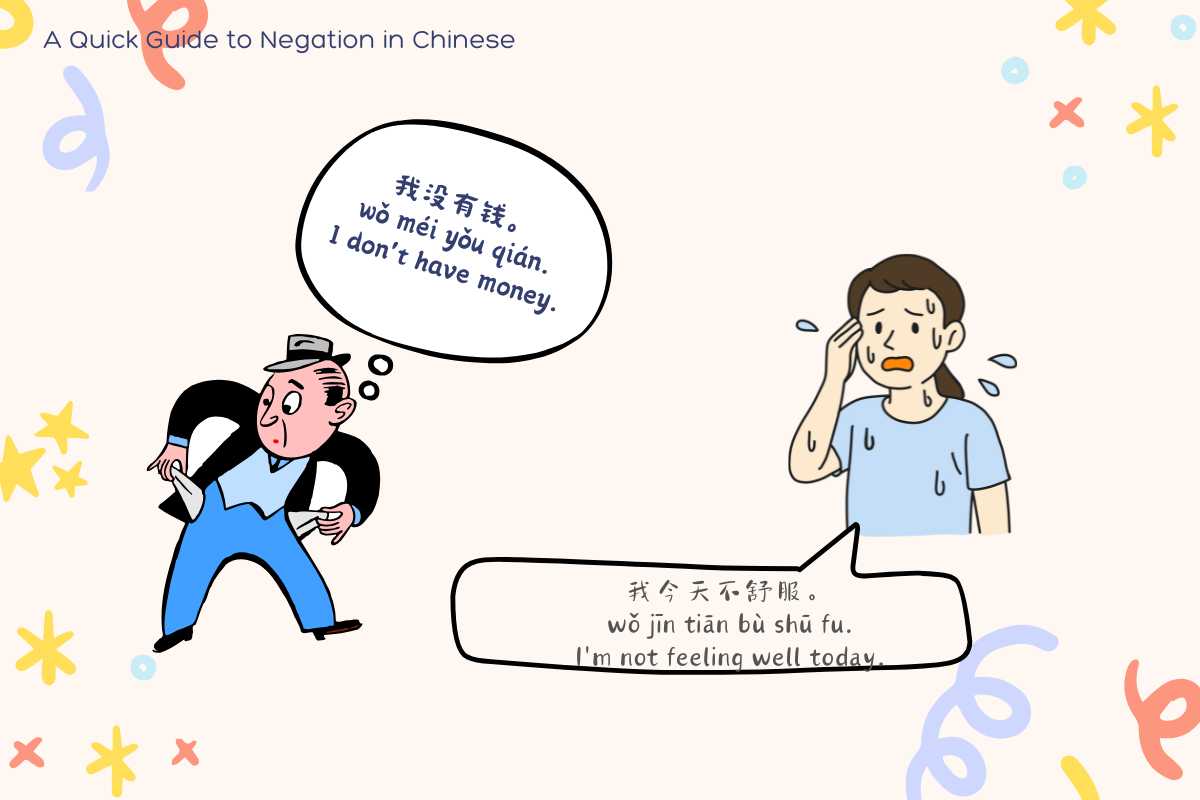
This image hints at the core difference, which we will now break down into clear, manageable rules.
1. The Two Absolute Rules
Before diving into the general principles, let's solidify the two most straightforward and inflexible rules in Mandarin negation. You have already encountered both.
-
To negate 有 (yǒu, to have), you MUST use 没 (méi).
- Correct: 我没有水。(Wǒ méiyǒu shuǐ.) - I do not have water.
- Incorrect: 我不有水。
-
To negate 是 (shì, to be), you MUST use 不 (bù).
- Correct: 我不是她。(Wǒ bú shì tā.) - I am not her.
- Incorrect: 我没是她。
These two rules are your foundation. To hear them explained clearly by a native speaker, please watch the following short clips.
Chinese Grammar: 不(bù) VS 没 (méi) 8 clear rules to use them correctly without mistake.
The video 'Chinese Grammar: 不(bù) VS 没 (méi)' from Yimin Chinese艺敏中文 clearly explains these two non-negotiable rules.
Please watch from 00:00:26 to 00:01:52. The first part covers the rule for 有 (yǒu), and the second covers the rule for 是 (shì).
2. The Core Principle: Static States vs. Dynamic Actions
Beyond those two specific verbs, a general principle governs the use of 不 and 没. Given your preference for analytical frameworks, this distinction should be particularly useful.
- 不 (bù) is used to negate static states. This includes inherent qualities, habits, subjective feelings, opinions, and unchanging facts. Think of it as negating what something is.
- 没 (méi) is used to negate dynamic actions or changes. This includes actions that did not happen (usually in the past) and changes of state that have not occurred. Think of it as negating what happened or what has changed.
This next video provides an excellent overview of this "static vs. dynamic" concept.
Negation in Mandarin | Chinese Grammar Lesson
In this video from Grace Mandarin Chinese, the presenter introduces the core difference between 不 and 没 in a clear, conceptual way.
Watch the segment from 00:02:09 to 00:02:52. Focus on how she defines 不 for 'static states' and 没 for 'dynamic situations'.
Let's break this down further with examples.
Using 不 (bù) for Static States
You use 不 to describe things that are constant, habitual, or a matter of personal judgment.
- Negating qualities/adjectives:
- 这个山不大。(Zhège shān bù dà.) - This mountain is not big. (Describing an inherent quality).
- Negating habits or willingness:
- 我不喝茶。(Wǒ bù hē chá.) - I don't drink tea. (This is a statement about a habit, not a specific action in the past).
- 我不去。(Wǒ bù qù.) - I am not going. (Expressing a decision or unwillingness).
Using 没 (méi) for Dynamic Actions
You use 没 to state the objective fact that an action did not take place or a change did not occur.
- Negating a past action:
- 我昨天没喝茶。(Wǒ zuótiān méi hē chá.) - I did not drink tea yesterday. (This refers to a specific, one-time event that didn't happen).
- Negating a change of state:
- 天没亮。(Tiān méi liàng.) - The sky has not become bright. (The change from dark to light has not happened).
The following article reinforces this distinction with more examples.
Do you know the differences between 不(bù) and 没(méi)?
The article 'Do you know the differences between 不(bù) and 没(méi)?' from eChineseLearning also uses this helpful 'static vs. dynamic' framework.
Read the article from the beginning down to the line that says, 'That is, “bù” is a static negation, and “méi” is dynamic.' This will solidify the concepts with written examples.
3. Negation and Time
A common simplification is that 不 is for the present/future and 没 is for the past. While often true, it's more nuanced. Here are the key rules regarding tense:
-
Future Tense: Only 不 can be used to negate future actions. 没 is never used for the future.
- Example: 我明天不去学校。(Wǒ míngtiān bù qù xuéxiào.) - I am not going to school tomorrow.
-
Past Tense: Both can be used, but they carry different meanings.
- 没 + Verb: States that an action did not happen. This is a simple, objective fact.
- 不 + Verb: Explains why an action wasn't performed, usually implying refusal or unwillingness.
Let's watch a video that clarifies this distinction between negating a habitual action versus a specific past action.
Chinese Grammar: 不(bù) VS 没 (méi) 8 clear rules to use them correctly without mistake.
Returning to the Yimin Chinese video, this segment clearly contrasts using 不 for habits and 没 for one-time past actions.
Watch from 00:02:12 to 00:03:20. The example with 'I don't smoke' (habit) versus 'I didn't smoke' (specific event) is particularly clear.
Practice
Let's test your understanding. Fill in the blanks with either 不 (bù) or 没 (méi).
- 我 ___ 是学生。(Wǒ ___ shì xuéshēng.) - I am not a student.
- 他昨天 ___ 来中国。(Tā zuótiān ___ lái Zhōngguó.) - He did not come to China yesterday.
- 她 ___ 有中国朋友。(Tā ___ yǒu Zhōngguó péngyǒu.) - She does not have Chinese friends.
- 他 ___ 高。(Tā ___ gāo.) - He is not tall.
Check your answers:
- 不 (negating 是)
- 没 (negating a past action)
- 没 (negating 有)
- 不 (negating a quality/adjective)
Conclusion
You've done an excellent job tackling one of the most fundamental grammar points in Mandarin. By moving beyond simple memorization and understanding the underlying principles, you're building a much stronger foundation for future learning.
Key Takeaways:
- The Golden Rules: Always use 没有 (méiyǒu) to negate "to have" and 不是 (bú shì) to negate "to be."
- The Core Principle: Use 不 (bù) for static states (qualities, habits, feelings, judgments) and 没 (méi) for dynamic actions or changes (events that didn't happen).
- The Future Rule: Only 不 (bù) can be used to negate actions in the future.
Preview of the Next Lesson:
Now that you have a solid grasp of forming basic statements and negations with 是 and 有, it's time to expand our vocabulary. In the next lesson, we will learn to recognize and write the characters for 中 (zhōng) and 国 (guó). Combining them forms 中国 (Zhōngguó), the word for China. This will enable you to start forming sentences about nationality, directly connecting your language learning to your interest in international relations.