Hello! Welcome back to your study of Mandarin.
In our last lesson, you learned how to express possession using the verb 有 (yǒu) with the sentence structure "Subject + 有 + Object." This was a significant step, allowing you to form sentences like 我有一本书 (Wǒ yǒu yī běn shū), "I have a book," once we learn the words for book.
Today, we'll learn the other side of that coin: how to express that you don't have something. You might guess we'd use the negation word 不 (bù) that we learned for 是 (shì), but 有 is a special case. It requires its own unique negator, 没 (méi). Our goal is to recognize and write 没 (méi), and then use it to form 没有 (méiyǒu) to negate possession.
1. The Character for "Not Have": 没 (méi)
Let's start by analyzing the character 没. Your preference for understanding the "why" behind characters will be very useful here, as 没 has an interesting story.
- Character: 没
- Pinyin: méi
- Tone: 2nd (rising)
- Meaning: not have; to sink, to submerge
The character is a phono-semantic compound, composed of two parts:
- On the left is the radical 氵(shuǐ), which is the "three-dot water" radical. You'll see this in many characters related to water or liquids. You've already learned the character 水 (shuǐ), so you can see the connection.
- On the right is a component, 殳 (shū), which originally depicted a hand holding a tool or weapon.
The following video provides a concise explanation of the character's origin and structure.
【NEW HSK1】_没有/meiyou/(have not) How to Pronounce & Write Chinese Vocabulary/Character Story
This clip from E's Chinese Class explains the origin and components of 没 (méi).
Please watch from 00:00:02 to 00:01:01. Pay attention to the original meaning ('to sink') and how the components (water radical and a hand) contribute to this meaning. Note that this character has another pronunciation, /mò/, but we will focus on /méi/ for now.
As the video explained, the original meaning of 没 was "to sink" or "submerge," which makes sense given the water radical. From this idea of something being gone or submerged, it extended to mean "to not have" or "there is not."
2. Writing 没 (méi)
Now, let's focus on writing 没. It has a total of 7 strokes. We follow the standard stroke order rules: left to right, top to bottom.
- First, write the three strokes of the water radical 氵.
- Then, write the four strokes of the right-hand component.
Here is a visual guide to the stroke order.
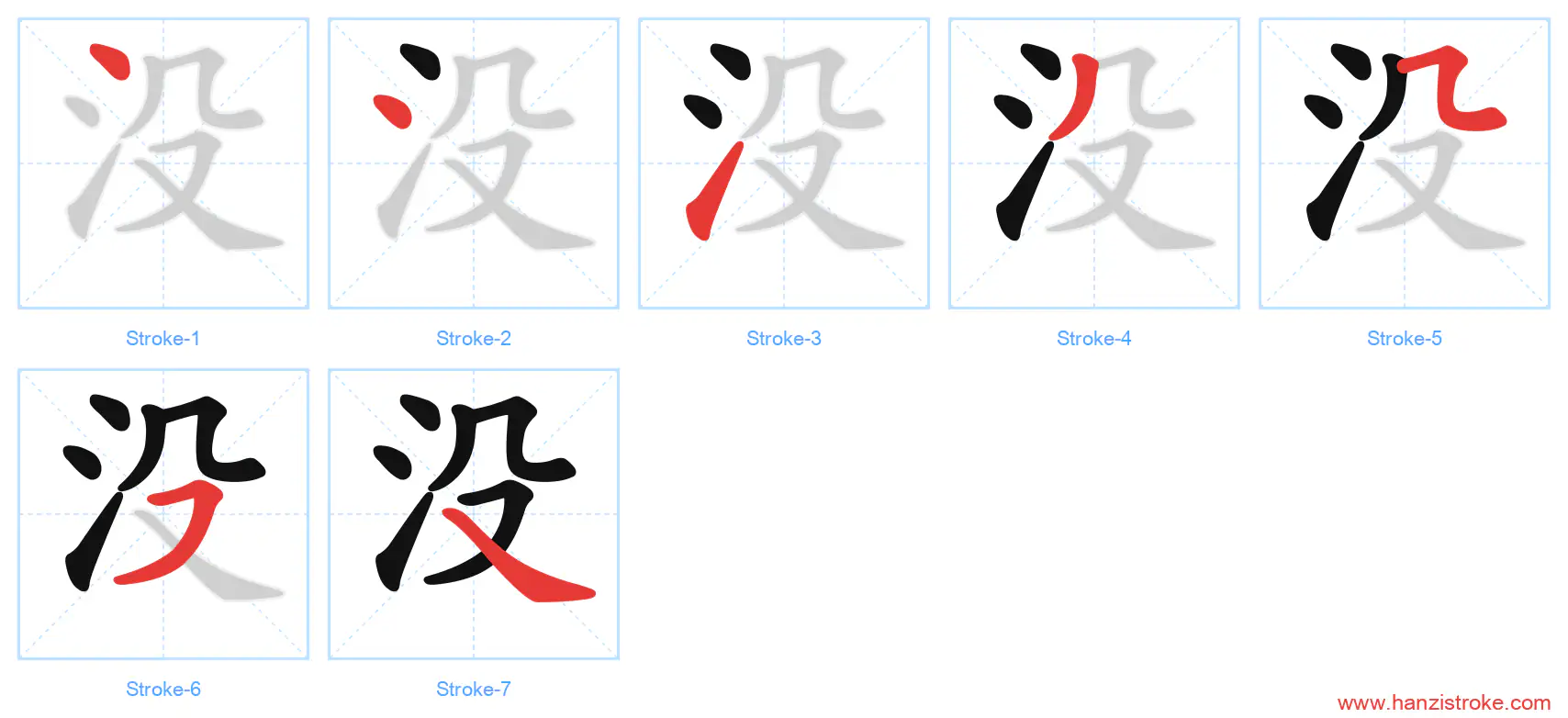
For practice, you can use the resource below. I recommend tracing the character a few times and then trying to write it on your own, focusing on the correct stroke sequence.
The Hanzi Stroke website provides an excellent interactive guide and practice worksheet for writing 没.
On the webpage, first observe the 'Animated Stroke Order 没'. Then, scroll down to the 'Stroke Order Diagrams 没' for a static reference. For hands-on practice, you can download the 'Free Printable Handwriting Practice' worksheet.
3. Using 没有 (méiyǒu) to Negate Possession
To say that someone "does not have" something, you combine 没 (méi) with the verb 有 (yǒu) to create the phrase 没有 (méiyǒu).
The sentence structure is a straightforward modification of the one you learned in the last lesson:
Let's read a clear explanation of this pattern.
The Ultimate Guide to 没有 (méi yǒu) in Chinese
This article from FluentU gives a clear breakdown of how to use 没有 to express 'to not have'.
Please read the first section, '没有 — To not have'. Focus on the sentence structure provided and the example sentences. Note the audio clips available for each sentence to practice pronunciation.
As the article demonstrates, you simply replace 有 with 没有.
Let's try this with characters we know:
- To say "I have water," you write: 我有水。 (Wǒ yǒu shuǐ.)
- To say "I do not have water," you write: 我没有水。 (Wǒ méiyǒu shuǐ.)
Notice that the tone of 有 (yǒu) is a neutral tone when it follows 没 (méi).
An Inflexible Rule
This is a critical rule in Mandarin: the verb 有 (yǒu) is only negated by 没 (méi). You must never use 不 (bù). The phrase *不有 is always incorrect.
This short video clip states the rule very clearly.
Chinese Grammar: 不(bù) VS 没 (méi) 8 clear rules to use them correctly without mistake.
This clip from Yimin Chinese makes the rule about negating 有 absolutely clear.
Watch from 00:00:26 to 00:01:04. The instructor explicitly states that only 没 can be used to negate the verb 有.
Practice Time
Let's practice forming sentences with 没有. How would you write the following in Chinese characters?
- You do not have fire.
- She does not have a hand.
- We do not have a big mountain.
Check your answers:
- 你没有火。 (Nǐ méiyǒu huǒ.)
- 她没有手。 (Tā méiyǒu shǒu.)
- 我们没有大山。 (Wǒmen méiyǒu dà shān.)
Conclusion
Great work today. You've learned the essential counterpart to possession. This small addition dramatically increases the range of things you can express.
Key Takeaways:
- The character 没 (méi) is used to negate having something. Its radical is 氵(water), reflecting its original meaning of "to sink."
- To express "do not have," you use the phrase 没有 (méiyǒu).
- The sentence structure is: Subject + 没有 + Object.
- Crucial Rule: You always use 没有 to negate 有. You never use 不有.
Preview of the Next Lesson:
Today we established that 有 has a special relationship with 没. This might raise a question: when do we use 不 and when do we use 没 for other verbs? In our next lesson, we will explore exactly that, explaining the fundamental difference between these two important negation words. This will clarify why you say 不是 (bú shì) but 没有 (méiyǒu).