Hello and welcome back to your Mandarin course.
In our last few lessons, we've focused on building the fundamental 'A 是 B' sentence structure and then learning how to negate it with 不是 (bú shì). You also did an excellent job mastering the tone sandhi rule for 不 (bù), a crucial piece of Mandarin phonetics.
Today, we will introduce another cornerstone of the language: the verb 有 (yǒu), which means "to have." This will unlock the ability to talk about possession, a new and powerful type of sentence. Following your preference for a structured, analytical approach, we will first deconstruct the character 有 itself, learn how to write it, and then practice using it in sentences.
1. Deconstructing the Character: 有 (yǒu)
Let's begin by examining the character for "to have."
有
- Pinyin: yǒu
- Tone: 3rd (falling-rising)
- Meaning: to have, to possess; there is/are
From an etymological standpoint, this character is a pictograph representing an action. It's composed of two parts:
- The top part, 𠂇, is an ancient form of the character 手 (shǒu), meaning "hand."
- The bottom part is 月 (yuè). While this character means "moon," in many compound characters it's actually a depiction of 肉 (ròu), meaning "meat" or "flesh."
So, the character 有 (yǒu) originally depicted a hand holding a piece of meat—a very direct and ancient representation of possession.
For a memorable way to encode this character, let's turn to the "Hanza Movie Method" you've seen before. The presenter uses creative mnemonics for the components.
Read Chinese In 85 Minutes (Without Pinyin)
In this segment from Mandarin Blueprint's video, the presenter will introduce the character 有 (yǒu) using their signature memory technique.
Watch the clip from 00:49:51 to 00:52:03. Pay attention to how the components are visualized (a 'gun' and a 'moon') and woven into a story about possession ('to have'). This offers a different, but effective, way to remember the character's form and meaning.
Notice the presenter's mnemonic for the top part is a 'gun'. This is purely based on visual similarity to help with recall. You can either use this creative mnemonic or stick with the etymological origin of 'hand'—whichever you find more effective.
2. Writing 有 (yǒu)
Now that we understand its structure, let's learn to write it correctly. 有 has six strokes. Adhering to the correct stroke order is fundamental to writing balanced and legible characters.
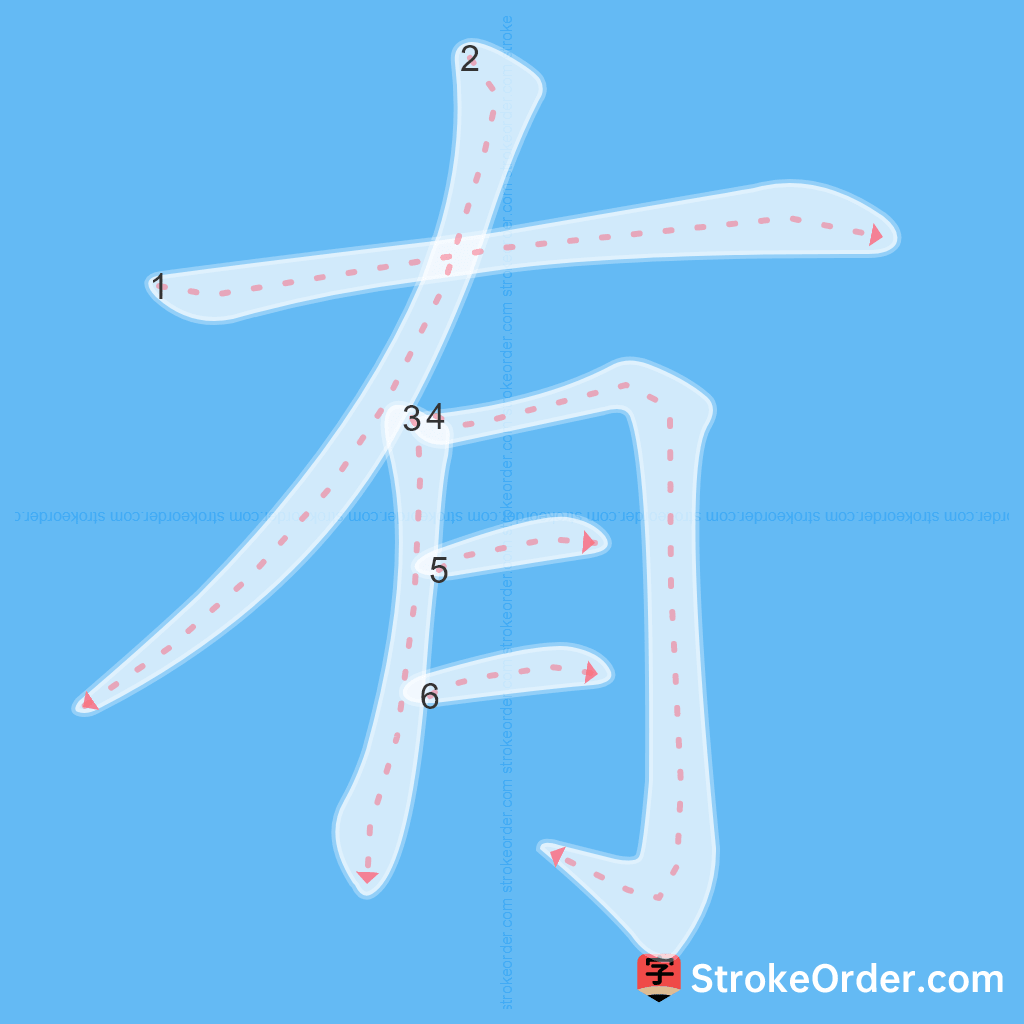
Take a moment to practice writing the character a few times, following the sequence shown in the image. Try to recall the components (hand and moon/meat) as you write.
3. Using 有 (yǒu) for Possession
The most common use of 有 (yǒu) is to state that someone possesses something. The sentence structure is simple and logical.
First, please read the following brief explanation. It clearly lays out the core grammar pattern.
A Simple Guide to Using 有(yǒu) in Chinese
The article 'A Simple Guide to Using 有(yǒu) in Chinese' provides excellent examples of how to express possession.
Please read the first section, '1. Use 有 (yǒu) to Express Possession'. Focus on the sentence pattern presented: subject + 有 (yǒu) + object.
As the article explained, the pattern is:
This is directly equivalent to "Subject has/have Object" in English. Now, let's watch a short video to hear this pattern used by a native speaker.
有 (you) Part 1 - So you think you know "有 you" ? - the Chinese verb "to have" and much more!
This clip from Twin Cities Chinese Tutor reinforces the basic sentence pattern for possession.
Watch from 00:00:55 to 00:01:35. Listen to the examples and repeat them to practice your pronunciation of 有 (yǒu) within a sentence.
Practice with Known Characters
Let's form some sentences using characters you have already learned:
- 我有水。 (Wǒ yǒu shuǐ.) - I have water.
- (我 wǒ - I; 有 yǒu - have; 水 shuǐ - water)
- 你有手。 (Nǐ yǒu shǒu.) - You have a hand.
- (你 nǐ - you; 有 yǒu - have; 手 shǒu - hand)
- 她们有三口。 (Tāmen yǒu sān kǒu.) - They have three mouths. (This can also be a way to say "There are three people in their family," but for now, we'll stick to the literal meaning).
- (她们 tāmen - they; 有 yǒu - have; 三 sān - three; 口 kǒu - mouth)
Now, your turn. How would you write the following in Chinese characters?
- He has fire.
- We have a big mountain.
Check your answers:
- 他有火。 (Tā yǒu huǒ.)
- 我们有大山。 (Wǒmen yǒu dà shān.)
4. A Second Meaning: Expressing Existence
In addition to possession, 有 (yǒu) is also used to state that "there is" or "there are." The structure changes slightly:
This pattern indicates that an object exists at a certain place. Let's use characters you know to form a perfect example:
- 山上有水。 (Shān shàng yǒu shuǐ.) - There is water on the mountain.
- (山 shān - mountain; 上 shàng - on; 有 yǒu - there is; 水 shuǐ - water)
We will explore this usage more in future lessons, but it is important to be aware of it, as it is extremely common.
Conclusion
Excellent work today. You have learned one of the most versatile and frequent characters in Mandarin.
Key Takeaways:
- The character 有 (yǒu) means "to have" or "there is/are."
- Its components are 𠂇 (hand) and 月 (moon/meat), depicting the act of possession.
- To express possession, you use the pattern: Subject + 有 + Object.
- To express existence, you use the pattern: Place + 有 + Object.
Preview of the Next Lesson:
Now that you can say you have something, the next logical step is to say you don't have something. You might assume we would use 不 (bù) for this, but 有 is special. It has its own unique negation word, 没 (méi). In the next lesson, we will learn how to write 没 (méi) and use the phrase 没有 (méiyǒu) to negate possession.