Hello! Welcome back to your study of Mandarin.
In our last lesson, we established a crucial sentence pattern for making descriptions: Subject + 很 (hěn) + Adjective. This allowed you to form complete sentences like 她很好 (tā hěn hǎo), meaning "She is good."
Today, we will focus on another fundamental building block of Chinese, and in fact, its single most frequently used character: the particle 的 (de). While we previewed it last time, today we will dedicate the full lesson to understanding its structure and its primary function: indicating possession.
Today's goal: You will learn to recognize and write the character 的 (de) and use it to show possession, similar to how "'s" or "my/your" functions in English (e.g., forming phrases like 我的人 - wǒ de rén, my person).
1. The Character 的 (de): Analysis and Writing
The character 的 is pronounced with a neutral tone, de. As you'll recall from our early pinyin lessons, this means it is unstressed and spoken lightly and quickly. This is typical for grammatical particles.
Character Breakdown
As you prefer an analytical approach, let's deconstruct 的. It's a phono-semantic compound character, combining components for meaning and sound, though the relationship is a bit more abstract than in some other characters you've seen.
It is composed of two main parts, written side-by-side:
- Left side: 白 (bái), which means "white."
- Right side: 勺 (sháo), which means "spoon."

In this compound, 白 (bái) acts as the semantic (meaning-related) component, though its link to possession is not direct. 勺 (sháo) is the phonetic component, providing a clue to the character's pronunciation, which has evolved over time.
Writing 的 (de)
The character 的 is written in 8 strokes. The process follows the standard stroke order rules we've discussed: left to right, and top to bottom within each component. You complete the left part (白) before moving to the right part (勺).
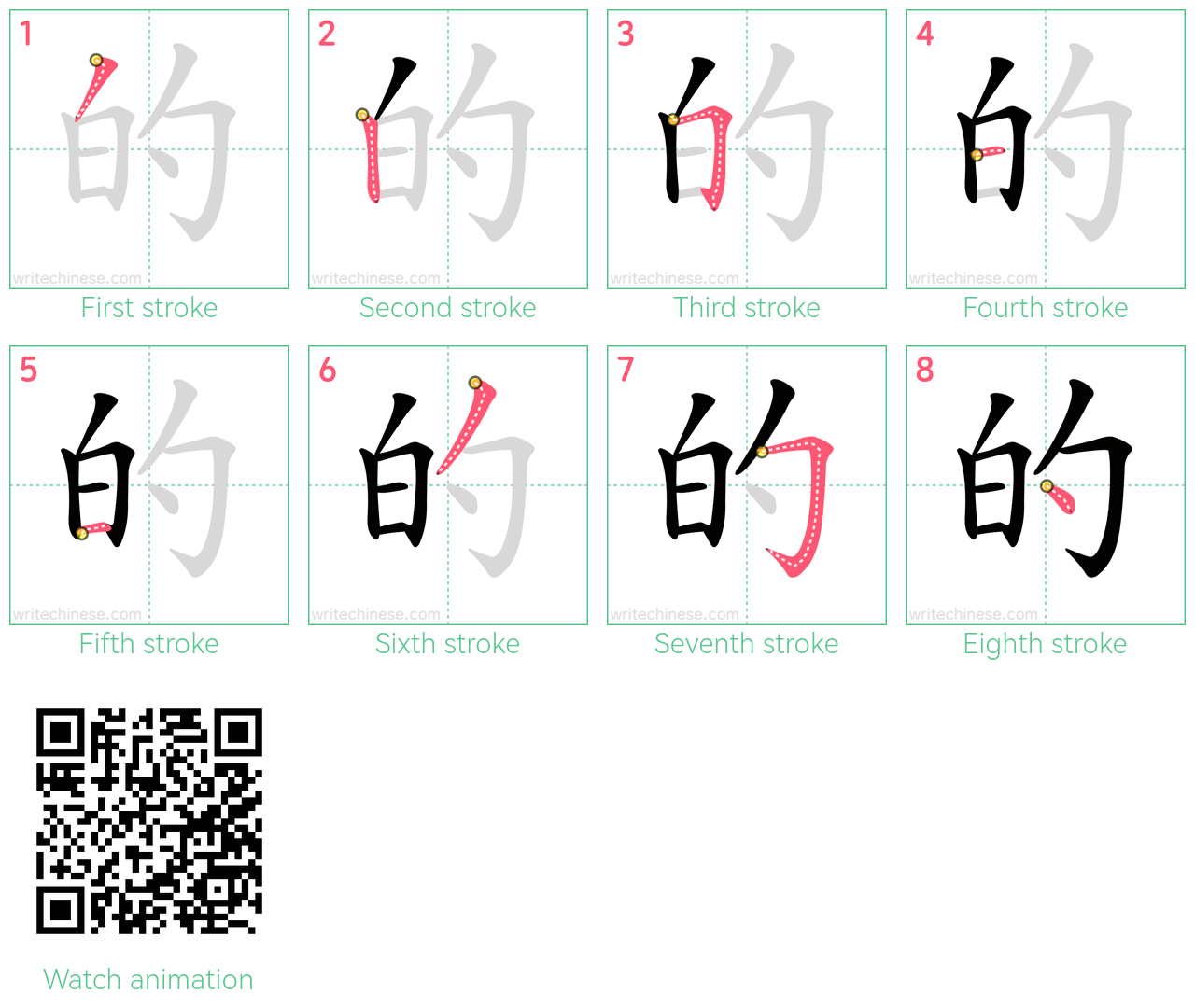
Take some time to practice writing the character, focusing on the correct stroke order and the proportions of the two components.
2. The Grammar of Possession with 的 (de)
The most fundamental use of 的 (de) is to show possession or a relationship between two nouns. It functions much like the English possessive "'s" (e.g., "the student's mountain") or possessive adjectives ("my," "your," "her").
The grammatical structure is straightforward and consistent:
This can also be expressed as:
To see this explained and hear the pronunciation from a native speaker, please watch the following short video.
how to use 🙌的de(Chinese grammar)| Learn Mandarin Chinese with Yimin
The video 'how to use 的 de' from Yimin Chinese introduces 的 as the most used character and clearly explains its first function, which is to show possession or connect a modifier to a noun.
Watch from the beginning to 01:49. Pay attention to how the speaker explains the function of 的 in connecting two parts, specifically in the example '我的电脑' (wǒ de diànnǎo) - my computer.
Now, let's explore this structure in more detail with a reading that provides clear examples.
的 in Chinese || How To Use the Chinese Possessive Particle
The article '的 in Chinese || How To Use the Chinese Possessive Particle' from Flexi Classes offers a very clear breakdown of this grammatical pattern.
Please read the following sections: 'HOW TO USE 的?': Focus on the pattern 'Noun / Pronoun + 的 + Noun' and the examples in the table (我的, 你的, 他的). You can click the 'Play' button next to them to hear the audio. '的 WITH RELATIONSHIPS': Note how this pattern extends to relationships like '我的老师' (my teacher). 'THE EXCEPTION: CLOSE RELATIONSHIPS': This is an important rule for sounding natural. Pay close attention to when 的 is omitted.
Key Usage Points
Based on the resources, let's solidify the rules:
-
Basic Possession: You combine a pronoun or noun with 的 to show ownership.
我 (wǒ) + 的 = 我的 (wǒ de)→ my/mine你 (nǐ) + 的 = 你的 (nǐ de)→ your/yours她 (tā) + 的 = 她的 (tā de)→ her/hers
-
The Exception for Close Relationships: As noted in the reading, for very close personal relationships (like immediate family) or affiliations (like your school or company), 的 is usually omitted.
我妈妈(wǒ māma) - my mom (Correct)我的妈妈(wǒ de māma) - (Grammatical, but sounds distant or overly formal)你哥哥(nǐ gēge) - your older brother (Correct)
For now, just be aware of this exception. We will apply it more as we learn family vocabulary. For all other possessions, including the ones we'll practice with today, you should use 的.
3. Practice
Let's combine this new structure with the vocabulary you've learned in previous lessons.
Examples:
- My person:
我的人(wǒ de rén) - Your student:
你的学生(nǐ de xuésheng) - His mountain:
他的山(tā de shān) - China's people (or Chinese people):
中国的人(zhōngguó de rén)
Now, try to form these phrases yourself. Write down the characters and the pinyin.
- My student
- Your mountain
- Her person
- Our people (plural 'we' is
我们 wǒmen)
Answers:
我的学生(wǒ de xuésheng)你的山(nǐ de shān)她的人(tā de rén)我们的人(wǒmen de rén)
Conclusion
In this lesson, you've mastered the first and most important function of the character 的 (de). Its role in indicating possession is essential for building more complex phrases.
Key Takeaways:
- The character 的 (de) is a neutral-tone particle composed of the radicals 白 (bái) and 勺 (sháo).
- Its primary function is to show possession, following the simple and reliable structure:
Possessor + 的 + Possessed Item. - This is equivalent to the English "'s" or possessive adjectives like "my," "your," etc.
- An important exception exists for close relationships, where 的 is often omitted to convey closeness.
Preview of the Next Lesson:
The particle 的 (de) is incredibly versatile. You've now learned how to use it for possession (我的学生 - my student). In our next lesson, we will explore its second major function: linking adjectives to nouns to create descriptive phrases, such as 好的学生 (hǎo de xuésheng - a good student). This will allow you to combine what you learned about adjectives with your new knowledge of 的, significantly expanding your descriptive abilities.