Hello! Welcome back.
In our last few lessons, we analyzed and learned to write the characters for two fundamental actions: 吃 (chī), to eat, and 喝 (hē), to drink. You saw how both are phono-semantic compounds, logically combining a "mouth" radical (口) for meaning with a component for sound.
Today, we will learn the characters for the objects of these actions: 饭 (fàn), meaning "rice" or "meal," and 茶 (chá), meaning "tea." This will allow you to form your first verb-object phrases, a significant step in building sentences. We will continue to use the analytical approach, breaking down each character into its structural components.
1. The Character for Meal: 饭 (fàn)
First, let's learn the character for the food you eat.
- Pinyin: fàn (fourth tone, a sharp, falling sound)
- Meaning: cooked rice; meal
Like the characters for eating and drinking, 饭 (fàn) is also a phono-semantic compound with a left-right structure: ⿰饣反.
Analyzing the Structure: 饭 (fàn)
-
Semantic Component (Meaning): The component on the left is 饣. This is the "food" radical. It is a simplified version of the character 食 (shí), which means "food" or "to eat." Whenever you see the 饣 radical, it's a very strong indicator that the character's meaning is related to food, eating, or drink. This is the first time we are formally encountering this important radical.
-
Phonetic Component (Sound): The component on the right is 反 (fǎn). By itself, this character is pronounced
fǎn(third tone) and means "opposite" or "reverse." Its purpose here is to give a clue to the pronunciation of 饭. The similarity betweenfǎnandfànis clear.
So, when you see 饭, you can decode it as: "It's related to food (饣) and sounds like fǎn (反)." This is the logic of phono-semantic compounds at work.
The following resource provides a good summary of this structure and offers practice tools.
饭fàn - English Meaning | HSK 1 - Mandarin Temple
The Mandarin Temple page for 饭 provides a complete breakdown of the character's etymology, components, and usage.
Please read the sections titled 'Pronunciation', 'Etymology of 饭 fàn', and '饭 fàn Decomposition'. The etymology section confirms its 'Phonetic compound' nature, identifying the food radical and the phonetic part. The decomposition section visually separates the components for you.
Writing 饭 (fàn)
The character 饭 is written with 7 strokes. Following the left-to-right rule, you write the 饣 radical first (3 strokes), followed by the 反 component (4 strokes).
This image breaks down the process:
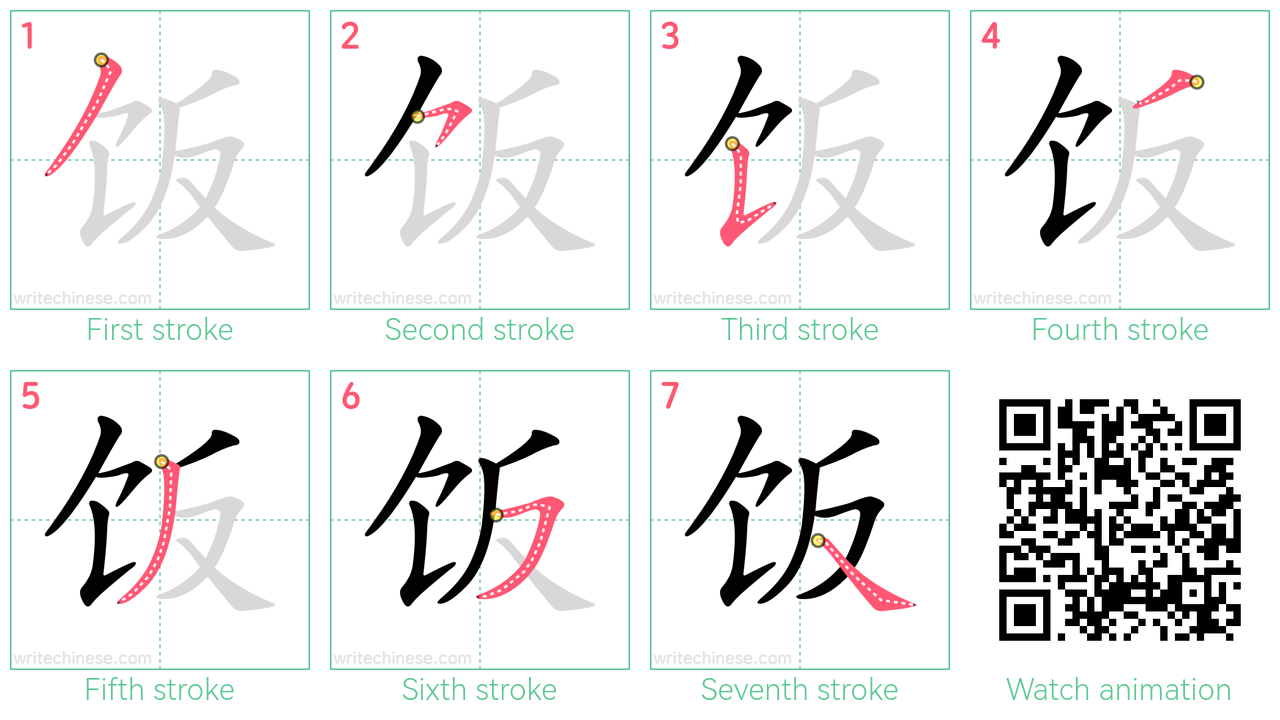
Now, take some time to practice writing the character. A solid muscle memory for stroke order is key.
饭fàn - English Meaning | HSK 1 - Mandarin Temple
Return to the Mandarin Temple resource to use its interactive writing tool. This will give you immediate feedback on your stroke order.
Navigate to the 'Write it!' section on the page. Click 'Show Strokes' to see the animation, then click 'Start Drawing' to practice writing the character directly on the screen. Repeat this until you feel comfortable with the sequence.
2. The Character for Tea: 茶 (chá)
Now for the object of 喝 (hē, to drink): tea. Given your interest in international relations and history, you'll find the story behind this character particularly interesting.
- Pinyin: chá (second tone, a rising sound)
- Meaning: tea
Let's look at its structure first. 茶 (chá) has a top-bottom structure. The top component is the "grass" radical (艹), which you've seen before, indicating a connection to plants. The bottom part, 余, provides the phonetic hint.
The Etymology of 茶 (chá)
The history of this character is a great example of how written language evolves to become more precise. The following video explains this evolution, from its linguistic origins to the simplification that gave us the modern character.
This short video from SwedishSinologyNerd, titled 'Chinese Etymology 茶 - "Tea"', details the fascinating history of the character, which aligns perfectly with your analytical interests.
Please watch the segment from 02:20 to 03:56. It explains how the original character was used for both 'tea' and 'bitter plants' and how, during the Tang Dynasty, it was split into two distinct characters to resolve the ambiguity. This is a perfect illustration of language evolving for clarity.
Writing 茶 (chá)
The character 茶 has 9 strokes. The writing order follows the top-to-bottom principle:
- Write the grass radical (艹) at the top (3 strokes).
- Write the component below, which looks like a combination of 人 (person) and 木 (wood). You write the 人-like strokes first (2 strokes), then the 木 at the very bottom (4 strokes).
This image shows the correct sequence:
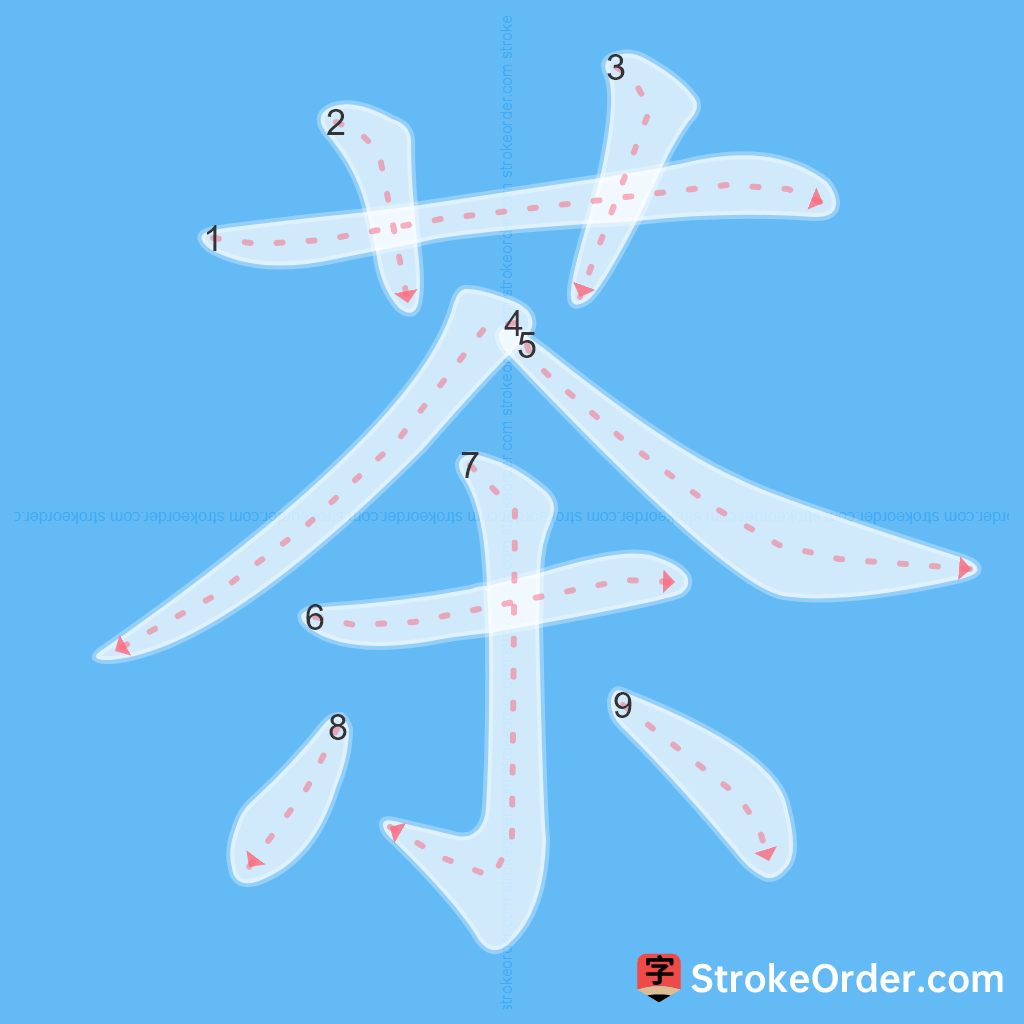
To see the character written fluidly, you can use the animated guide in the resource below. It also provides an audio clip for the pronunciation.
English translation of 茶 ( cha / chá ) - tea in Chinese
The HanTrainerPro dictionary entry offers a clean animation for stroke order and a clear audio recording.
First, listen to the pronunciation under 'Listen to pronunciation'. Then, observe the 'stroke order animation' multiple times. Notice how the three components (艹, 人, 木) are written in a top-down sequence. Finally, practice writing the character on paper several times.
3. Forming Your First Words
You have now mastered the individual characters for "eat," "drink," "meal," and "tea." In Chinese, combining a verb and its object is often as simple as placing them side-by-side. You can now recognize and write two very common words:
- 吃饭 (chī fàn): to eat a meal
- 喝茶 (hē chá): to drink tea
This demonstrates the power of your "characters before words" approach. By understanding the building blocks, forming and understanding words becomes a logical next step rather than an act of pure memorization.
Conclusion
In this lesson, you've added two essential nouns to your vocabulary, completing the set required for basic "eating" and "drinking" phrases.
Key Takeaways:
- 饭 (fàn): Means "rice" or "meal." It's a phono-semantic compound using the food radical (饣) for meaning and 反 (fǎn) for sound.
- 茶 (chá): Means "tea." It's a compound character with the grass radical (艹) on top, indicating it is a plant, and a phonetic component below. Its form was standardized to distinguish it from a similar character meaning "bitter."
- You can now form basic verb-object words: 吃饭 (chī fàn) and 喝茶 (hē chá).
Preview of the Next Lesson:
You've learned the characters and the two-character words. The next logical step is to place them into full sentences. In our next lesson, we will officially introduce simple sentence structures, allowing you to say things like "I am drinking tea" or "He is eating a meal." We will learn how to form these simple verb-object sentences using the pronouns (我,你, 他) and verbs (吃, 喝) you already know.