Hello! Welcome back to our course.
In the last lesson, we completed our first verb-object pairs by learning the characters for "meal," 饭 (fàn), and "tea," 茶 (chá). You combined them with the verbs you already knew to form the words 吃饭 (chī fàn) and 喝茶 (hē chá).
Today, we'll take the final and most rewarding step: using these components to build complete, meaningful sentences. This lesson focuses on the fundamental grammatical structure that underpins most of Mandarin Chinese. By the end, you'll be able to form simple but complete statements about eating and drinking, putting your systematically acquired knowledge into practice.
1. The Core of Chinese Grammar: Subject-Verb-Object (SVO)
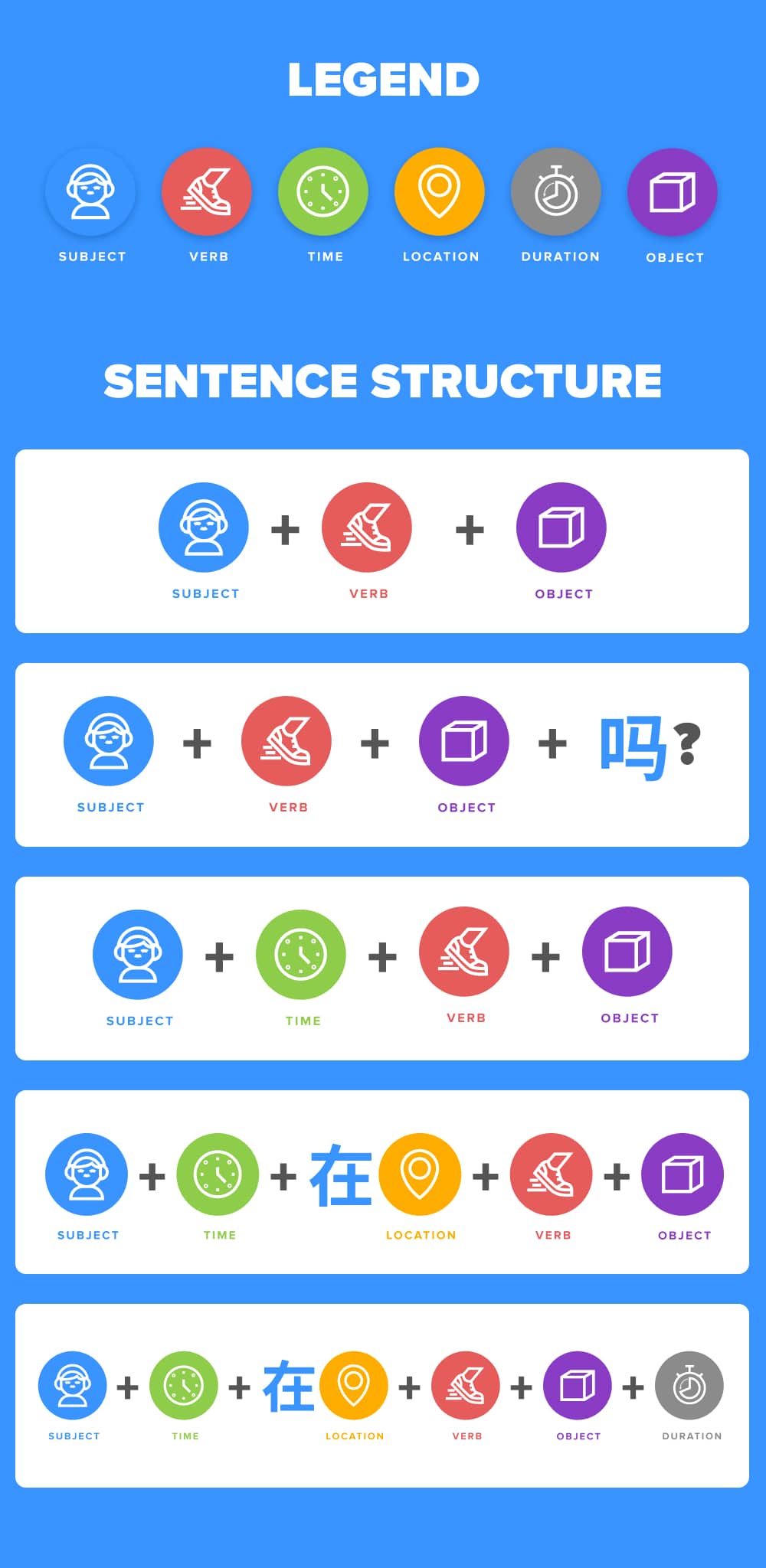
One of the most helpful aspects of basic Chinese grammar for English speakers is that its most common sentence structure is the same: Subject + Verb + Object (SVO).
- Subject: The person or thing performing the action (e.g., 我, 你, 他).
- Verb: The action being performed (e.g., 吃, 喝).
- Object: The person or thing receiving the action (e.g., 饭, 茶).
Let's start with a short, clear video that introduces this concept.
Chinese Sentence Structure ~ Learn Basic Grammar!
The video 'Chinese Sentence Structure ~ Learn Basic Grammar!' from the ABChinese channel provides an excellent introduction to the SVO structure. It confirms that the word order is very similar to English, which is a great starting point.
Please watch from 00:19 to 01:20. Pay close attention to the example '她吃饭' (tā chī fàn - she eats food), as it uses a verb and object you know very well.
As the video explained, the structure is straightforward. To reinforce this, let's look at a textual resource that breaks it down with more examples.
How to Build a Chinese Sentence: Subject + Verb + Object (SVO)
The article 'How to Build a Chinese Sentence: Subject + Verb + Object' from ChineStudy offers a clear, table-based breakdown of the SVO structure.
Read the sections 'What Is Subject + Verb + Object?' and 'More Examples'. Notice the example '他喝茶' (Tā hē chá) – 'He drinks tea'. This directly applies the grammar rule to the characters we've learned.
This SVO pattern is the bedrock of many sentences you will form. Here is a helpful visual summary of this basic structure.
2. Forming Your First Sentences
Now, let's combine the grammar rule with the characters you have mastered.
Recall your building blocks:
- Subjects (Pronouns): 我 (wǒ), 你 (nǐ), 他 (tā), 她 (tā)
- Verbs: 吃 (chī), 喝 (hē)
- Objects: 饭 (fàn), 茶 (chá)
By assembling them in the Subject + Verb + Object order, you can now form complete sentences.
| Subject | Verb | Object | Pinyin | Translation |
|---|---|---|---|---|
| 我 | 吃 | 饭 | Wǒ chī fàn. | I eat a meal. |
| 你 | 喝 | 茶 | Nǐ hē chá. | You drink tea. |
| 他 | 吃 | 饭 | Tā chī fàn. | He eats a meal. |
| 她 | 喝 | 茶 | Tā hē chá. | She drinks tea. |
Notice how logical and direct this is. There are no verb conjugations (like "eat" vs. "eats") or articles ("a," "the") to worry about in these basic sentences. The meaning is conveyed purely by the characters and their order.
This is the payoff for your structured learning approach: once you understand the components (characters) and the rule for combining them (grammar), you can immediately generate new, correct sentences.
3. Practice
Let's test your understanding. Based on the SVO rule and the vocabulary you know, try to construct the following sentences in Chinese. Write them down on paper.
- I drink tea.
- He eats a meal.
- You eat a meal.
- She drinks tea.
Pause here and write down your answers before proceeding.
Answers:
- 我喝茶。 (Wǒ hē chá.)
- 他吃饭。 (Tā chī fàn.)
- 你吃饭。 (Nǐ chī fàn.)
- 她喝茶。 (Tā hē chá.)
This exercise demonstrates your ability to not just recognize but actively produce correct Chinese sentences.
Conclusion
In this lesson, you took a major step forward by learning the fundamental Subject + Verb + Object sentence structure. This allowed you to move from individual characters and two-character words to forming complete, meaningful thoughts.
Key Takeaways:
- The basic word order in a simple Chinese sentence is Subject + Verb + Object (SVO), just like in English.
- By combining the pronouns (我, 你, etc.), verbs (吃, 喝), and nouns (饭, 茶) you've learned, you can now form complete sentences.
- Examples like 我吃饭 (Wǒ chī fàn) and 你喝茶 (Nǐ hē chá) illustrate this core grammatical principle in action.
Preview of the Next Lesson:
We will continue expanding your vocabulary by introducing a new, high-frequency verb: 说 (shuō), which means "to speak." As always, we will begin by analyzing the character's structure, identifying its radical and phonetic components, before learning how to use it in sentences.