Hello! Welcome back to your study of Mandarin.
In our last lesson, we took a deep dive into the character 吃 (chī), "to eat." You learned how to deconstruct it into its semantic component, the 'mouth' radical 口 (kǒu), and its phonetic component, 乞 (qǐ). This analytical method is the core of our approach to mastering characters.
Today, we will continue with this method to learn another essential verb. Our focus is on the character for "to drink." By applying the same logic as last time, you'll see how patterns emerge in character construction, making them easier to recognize and remember.
1. Deconstructing 喝 (hē): Another Phono-Semantic Compound
Following the action of eating is, quite naturally, drinking. The character for this is 喝 (hē).
- Pinyin: hē (first tone, a high, level sound)
- Meaning: to drink
Just like 吃 (chī), 喝 (hē) is a phono-semantic compound with a left-right structure. Let's break it down: ⿰口曷.
-
Semantic Component (Meaning): On the left, you see our familiar friend, the radical 口 (kǒu). As you now know, its presence is a strong clue that the character's meaning is related to the mouth or an action performed with it. This immediately connects the character's form to the concept of drinking.
-
Phonetic Component (Sound): On the right is the character 曷. By itself, it is pronounced
hé(second tone). Its function here is to provide the phonetic clue for 喝. Notice how similarhéis tohē. This is a very clear example of how a phonetic component guides you to the correct pronunciation.
To confirm this analysis and explore the character's origin, please review the following resource.
喝 hē - English Meaning | HSK 1 - Mandarin Temple
The Mandarin Temple page for 喝 provides a concise etymological breakdown that perfectly illustrates the phono-semantic structure we just discussed.
Please read the sections 'About 喝 hē' and 'Etymology of 喝 hē'. Note how it explicitly identifies the character as a 'pictophonetic' type, listing 口 (kǒu) as the semantic compound and 曷 (hé) as the phonetic compound. The Pinyin for 喝 also has another, less common reading, 'hè', which usually means 'to shout'. For now, we will focus exclusively on the primary HSK 1 meaning, 'to drink' (hē).
By recognizing this 口 + 曷 pattern, you are no longer memorizing a complex symbol; you are decoding a logical puzzle.
2. Writing 喝 (hē): Stroke by Stroke
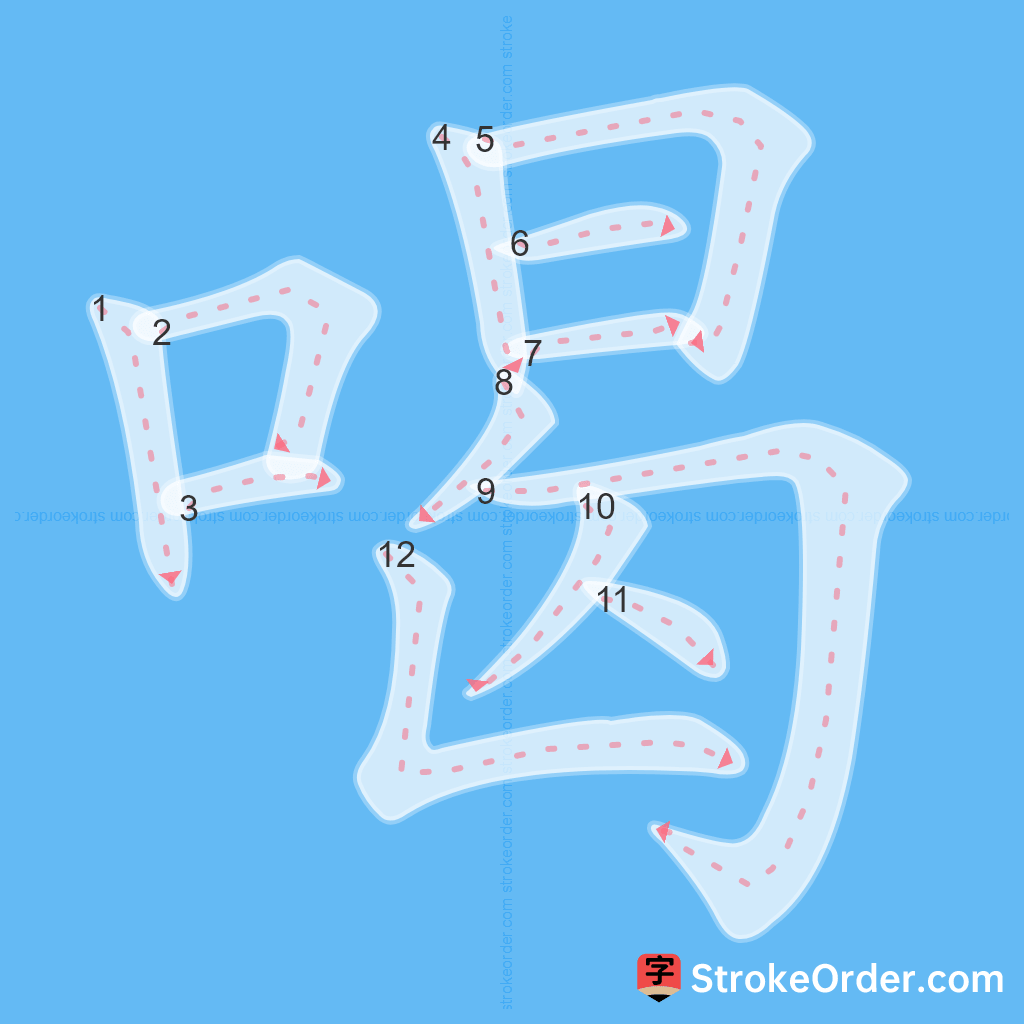
Now that you understand its components, let's learn how to write 喝. The character has a total of 12 strokes. We will follow the fundamental stroke order rules you've been practicing:
- Left to right: First, complete the left-side component, 口.
- Top to bottom: Then, write the right-side component, 曷, starting from its top strokes and working your way down.
The image below provides a clear, step-by-step guide.
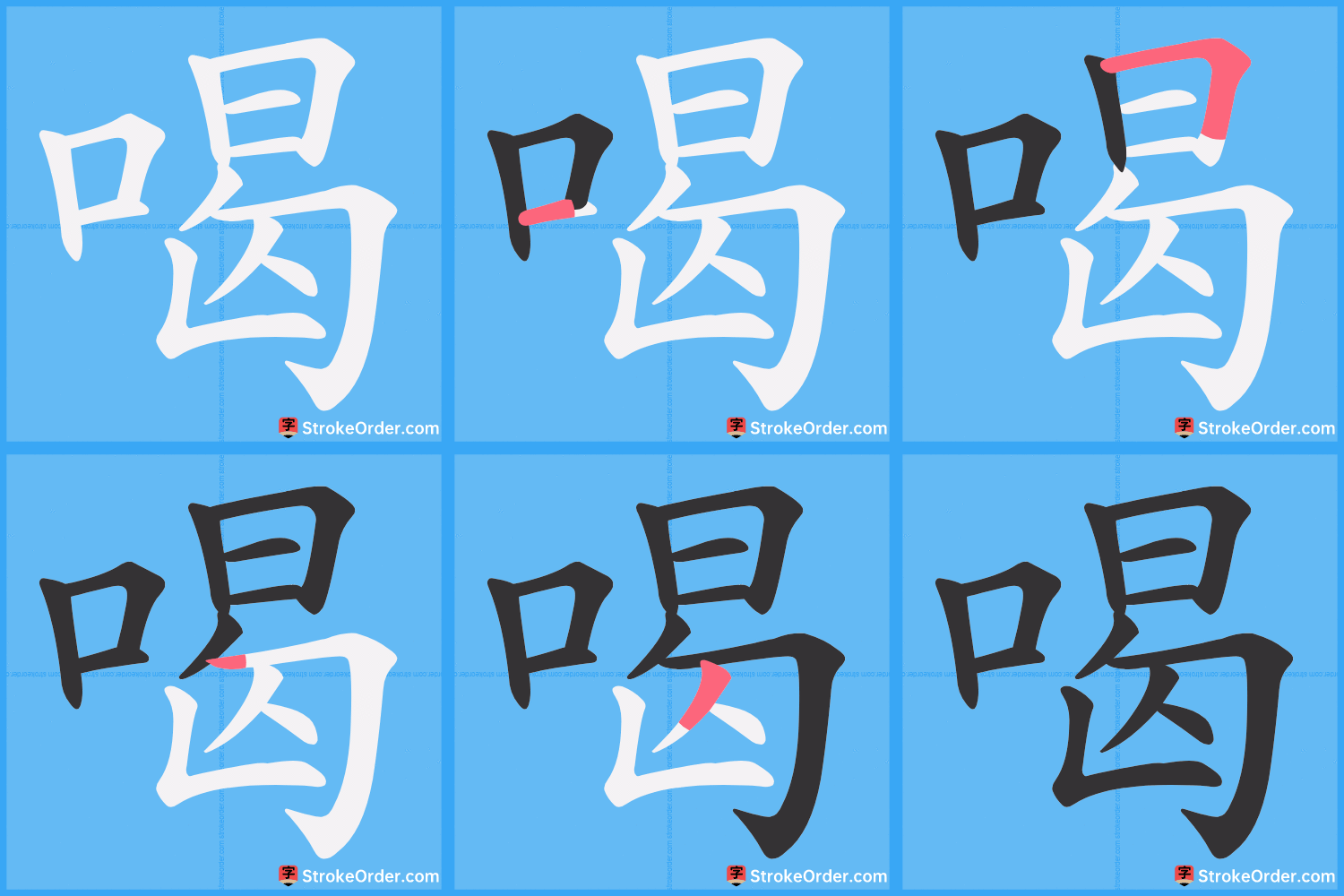
To see the strokes in motion and get a feel for the writing process, please observe the animation below.
With the structure and stroke order in mind, it's time to practice. The following resource offers excellent tools for this.
Learn how to write 喝 through stroke order & printable worksheets
The WriteChinese.com page for 喝 offers an animated guide and printable worksheets, which are ideal for building muscle memory.
First, watch the 'Animated Stroke Order of 喝' again to reinforce the pattern. Then, I recommend downloading and printing one of the 'Free Printable 喝 Handwriting Practice Worksheets'. Use it to practice writing the character several times, focusing on keeping the components balanced and the strokes in the correct order.
Consistent practice with the correct stroke order is crucial for developing legible and natural handwriting.
Conclusion
In this lesson, you've successfully analyzed and learned to write your second major verb. By applying the same deconstruction method we used for 吃 (chī), you've reinforced a powerful pattern for learning new characters.
Key Takeaways:
- The character 喝 (hē) means "to drink" and is pronounced with the first tone.
- It is a phono-semantic compound (⿰口曷) composed of a meaning component and a sound component.
- The radical 口 (kǒu) on the left provides the semantic clue (related to the mouth).
- The component 曷 (hé) on the right provides the phonetic clue (sound).
- 喝 is written with 12 strokes, following the left-to-right and top-to-bottom principles.
Preview of the Next Lesson:
You have now learned the characters for "to eat" (吃) and "to drink" (喝). Logically, the next step is to learn the characters for what you eat and drink. In our next lesson, we will learn to recognize and write 饭 (fàn, rice/meal) and 茶 (chá, tea). This will enable you to start forming simple, meaningful verb-object phrases like 吃饭 (to eat a meal) and 喝茶 (to drink tea).