Hello! Welcome back to your Chinese course.
In our last lesson, we focused on conversation skills, specifically how to answer the questions you've learned to ask. You now know how to affirm or deny a statement by repeating the verb and how to answer "what" questions by replacing 什么 (shénme) with the new information.
Today, as promised, we are pivoting back to the foundational building blocks of the language: the characters. We'll begin Module 9, which focuses on common action verbs. Our goal for this lesson is to learn your first major verb character: 吃 (chī), which means "to eat." True to your analytical learning style, we won't just memorize it. We'll break it down by first examining its most important component, the 口 (kǒu) or "mouth" radical, which you've seen before.
1. The Semantic Clue: The 'Mouth' Radical - 口 (kǒu)
Many actions are closely associated with a part of the body. Logically, characters for actions like eating, drinking, or speaking often contain the radical for "mouth," which is 口 (kǒu). You've already encountered this character when we learned numbers, but now let's analyze it as a radical.
As a standalone character, 口 is a pictograph that originally looked like an open mouth. It is pronounced kǒu (third tone).
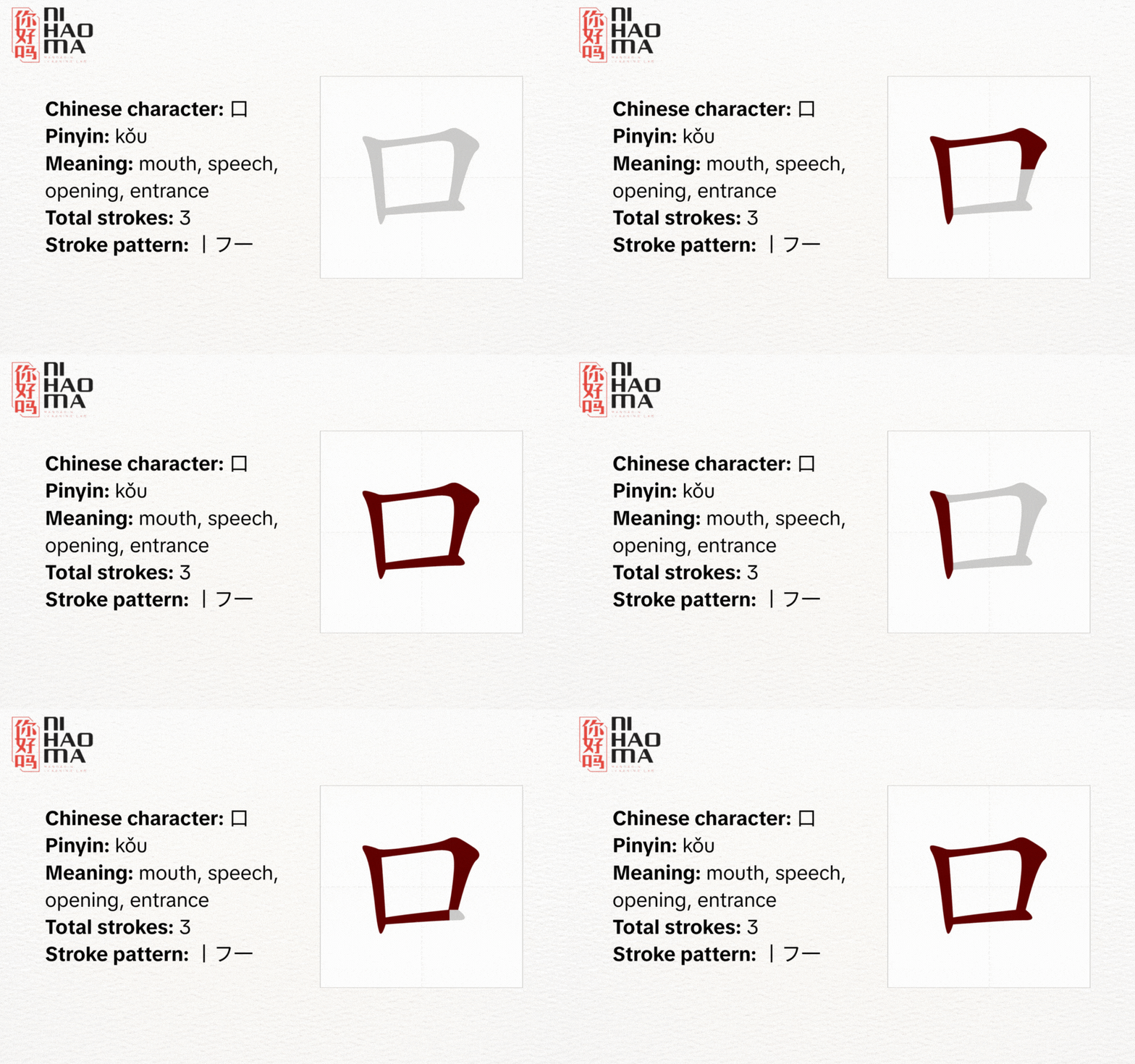
To deepen your understanding of how this radical functions, please watch the following short video. It explains the radical's origin, how to write it, and how it provides meaning to other characters.
Chinese Radical #3: 口 (mouth) 👄 Dinara Min School ✌
This video from Dinara Min School provides an excellent overview of the 口 radical. It covers its history, stroke order, and function, which aligns perfectly with our analytical approach.
Please watch from the beginning to 02:04. Pay attention to three key points: The stroke order for drawing the 口 radical (0:17). The historical reason why the character became a square (1:07). How it provides a semantic (meaning-based) clue in other characters (1:50).
The key takeaway is that when you see the 口 radical in a character, it's a strong hint that the character's meaning is related to the mouth, speech, or consumption.
2. Deconstructing 吃 (chī): A Phono-Semantic Compound
Now we're ready to tackle the character 吃 (chī).
- Pinyin: chī (first tone)
- Meaning: to eat
This character is a perfect example of a phono-semantic compound, the most common type of Chinese character. This means it's composed of two parts: one that suggests the meaning (the semantic component) and one that suggests the sound (the phonetic component).
Let's look at the structure of 吃: ⿰口乞
It's a left-right structure.
-
Semantic Component (Meaning): On the left, we have 口 (kǒu), the "mouth" radical. This tells you the character's meaning is related to the mouth, which makes perfect sense for "to eat."
-
Phonetic Component (Sound): On the right, we have the character 乞 (qǐ). Its primary role here is to provide a clue to the pronunciation. While
qǐandchīare not identical, they share a similar "chee" sound. Over centuries of language evolution, the pronunciations of phonetic components and the characters they form often diverge slightly.
The following resource provides a clear breakdown of this structure.
吃 chī - English Meaning | HSK 1 - Mandarin Temple
The Mandarin Temple dictionary entry for 吃 provides a concise etymological breakdown of the character.
Please scroll down to the 'Etymology of 吃 chī' and '吃 chī Decomposition' sections. Notice how it explicitly labels 吃 as a 'pictophonetic' (another term for phono-semantic) character and identifies 口 as the semantic compound and 乞 as the phonetic compound.
Understanding this phono-semantic structure is a powerful tool. It turns character learning from pure memorization into a logical decoding process.
3. Writing 吃 (chī)
With your understanding of the components, let's learn to write the character. It consists of 6 strokes. Following the fundamental left-to-right stroke order rule, you write the 口 component first, followed by the 乞 component.
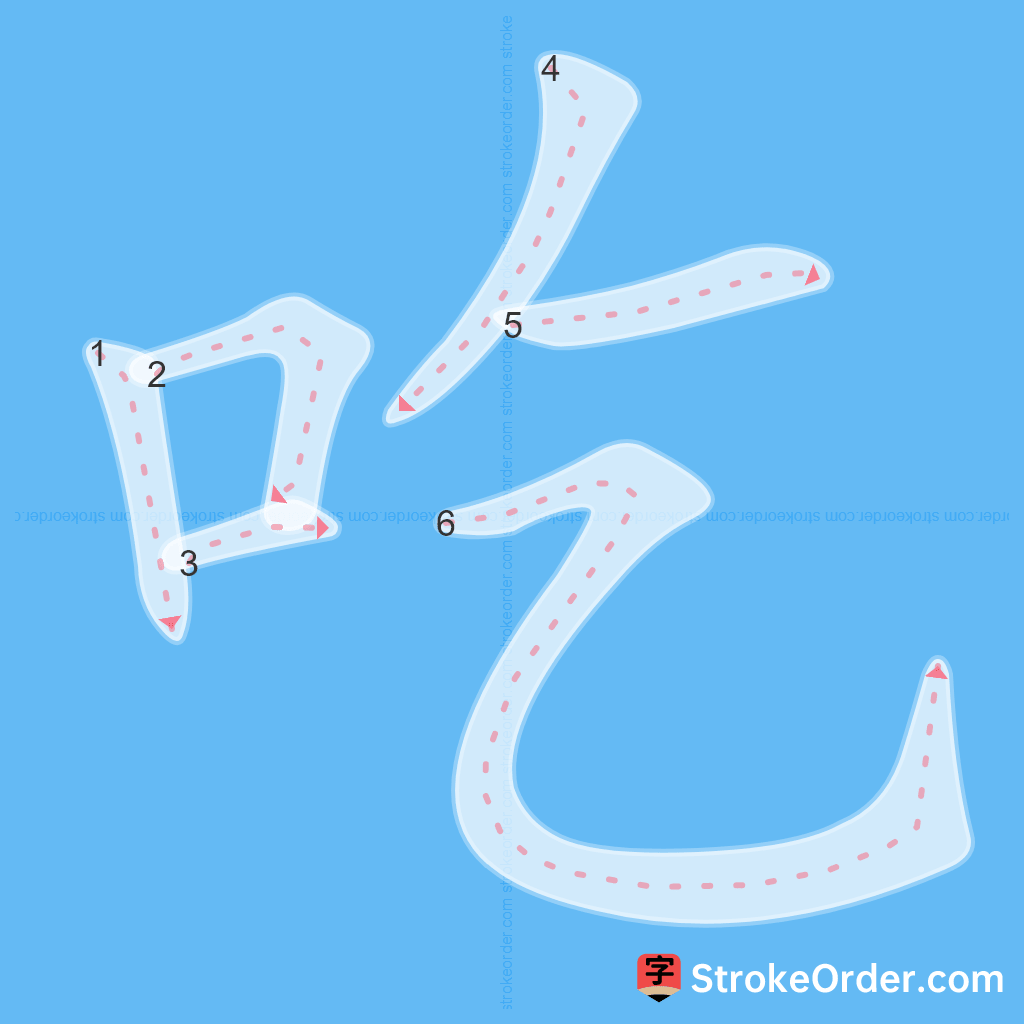
For a dynamic demonstration and further practice, the resource below is very helpful.
The StrokeOrder.com website provides excellent animated and static guides for writing characters. It's a great tool for mastering the correct form.
On this page, observe the 'Animated Stroke Order of 吃' to see the flow of writing. Then, use the static diagrams and the downloadable worksheet (if you wish) to practice writing the character yourself. Internalizing the stroke order is key to writing balanced and legible characters.
Spend some time practicing. The muscle memory you build from correct stroke order will be invaluable as you learn more complex characters.
Conclusion
In this lesson, you have learned your first major verb character by dissecting its components and structure. This analytical method will be our guide for all future character learning.
Key Takeaways:
- The character 吃 (chī) means "to eat" and is pronounced with the first tone.
- It is a phono-semantic compound with a left-right structure.
- The radical 口 (kǒu) is the semantic component, indicating the meaning is related to the mouth.
- The character 乞 (qǐ) is the phonetic component, providing a clue to its pronunciation.
- The character is written with 6 strokes, following the left-to-right rule.
Preview of the Next Lesson:
We will continue exploring verbs related to the mouth. In the next lesson, you will learn to recognize and write 喝 (hē), the character for "to drink." We will apply the same analytical process, identifying its semantic radical and phonetic component to make learning it just as logical.