Hello! Welcome back to our lesson.
In our previous session, you learned how to use the verb 说 (shuō) to form sentences about speaking languages, like 她说英文 (Tā shuō Yīngwén), and how to negate them with 不 (bù). This gave you a solid grasp of the basic Subject-Verb-Object sentence structure.
Today, we will add a crucial new element to your grammatical toolkit: measure words. Specifically, you will learn to recognize and write the most common measure word, 个 (gè), and use it to count nouns. This is a fundamental concept in Chinese and will allow you to build more descriptive and precise noun phrases, moving from saying "person" (人) to "one person" (一个人).
1. The Concept of Measure Words in Chinese
In English, we sometimes use counters or measure words for specific nouns, such as "a sheet of paper" or "two loaves of bread." However, for most simple objects, we don't: we just say "three students."
In Mandarin Chinese, this concept is universal. Every time you count a noun with a number, you must include a measure word. The general structure is always:
Number + Measure Word + Noun
To understand this core rule and to be introduced to the most important measure word, 个 (gè), please watch the following short video clip.
Chinese Measure Words 量词 - Chinese Grammar Simplified 205
This explanation from the Twin Cities Chinese Tutor channel clearly outlines the role of measure words and introduces '个' (gè) as the most common one.
Please watch from 01:55 to 03:08. Focus on two key ideas: Unlike English, Chinese uses a measure word for every noun you count. '个' (gè) is the most common and versatile measure word, making it a safe and useful default.
As the video explains, if you're ever unsure which specific measure word to use for a noun, 个 (gè) is often a correct, or at least understandable, choice.
Given your preference for analytical understanding, you might ask: why this specific character, 个? Its original meaning provides the answer.
Explain why MEASURE WORD in Chinese and HOW to remember them fast !
This clip from Yimin Chinese explains the logic behind why '个' became the general-purpose measure word.
Watch from the beginning until 01:24. The key insight is that the character '个' originally meant 'individual.' This directly connects to its modern function of counting individual people or items.
So, to summarize: when counting individual things—people, teacups, schools—you will use 个 (gè).
2. Writing and Analyzing the Character: 个 (gè)
Now, let's break down the character itself, following our "components before characters" principle.
个
- Pinyin: gè
- Tone: 4th (falling)
- Meaning: "individual"; the general measure word
- Strokes: 3
The character is simple and combines elements you've seen before. It is composed of the 人 (rén) radical at the top, which you know means "person," and a vertical stroke 丨 (shù) below it. You can think of this as representing an "individual person," which aligns perfectly with its original meaning.
Let's watch the stroke order.
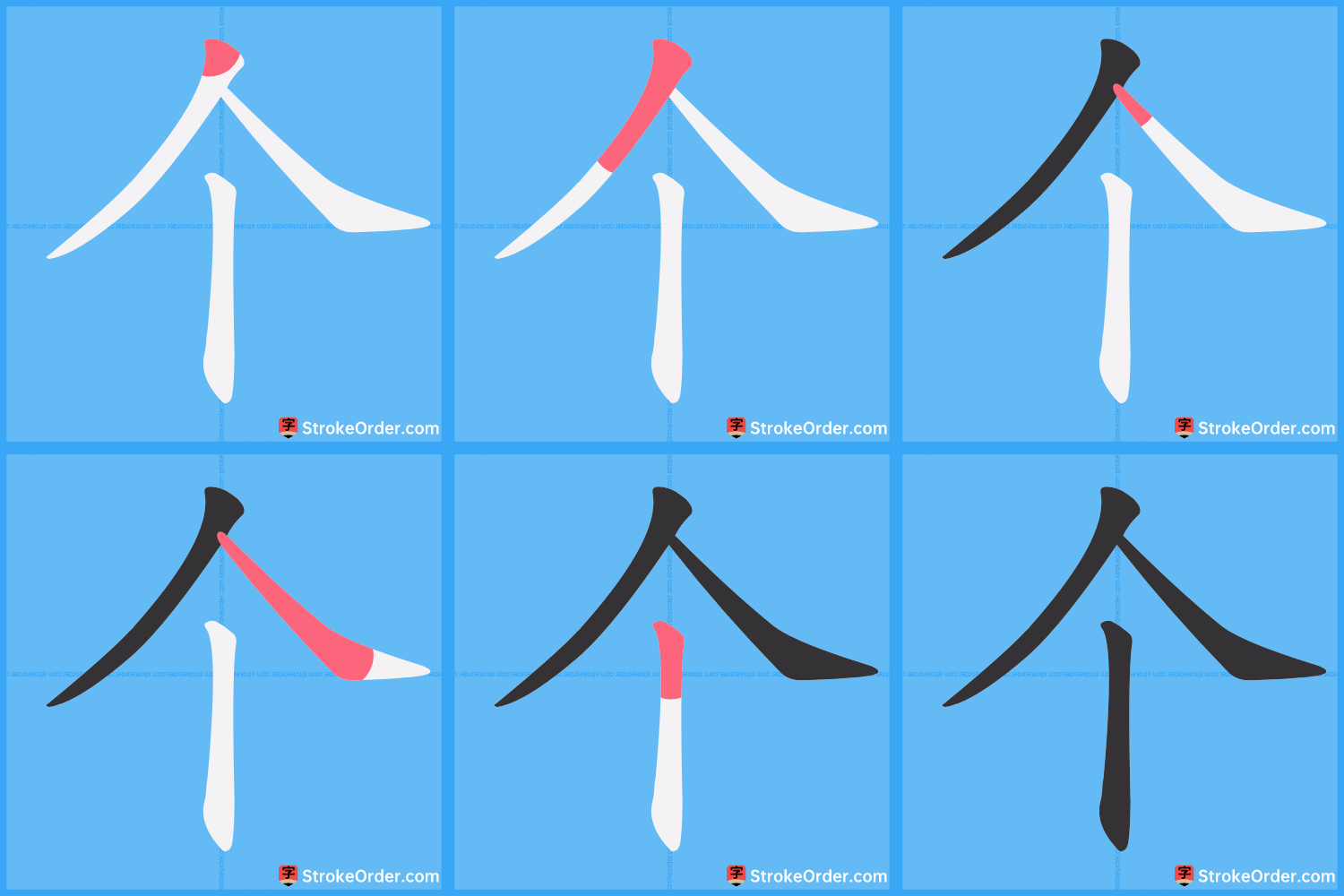
To practice writing it yourself, you can use a worksheet.
How to Write 个 - Chinese Stroke Order
The website Hanzi Stroke provides excellent resources for practicing character writing. We'll use their page for '个' to guide your practice.
Please visit the resource and use the following sections: Animated Stroke Order: Review the animation at the top of the page. Stroke Order Diagrams: Look at the static diagrams below the animation to see each step clearly. Free Printable Handwriting Practice: You can download the worksheet here to practice writing the character on paper. \nSpend about 10-15 minutes practicing until you are comfortable with the character's form and stroke order.
3. Using 个 (gè) in Phrases
Now we will combine everything you know to form 'number + gè + noun' phrases. Remember the characters for numbers one to ten from our early lessons?
- 一 (yī), 二 (èr), 三 (sān), 四 (sì), 五 (wǔ), 六 (liù), 七 (qī), 八 (bā), 九 (jiǔ), 十 (shí)
And recall the nouns you've learned:
- 人 (rén) - person
- 学生 (xuéshēng) - student
Let's build some phrases:
- 一个人 (yí ge rén) - one person
- Tone Change Alert: Remember the tone sandhi for 一 (yī). When it comes before a 4th tone syllable like gè, its own tone changes from 1st to 2nd: yī → yí. The pinyin for 个 (gè) becomes neutral in rapid speech, written as
ge. So, you will hear and say yí ge rén.
- Tone Change Alert: Remember the tone sandhi for 一 (yī). When it comes before a 4th tone syllable like gè, its own tone changes from 1st to 2nd: yī → yí. The pinyin for 个 (gè) becomes neutral in rapid speech, written as
- 三个学生 (sān ge xuésheng) - three students
- 十个人 (shí ge rén) - ten people
4. Practice: Forming Phrases and Sentences
Let's put this new structure into practice.
Activity 1: Form the Phrases
Translate the following English phrases into Chinese characters. Say them aloud, paying close attention to the tones.
- two students
- five people
- one student
(Take a moment to write your answers.)
Answers
- 二个学生 (èr ge xuésheng) or 两个学生 (liǎng ge xuésheng)
- Note: When counting "two" of something, it is more common in spoken Chinese to use 两 (liǎng) instead of 二 (èr). We haven't formally learned 两 yet, but it's good to be aware of. For now, 二个 is grammatically correct and understandable.
- 五个人 (wǔ ge rén)
- 一个学生 (yí ge xuésheng)
Activity 2: Use in a Sentence
Now, let's integrate these phrases into the sentence patterns you already know. For example, using the verb 有 (yǒu, to have).
- 我家有三个人。 (Wǒ jiā yǒu sān ge rén.) - My family has three people.
- 他们有十个学生。 (Tāmen yǒu shí ge xuésheng.) - They have ten students.
Try forming this sentence:
- I have one student.
(Take a moment to write your answer.)
Answer
- 我有一个学生。 (Wǒ yǒu yí ge xuésheng.)
Conclusion
Excellent work today. You've mastered a critical piece of Chinese grammar that will appear in almost every conversation.
Key Takeaways:
- Measure Words are Mandatory: When counting a noun in Chinese, you must use a measure word in the structure: Number + Measure Word + Noun.
- 个 (gè) is your Go-To: 个 (gè) is the general-purpose measure word for individual items and people. Its character combines 人 (rén) and 丨 (shù), reflecting its meaning of "individual."
- You can now form quantitative phrases: You are able to construct phrases like 三个学生 (sān ge xuésheng) to specify quantities.
Preview of the Next Lesson:
In our next lesson, we will continue expanding your vocabulary and conversational ability. We will learn the characters for expressing wants, 想 (xiǎng) and 要 (yào), and introduce new question words like 谁 (shéi - who) and 哪 (nǎ - which). You will see that 哪 (nǎ) is also used with measure words (e.g., 哪个人 - which person?), so today's lesson was perfect preparation.