Hello! Welcome back to your Chinese lessons.
In our last session, you learned how to use 想 (xiǎng) to express a desire or wish to do an action, like 我想喝茶 (Wǒ xiǎng hē chá - "I would like to drink tea"). You learned that 想 contains the 'heart' radical (心), suggesting a desire that exists in your mind or as a thought.
Today, we will learn another character for "want": 要 (yào). This character expresses a stronger, more definite need, particularly when you want a physical object. This lesson will focus on recognizing and writing 要 and using it to say you want something directly. This is a crucial skill for everyday situations like ordering food or shopping.
1. The Character 要 (yào): Deconstructing a Need
Let's begin with your preferred analytical approach: breaking down the character 要 (yào) to understand its structure.
- Pinyin: yào
- Tone: 4th (falling)
- Meaning: to want; to need; will/going to
The character 要 is a compound character with a top-bottom structure.
The resource from China Sage provides a concise breakdown of the components that form the character 要.
Please read the first few lines of the page, which identify the two main components that make up the character. You can ignore the 'Related characters' section for now.
As you saw, 要 is composed of:
- Top component: 西 (xī), which means "west."
- Bottom component: 女 (nǚ), which means "woman" (a character you already know).
While the etymological origin is complex, you can think of these components as the building blocks for writing. The character has 9 strokes in total.
Writing 要 (yào)
Mastering the stroke order is essential for writing characters correctly and legibly. Let's look at the sequence.
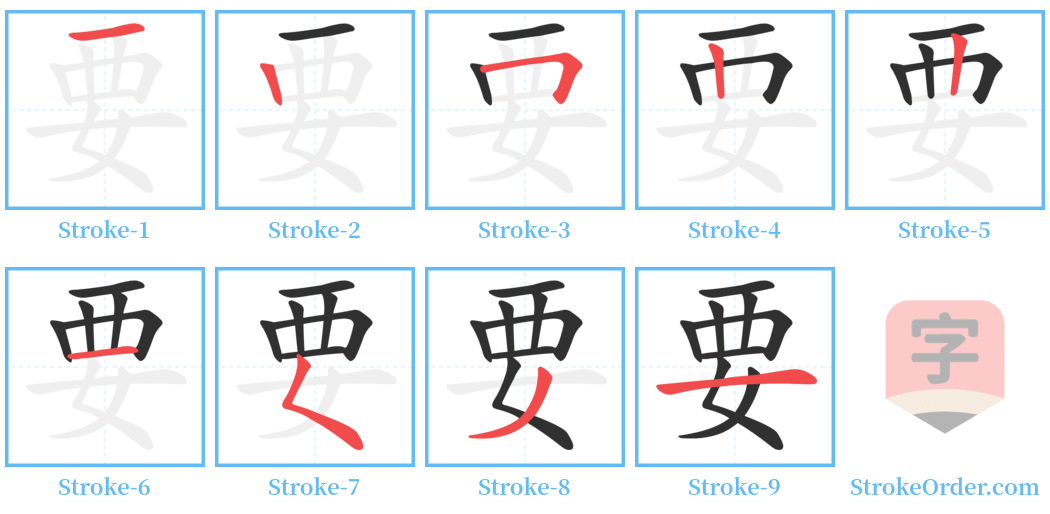
As a general rule, you write from top to bottom.
- First, write the top component, 西 (xī).
- Then, write the bottom component, 女 (nǚ).
Now, watch the animated stroke order to see it in action.
This same China Sage page includes an animated GIF demonstrating the stroke order. Watching the motion can help solidify the writing pattern in your mind.
Scroll down to just below the 'Pronunciation' section and find the animated GIF titled 'stroke order for 要'. Watch it a few times and trace the character with your finger.
2. The Meaning of 要 (yào): A Determined Want
While 想 (xiǎng) is a softer "would like to," 要 (yào) conveys a more definite, determined want. Think of it as moving from a thought to an intention. It implies that something is going to happen.
This video provides an excellent way to understand the "feeling" behind 要.
要(yào) is not always WANT - Think in Chinese and understand 要(yào) VS 想 (xiǎng) VS 想要 (xiǎngyào)
The ShuoshuoChinese channel explains the concept behind '要' as a feeling that something is 'truly going to happen'. This is key to distinguishing it from '想'.
Please watch two short clips from this video: 00:48 - 01:32: The presenter introduces the core idea of '要' as a determined desire or a near-future plan. 02:42 - 03:45: This part explains why '要' is used when ordering something, a perfect example of wanting an object with determination.
The key takeaway is that when you use 要 (yào), you are expressing a strong intention or making a direct request for something you expect to receive.
3. Usage: Expressing a Need for an Object
This brings us to today's main learning outcome. When you want a thing (a noun), you use the structure:
Subject + 要 (yào) + Object (Noun / Noun Phrase)
This is different from the structure you learned for 想 (xiǎng), which is typically followed by a verb.
Let's look at a clear explanation with practical examples.
Complete explanation the difference between 想xiang and 要yao
The article from GoEast Mandarin has a very clear section on using '要' when you want an object, like when shopping or ordering.
On the page, scroll down to the section titled 'Tips 6: 要(yào) + something: used when you order food, shopping or make a demand.' Focus on this section and its examples.
Let's practice this structure with words you already know:
- 我要茶。 (Wǒ yào chá.)
- I want tea. (A direct request, like when ordering.)
- 他要书。 (Tā yào shū.)
- He wants a book.
- 我要一个学生。 (Wǒ yào yí ge xuésheng.)
- I want a student. (Note the use of the measure word 个 you learned).
- 我要一个。 (Wǒ yào yí ge.)
- I want one (of something). This is a very useful phrase when pointing at something you want to buy.
Notice the key difference in these two sentences:
- 我想喝茶。 (Wǒ xiǎng hē chá.) - I would like to drink tea. (Desire to do an action)
- 我要茶。 (Wǒ yào chá.) - I want tea. (Desire for an object)
This distinction is fundamental. 想 (xiǎng) is for the action you're thinking about, while 要 (yào) is for the thing you want in your hand.
4. Practice
Let's test your understanding. Try to form the following sentences in Chinese using characters. Remember to say them aloud.
- We want a teacher. (Hint: teacher is 老师 lǎoshī, but we haven't learned those characters yet. Let's use "person" 人 rén instead.) "We want a person."
- She wants a home/family. (家 jiā)
- I don't want a student. (Negation for 要 can be complex. For wanting objects, the most common way to say "don't want" is 不要 bú yào).
(Take a moment to write down your answers.)
Answers:
- 我们要一个人。 (Wǒmen yào yí ge rén.)
- 她要一个家。 (Tā yào yí ge jiā.)
- 我不要一个学生。 (Wǒ bú yào yí ge xuésheng.) - Notice the tone change on 不 (bù). When followed by a 4th tone like 要 (yào), 不 becomes 2nd tone: bú.
Conclusion
Excellent work today! You have learned a second, very powerful way to express "want."
Key Takeaways:
- The character 要 (yào) is formed by 西 (xī) on top and 女 (nǚ) on the bottom. It has 9 strokes.
- 要 (yào) expresses a strong, definite want or need, as opposed to the softer "wish" of 想 (xiǎng).
- The primary structure for this lesson is Subject + 要 (yào) + Object, used when you want a thing.
- This contrasts with the Subject + 想 (xiǎng) + Verb structure for wanting to do an action.
Preview of the Next Lesson:
Today we introduced the core difference between 想 and 要. In our next lesson, we will dedicate the entire session to a more detailed comparison of these two crucial verbs, looking at different contexts so you can feel confident choosing the right word every time. We will then continue building your vocabulary by learning how to ask questions with 谁 (shéi - who).