Hello! Welcome to your next lesson.
In our last session, you learned how to talk about your family, specifically how to state its size using characters like 家 (jiā), 有 (yǒu), and 几 (jǐ). You can now write sentences such as 我家有三个人 (My family has three people).
Today, we will combine several concepts you've learned throughout the course to build more descriptive sentences. The goal is to write a sentence describing a simple daily activity using a time word and location. A perfect example, and one you'll be able to write by the end of this lesson, is: 我今天在家看书 (Wǒ jīntiān zài jiā kàn shū), which means "I am reading at home today."
This brings together your knowledge of subjects, time expressions, locations, and actions into one powerful sentence structure.
1. The Golden Rule of Chinese Sentence Order
In English, we often place time and location details at the end of a sentence ("I read a book at home today"). Chinese grammar follows a different, very consistent logic. The core principle is to set the context before describing the action. This means you establish who, when, and where before stating what is happening.
This leads to the fundamental word order for descriptive sentences:
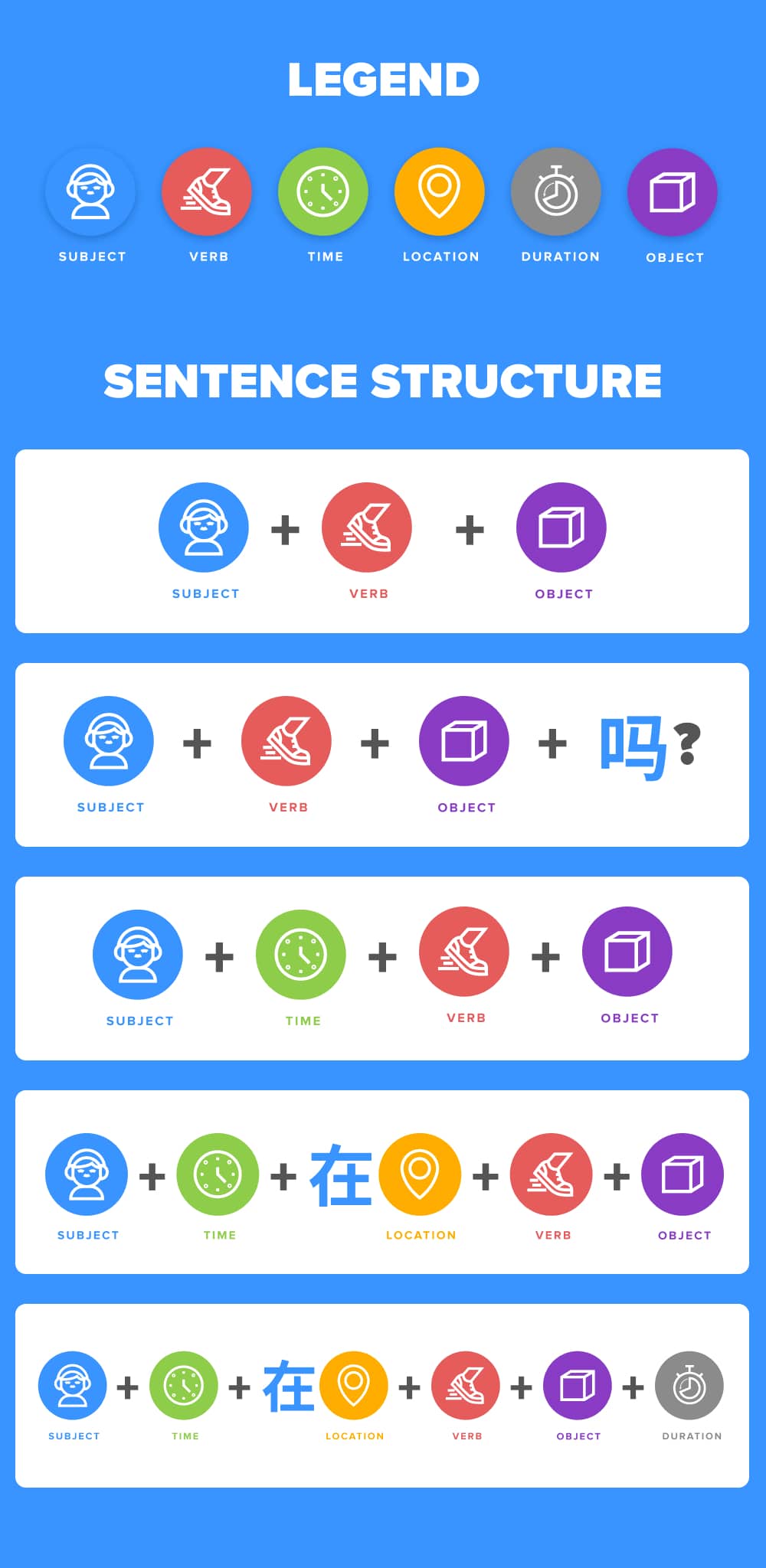
Subject + Time + Place + Verb + Object (S-T-P-V-O)
Take a look at the following image which visually represents this structure. Notice how the time and place elements (represented by a clock and a location pin) come before the verb.
To hear this principle explained, please watch the following short video.
Chinese Sentence Structure - Chinese Grammar Simplified 101
This clip from Twin Cities Chinese Tutor provides a concise explanation of how time and place are positioned before the verb in Chinese.
Watch from 00:41 to 01:44. The video directly contrasts the English and Chinese word order for sentences that include time and location.
2. Combining Time and Location in a Sentence
You've already learned all the necessary building blocks for this structure in previous lessons. Let's briefly review them:
- Time words:
今天(jīntiān, today),明天(míngtiān, tomorrow) - Location phrases:
在家(zài jiā, at home),在学校(zài xuéxiào, at school) - Action phrases (Verb-Object):
看书(kàn shū, to read a book),喝茶(hē chá, to drink tea)
Now, let's see how they fit together. The following reading provides a clear text-based explanation and an excellent example.
Introduction to Basic Chinese Grammar Rules
This article from CLI, 'Introduction to Basic Chinese Grammar Rules,' explains the placement of time and location words with clear examples.
Please read the section titled 'Time and place'. Focus on the rule for word order and the final example sentence given: 我昨天在家看书 (Wǒ zuótiān zàijiā kànshū).
As the article confirms, the standard structure combines these elements in a logical sequence. Let's deconstruct the example from the article:
我 昨天 在家 看书。 (Wǒ zuótiān zài jiā kàn shū.)
I yesterday at home read book.
- Subject: 我 (wǒ) - I
- Time: 昨天 (zuótiān) - yesterday
- Place: 在家 (zài jiā) - at home
- Verb: 看 (kàn) - to read
- Object: 书 (shū) - book
The sentence flows logically: it establishes the actor (I), the timeframe (yesterday), and the location (at home), before finally revealing the action (reading a book).
3. Sentence Building in Action
Now that you understand the theory, let's watch a video that demonstrates how to build these sentences from scratch.
Chinese Sentence Structure: How to make sentences in Chinese Mandarin? Word Order in Chinese
This video from Andy and Sarah Mandarin walks through building complex sentences, including the exact structure we are studying.
Please watch from 11:19 to 12:55. This section covers 'structure number seven,' which is Subject + Time + Place + Verb + Object, and provides two clear examples.
4. Writing Practice
It's time to apply what you've learned. Using the S-T-P-V-O structure, translate the following sentences into Chinese characters. All the vocabulary should be familiar from previous lessons.
-
I am reading a book at school today.
- Subject: 我
- Time: 今天
- Place: 在学校
- Action: 看书
- Your sentence: ___________________
-
He will drink tea at home tomorrow.
- Subject: 他
- Time: 明天
- Place: 在家
- Action: 喝茶
- Your sentence: ___________________
-
My mom speaks Chinese in China.
- Subject: 我妈妈
- Time: (No time word needed here)
- Place: 在中国
- Action: 说中文
- Your sentence: ___________________
Take a moment to write these down on paper. This exercise will solidify the word order in your mind.
Solutions:
我今天在学校看书。(Wǒ jīntiān zài xuéxiào kàn shū.)他明天在家喝茶。(Tā míngtiān zài jiā hē chá.)我妈妈在中国说中文。(Wǒ māma zài Zhōngguó shuō Zhōngwén.)
Conclusion
Congratulations! You have now mastered a sentence structure that is fundamental to expressing yourself in Mandarin. By combining time, place, and action, you can describe daily activities with much greater detail and precision.
Key Takeaways:
- The standard word order for describing an activity in context is Subject + Time + Place + Verb + Object.
- This structure follows a logic of "setting the scene" before stating the action, which is different from the typical English word order.
- You can build these sentences using characters and grammar patterns you have already learned, such as
在for location and time words like今天.
Preview of the Next Lesson:
You can now make a statement like 我今天在家看书. In our next lesson, you will learn how to turn these statements into questions. We will focus on forming a question asking about someone's daily activity, for example: 你明天去学校吗? (Nǐ míngtiān qù xuéxiào ma? - Are you going to school tomorrow?).