Hello! Welcome back to your Chinese course.
In our last lesson, you learned how to construct descriptive sentences by combining subject, time, place, and action into the fundamental Subject-Time-Place-Verb-Object (S-T-P-V-O) structure. You can now confidently write a statement like 我今天在家看书 (Wǒ jīntiān zài jiā kàn shū), meaning "I am reading at home today."
Today, we will build directly on that knowledge. Our goal is to form a question asking about someone's daily activity. We will learn how to turn the statements you can already make into simple yes/no questions. By the end of this lesson, you will be able to ask, for example: 你明天去学校吗? (Nǐ míngtiān qù xuéxiào ma?), meaning "Are you going to school tomorrow?"
This involves learning one new, extremely useful character and a simple grammatical rule.
1. The Question Particle: 吗 (ma)
In Mandarin, one of the most common ways to form a yes/no question is by adding a special particle to the end of a statement. This particle is 吗 (ma).
Character Analysis: 吗 (ma)
True to your analytical learning style, let's break this character down first. 吗 is a perfect example of a phono-semantic compound, a type of character where one part suggests the meaning and the other suggests the sound.
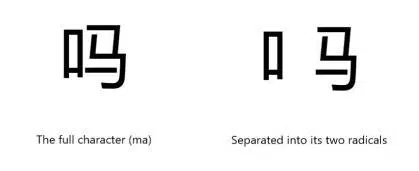
- Semantic Component (Meaning): The radical on the left is 口 (kǒu), which means "mouth." This radical is often found in characters related to speaking, eating, or making sounds. Here, it signals that
吗is used in speech, specifically for asking questions. - Phonetic Component (Sound): The character on the right is 马 (mǎ), which means "horse." In this context, its primary role is to provide the pronunciation, as
mǎsounds very similar toma.
The pronunciation of 吗 is a neutral tone ma. It is unstressed and follows the tone of the syllable before it.
Now, let's look at how to write it. Pay close attention to the stroke order, following the standard left-to-right rule for its two components.

2. The Grammar of Asking Questions
The grammatical rule for using 吗 is refreshingly simple: to turn a statement into a yes/no question, simply add 吗 to the end. The word order of the original statement does not change.
Statement: Subject + (Time) + (Place) + Verb + Object.
Question: Subject + (Time) + (Place) + Verb + Object + 吗?
Let's explore this rule through a reading.
Introduction to Basic Chinese Grammar Rules
The article 'Introduction to Basic Chinese Grammar Rules' from the Chinese Language Institute provides a clear explanation of how to use 吗 (ma).
Please read the section titled '6. Asking questions.' Focus on the explanation and the two pairs of statement/question examples. Notice how the character 吗 is simply added to the end.
As the article demonstrates, a statement like 他喜欢猫 (Tā xǐhuān māo - He likes cats) becomes the question 他喜欢猫吗? (Tā xǐhuān māo ma? - Does he like cats?).
Let's apply this to the structure from our previous lesson:
- Statement:
你明天去学校。(Nǐ míngtiān qù xuéxiào.) - You are going to school tomorrow. - Question:
你明天去学校吗?(Nǐ míngtiān qù xuéxiào ma?) - Are you going to school tomorrow?
The following video discusses two ways to ask yes/no questions. For now, focus on the second pattern it presents, which uses 吗.
Ask & Answer Yes/No Questions in Mandarin Chinese for beginners Chinese Sentence Structure
This video from Andy and Sarah Mandarin, 'Ask & Answer Yes/No Questions,' explains two common question patterns. We will focus on the 'ma' pattern.
Watch the segment from 05:59 to 07:19. The speaker explains 'pattern two,' which involves adding 吗 (ma) to the end of a sentence. He notes that this is very common, especially with longer verbs.
3. Practice: Building and Answering Questions
Now, let's put everything together. We'll start with a statement, then transform it into a question.
Step 1: Form the statement using S-T-P-V-O.
他今天在家看书。(Tā jīntiān zài jiā kàn shū.)- He | today | at home | reads books.
Step 2: Add 吗 to form the question.
他今天在家看书吗?(Tā jīntiān zài jiā kàn shū ma?)- Is he reading books at home today?
How to Answer?
A fascinating aspect of Chinese is that there isn't a single word for "yes" or "no." Instead, you answer by affirming or negating the main verb of the question.
- Question:
...去...吗?(...qù...ma?)- "Yes" answer:
去(qù) - "No" answer:
不去(bú qù)
- "Yes" answer:
- Question:
...看...吗?(...kàn...ma?)- "Yes" answer:
看(kàn) - "No" answer:
不看(bú kàn)
- "Yes" answer:
The video you watched earlier has an excellent section explaining this.
Ask & Answer Yes/No Questions in Mandarin Chinese for beginners Chinese Sentence Structure
Let's return to the 'Ask & Answer Yes/No Questions' video to learn how to respond. The 'quote the verb' trick is a fundamental concept.
Watch the segment from 13:08 to 15:30. Pay close attention to the 'quote the verb' method for answering. For example, to answer '他是不是中国人吗?', the short answer is '是' (yes) or '不是' (no).
Your Turn to Practice
Now, try forming these questions yourself. Write down the full Chinese sentence for each.
-
Are you going to school tomorrow?
- Statement base: You tomorrow go to school.
你明天去学校。- Your question: _________________
-
Does she drink tea at home?
- Statement base: She at home drinks tea.
她在家喝茶。- Your question: _________________
-
Is your mom in China?
- Statement base: Your mom is at China.
你妈妈在中国。- Your question: _________________
Solutions:
你明天去学校吗?(Nǐ míngtiān qù xuéxiào ma?)她在家喝茶吗?(Tā zài jiā hē chá ma?)你妈妈在中国吗?(Nǐ māma zài Zhōngguó ma?)
Conclusion
Excellent work today. You have added a crucial tool to your linguistic toolkit. By learning a single character, 吗, you can now transform any statement you make into a yes/no question, opening up a whole new dimension of communication.
Key Takeaways:
- To form a yes/no question, add the neutral-tone particle
吗(ma) to the end of a statement. - The word order of the original statement (e.g., S-T-P-V-O) does not change.
- The character
吗is a phono-semantic compound: 口 (mouth) provides the meaning category, and 马 (horse) provides the sound. - To answer a yes/no question, you affirm or negate the main verb (e.g.,
去for "yes, I'll go,"不去for "no, I won't go").
Preview of the Next Lesson:
You are now at a fantastic point where you can form statements, ask questions, and describe activities with time and location. In our next lesson, we will consolidate all the grammar and vocabulary you've learned. You will practice translating a variety of simple English sentences into Chinese characters, applying all the patterns we've covered in this course.