Welcome to the final lesson of your introductory Chinese course. I'd like to begin by congratulating you on the incredible progress you've made. Over the past eleven modules, you have built a strong foundation, moving from the fundamentals of Pinyin to constructing and translating complete sentences. In our last lesson, you applied this cumulative knowledge to the practical task of translation, learning to deconstruct meaning in English and reconstruct it according to Chinese grammar.
Today, we will bring our focus back to the heart of the written language: the characters themselves. This final lesson is designed as a comprehensive review, consolidating everything you've learned about character anatomy. Our goal is to review and identify the radical and structure of all learned characters. This exercise will sharpen the analytical skills that are crucial for demystifying new characters and will solidify your understanding of the ones you already know, reinforcing the structured, component-based approach you prefer.
1. Deconstructing Chinese: A Quick Review of Key Concepts
Throughout this course, we've emphasized that Chinese characters are not random collections of strokes but logical constructions. They can be broken down into smaller, meaningful parts.
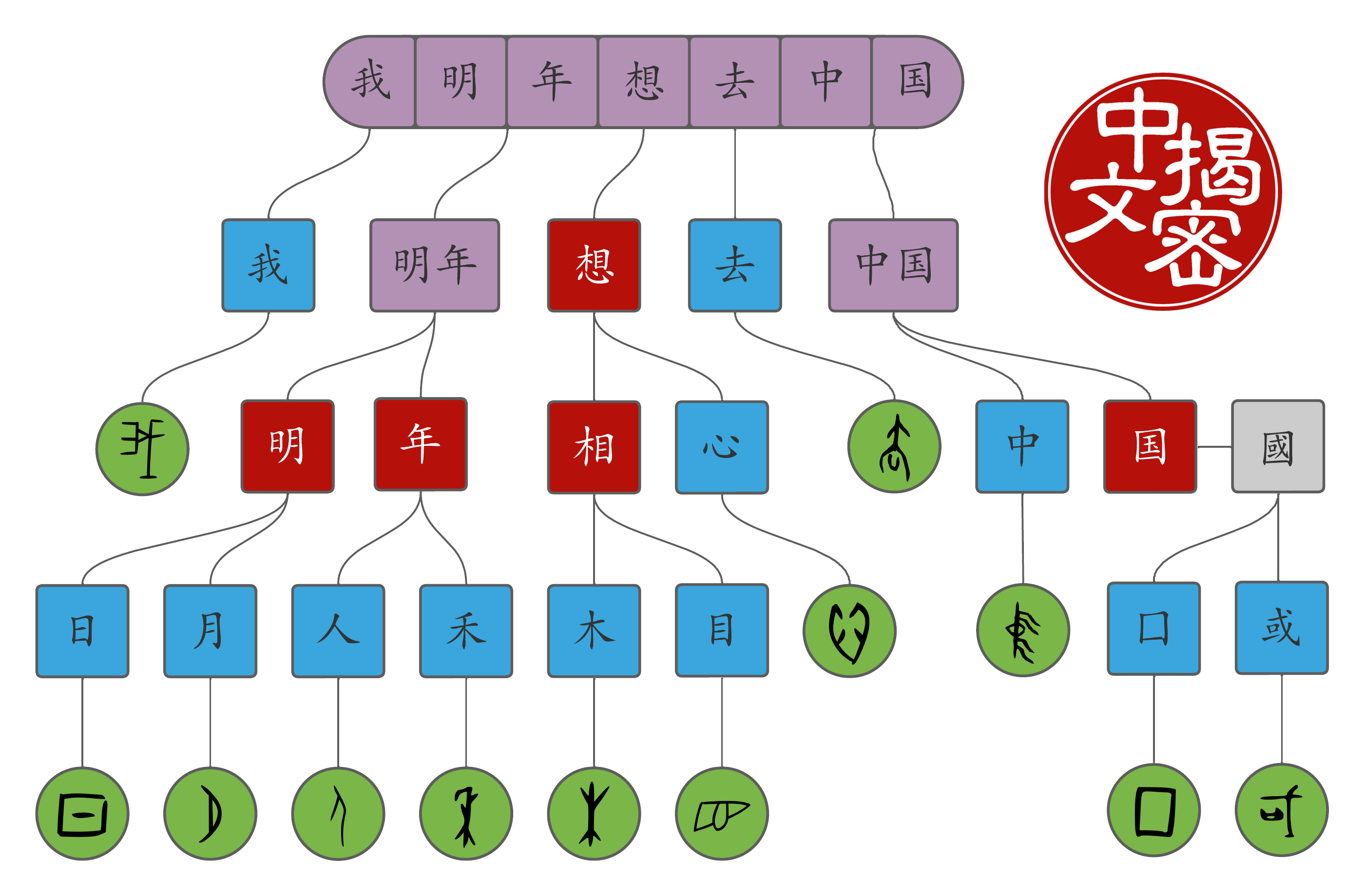
Before we analyze the specific characters you've learned, let's quickly clarify the terminology.
The concepts of 'components' and 'radicals' are often used interchangeably, but there's a useful distinction. This video clip offers a clear, modern perspective on their different roles.
Please watch from 05:32 to 08:16. Pay close attention to: The definition of 'components' as the fundamental building blocks (semantic or phonetic). The explanation of 'radicals' as a system for organizing traditional dictionaries, and why focusing on 'components' is often more practical for learners.
To build on that, while radicals originated as a dictionary indexing system, they are still incredibly useful for learners. A character's designated radical often provides the primary clue to its meaning. For this lesson, when we identify a character's "radical," we are referring to its primary semantic (meaning-giving) component.
The article below provides an excellent summary of the different functions these components serve.
Chinese Radicals: The Basic Unit of Characters
The article 'Chinese Radicals: The Basic Unit of Characters' from Sapore di Cina details the practical functions of radicals (or key components) for a learner.
Please read the sections titled 'Function 2: suggest the meaning of a character', 'Function 3: suggest the sound of a character', and the final summary 'The functions of radicals'. This will reinforce how analyzing components helps you guess a character's meaning and pronunciation.
In summary, we analyze characters by breaking them down into:
- Components: The visual building blocks.
- Radical: The main component that gives a clue to the meaning.
- Phonetic Component: A component that gives a clue to the sound.
- Structure: The way the components are arranged (e.g., left-right, top-bottom).
2. A Systematic Review of Your Character Set
Now, let's apply this analytical framework to all the characters you have learned in this course. We will group them by their structure to make the patterns clear.
Group A: Single-Component Characters
These characters are not composed of smaller, distinct components. They are often ancient pictographs or ideographs and serve as fundamental building blocks for more complex characters.
| Character (Pinyin) | Origin/Type | Notes |
|---|---|---|
| 一, 二, 三 (yī, èr, sān) | Ideograph | Represent the numbers one, two, and three with lines. |
| 上, 下 (shàng, xià) | Ideograph | A vertical line with a mark above or below it to indicate direction. |
| 人 (rén) | Pictograph | A stylized drawing of a person walking. |
| 口 (kǒu) | Pictograph | An outline of an open mouth. |
| 大, 小 (dà, xiǎo) | Ideograph/Pictograph | 大 depicts a person with arms outstretched (big); 小 depicts three small dots or grains. |
| 山 (shān) | Pictograph | Depicts three mountain peaks. |
| 水 (shuǐ) | Pictograph | Originally showed flowing water. It's the basis for the 氵 radical. |
| 火 (huǒ) | Pictograph | Shows flames rising. It's the basis for the 灬 radical. |
| 木 (mù) | Pictograph | A drawing of a tree with branches and roots. |
| 日 (rì) | Pictograph | An abstract representation of the sun. |
| 月 (yuè) | Pictograph | A crescent moon. |
| 女 (nǚ) | Pictograph | Depicts a kneeling woman. |
| 手 (shǒu) | Pictograph | A drawing of a hand with fingers. |
| 中 (zhōng) | Ideograph | A line passing through the center of a box, meaning 'middle' or 'center'. |
| 不 (bù) | Ideograph | Originally a pictograph of a bird flying up to the sky and not coming down. Now used for negation. |
| 天 (tiān) | Ideograph | A large (大) person with a line above representing the sky or heaven. |
| 年 (nián) | Pictograph | Originally showed a person carrying a harvest of grain, representing a full year's cycle. |
| 我 (wǒ) | Phono-semantic | Historically complex, involving a hand (手) and a type of weapon (戈). For learning purposes, it's best treated as a single, indivisible unit. |
Group B: Left-Right Structure
These characters are composed of two or more components arranged side-by-side. This is the most common structure in Chinese.
| Character (Pinyin) | Radical | Structure | Analysis (Semantic + Phonetic) |
|---|---|---|---|
| 你 (nǐ) | 亻 (person) | Left-right | 亻 (person) + 尔 (ěr, phonetic) |
| 他 (tā) | 亻 (person) | Left-right | 亻 (person) + 也 (yě, phonetic) |
| 她 (tā) | 女 (woman) | Left-right | 女 (woman) + 也 (yě, phonetic) |
| 们 (men) | 亻 (person) | Left-right | 亻 (person) + 门 (mén, phonetic); makes pronouns plural. |
| 好 (hǎo) | 女 (woman) | Left-right | 女 (woman) + 子 (zǐ, child). A compound ideograph: a woman with a child is 'good'. |
| 的 (de) | 白 (white) | Left-right | 白 (bái, phonetic) + 勺 (sháo, phonetic). A very common grammatical particle. |
| 很 (hěn) | 彳 (step) | Left-right | 彳 (step radical) + 艮 (gěn, phonetic). Originally meant 'disobedient', now 'very'. |
| 在 (zài) | 土 (earth) | Left-right | 才 (cái, phonetic) + 土 (earth). The 'earth' radical suggests location. |
| 校 (xiào) | 木 (wood) | Left-right | 木 (wood) + 交 (jiāo, phonetic). 'School' was historically a place of wood and learning. |
| 妈 (mā) | 女 (woman) | Left-right | 女 (woman) + 马 (mǎ, phonetic). A classic phono-semantic compound. |
| 吗 (ma) | 口 (mouth) | Left-right | 口 (mouth) + 马 (mǎ, phonetic). The mouth radical indicates a question particle. |
| 吃 (chī) | 口 (mouth) | Left-right | 口 (mouth) + 乞 (qǐ, phonetic). The mouth radical relates to eating. |
| 喝 (hē) | 口 (mouth) | Left-right | 口 (mouth) + 曷 (hé, phonetic). The mouth radical relates to drinking. |
| 饭 (fàn) | 饣 (food) | Left-right | 饣 (food) + 反 (fǎn, phonetic). The food radical relates to meals. |
| 茶 (chá) | 艹 (grass) | Top-bottom | Actually a top-bottom structure: 艹 (grass/plant) on top, with 人 (person) and 木 (wood) below. 'Tea' is a plant. |
| 说 (shuō) | 讠 (speech) | Left-right | 讠 (speech) + 兑 (duì, phonetic). The speech radical indicates speaking. |
| 和 (hé) | 禾 (grain) | Left-right | 禾 (grain) + 口 (mouth). Represents harmony and joining. |
| 明 (míng) | 日 (sun) | Left-right | 日 (sun) + 月 (moon). Compound ideograph: the sun and moon together are 'bright'. |
Group C: Top-Bottom Structure
Components are stacked vertically.
| Character (Pinyin) | Radical | Structure | Analysis (Semantic + Phonetic) |
|---|---|---|---|
| 是 (shì) | 日 (sun) | Top-bottom | 日 (sun) + 正 (zhèng, correct, simplified). 'To be'. |
| 有 (yǒu) | 月 (moon) | Top-bottom | 𠂇 (a variant of 'hand') + 月 (meat/moon). 'To have' or 'possess'. |
| 学 (xué) | 子 (child) | Top-bottom | Top part (𦥯) represents learning/hands + 子 (child). A child learning. |
| 生 (shēng) | 生 (life) | Single comp. | A pictograph of a plant sprouting from the ground, meaning 'life' or 'to be born'. |
| 家 (jiā) | 宀 (roof) | Top-bottom | 宀 (roof) + 豕 (shǐ, pig). A pig under a roof signifies 'home'. |
| 爸 (bà) | 父 (father) | Top-bottom | 父 (father) + 巴 (bā, phonetic). |
| 想 (xiǎng) | 心 (heart) | Top-bottom | 相 (xiāng, phonetic) + 心 (heart/mind). 'To think' or 'want' is an activity of the mind. |
| 要 (yào) | 西 (west) | Top-bottom | 西 (west, here a component) + 女 (woman). 'To want'. |
| 看 (kàn) | 目 (eye) | Top-bottom | 手 (hand) over 目 (eye). A hand shading an eye to 'look' or 'see'. |
| 书 (shū) | 曰 (to say) | Single comp. | A pictograph of a hand holding a brush. Often considered a single unit now. |
| 今 (jīn) | 人 (person) | Top-bottom | Combination of components meaning 'to cover' and 'now'. |
Group D: Other Structures (Enclosing, etc.)
These characters have components that surround other parts.
| Character (Pinyin) | Radical | Structure | Analysis |
|---|---|---|---|
| 国 (guó) | 囗 (enclosure) | Full enclosure | 囗 (enclosure/border) + 玉 (yù, jade). Jade within a border signifies a 'country' or 'kingdom'. |
| 四 (sì) | 囗 (enclosure) | Full enclosure | 囗 (enclosure) + 儿 (human legs). The number 'four'. |
| 回 (huí) | 囗 (enclosure) | Enclosure | A small square inside a big one, meaning 'to return' or go around. |
| 去 (qù) | 土 (earth) | Top-bottom | 土 (earth) + 厶 (private). An ideograph of a person leaving a dwelling, 'to go'. |
| 没 (méi) | 氵 (water) | Left-right | 氵 (water) + 殳 (weapon). Originally meant to sink in water, now used as a negator for 有. |
| 什 (shén) | 亻 (person) | Left-right | 亻 (person) + 十 (shí, ten, phonetic). |
| 么 (me) | 厶 (private) | Top-bottom | A simple character used in words like 什么 and 怎么. |
| 谁 (shéi) | 讠 (speech) | Left-right | 讠 (speech) + 隹 (zhuī, phonetic). The speech radical indicates a question word about a person. |
| 哪 (nǎ) | 口 (mouth) | Left-right | 口 (mouth) + 那 (nà, phonetic). The mouth radical often appears in question words. |
Conclusion: Your Foundation for the Future
This systematic review marks the end of our course. You have not just memorized a list of characters; you have learned to see through them, to understand their logic, their history, and their structure. This analytical ability is the most powerful tool you can have as you continue your journey with Chinese.
Key Takeaways from this Lesson and the Course:
- Chinese characters are built from a finite set of components arranged in predictable structures.
- Identifying a character's radical (semantic component) and phonetic component can help you deduce its meaning and pronunciation.
- By understanding character anatomy, you can learn new characters more efficiently and remember them more permanently.
You began this course with no prior knowledge and have now built a robust foundation covering pronunciation, character analysis, and sentence construction. You are well-equipped to move on to intermediate studies, whether that involves expanding your vocabulary with tools like spaced repetition systems (SRS), tackling more complex texts, or starting to practice conversation.
It has been a pleasure to guide you through these foundational steps. Congratulations on your hard work and achievement. I wish you the very best in all your future language-learning endeavors.