Hello! Welcome to the first lesson of our final module, "Course Consolidation and Application."
In the last lesson, you successfully integrated all the grammar and vocabulary we've covered to read and translate a complete paragraph. This demonstrated your ability to see how individual characters and rules come together to form a cohesive narrative.
Today, we will build on that foundation to achieve a very practical and personal communicative goal: writing a sentence to introduce your nationality. We'll focus on the standard sentence pattern, using the example 我是中国人 (Wǒ shì Zhōngguó rén), and then learn how you can adapt this to state your own nationality.
1. The Core Structure for Stating Nationality
You are already familiar with the fundamental "A 是 B" sentence structure for identification, as in 我是学生 (Wǒ shì xuéshēng - I am a student). Stating your nationality uses the exact same pattern.
The logic in Mandarin for forming a nationality is very straightforward:
Country Name + 人 (rén) = Nationality
You already know the characters for China, 中国 (Zhōngguó), and the character for person, 人 (rén). When you combine them, you get:
中国 (Zhōngguó) + 人 (rén) → 中国人 (Zhōngguó rén) - "Chinese person"
Now, you can place this new word into our "A 是 B" sentence structure:
This gives you the complete sentence: 我是中国人。 (I am Chinese.)
To see and hear this structure in action, let's watch a short video.
Learn Chinese for Beginners | Nationalities in Chinese | Country Names in Chinese
This video from the ChineseFor.Us channel will clearly demonstrate the 'Country + 人' formula and provide native pronunciation for the key sentences.
Please watch from 00:14 to 03:13. The instructor will explain the structure for 'I'm Chinese' and also introduce the sentence for 'I'm American', reinforcing the pattern.
2. Expanding Your Vocabulary: Country Names
While 我是中国人 is our model sentence, the goal is for you to be able to state your own nationality. Let's learn the names for a few other countries. Notice that many country names are phonetic transliterations and often include the character 国 (guó), which means "country" or "nation."
Here is a short list.
| Country (English) | Characters | Pinyin |
|---|---|---|
| USA | 美国 | Měiguó |
| UK | 英国 | Yīngguó |
| France | 法国 | Fǎguó |
| Germany | 德国 | Déguó |
Using this list, how would you say "I am American"? You simply substitute 中国 with 美国:
我是美国人。 (Wǒ shì Měiguó rén.)
3. Character Analysis and Writing Practice
The learning outcome for today is to write the sentence. You are already familiar with most of these characters, but let's take this opportunity for a quick review and analysis, in line with your preference for understanding character construction.
Known Characters Review:
- 我 (wǒ): I, me
- 是 (shì): to be
- 人 (rén): person
- 中 (zhōng): middle, center
Focus Character: 国 (guó) - Country
You were introduced to this character in Module 5. Let's break it down:
- Radical:
囗(wéi). This is the "enclosure" radical. It represents borders, a boundary, or a territory. - Inner Component:
玉(yù). This component means "jade". In ancient forms of the character, the inner part was或(huò), which depicted a walled city defended by a spear, symbolizing a state or region. Over time, this was simplified into the modern form玉, though the original meaning related to territory is carried by the囗radical.
Writing Practice
First, let's refresh our memory on the stroke order for 是 (shì), a crucial character for this structure.
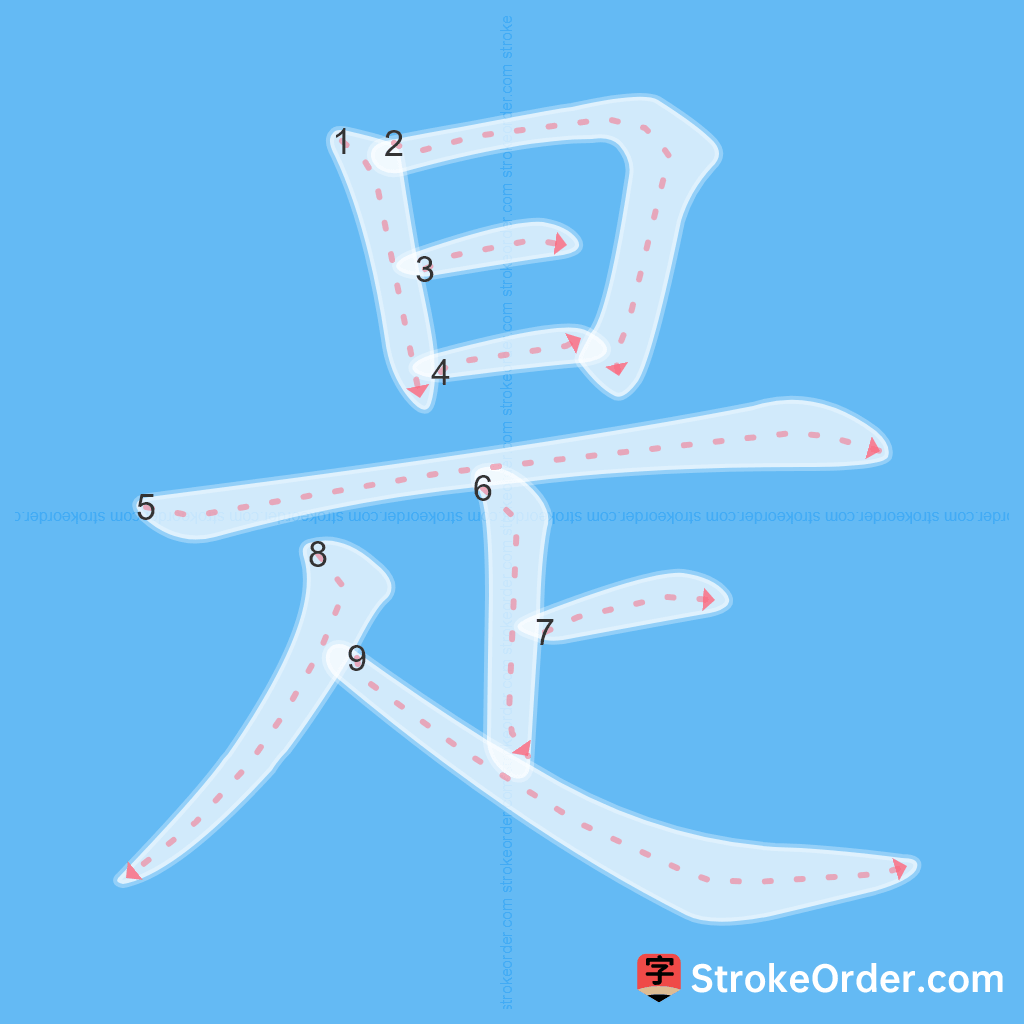
Now, take out a piece of paper and practice writing our key sentence.
- Write: 我是中国人。
- Next, choose a country from the list above (or your own, if you wish to look it up) and write the sentence for that nationality. For example: 我是法国人。
4. Practice in Context
Now that you understand the components and have practiced writing, let's see these sentences used in dialogues. The following resource provides simple conversations with audio, which will help you with listening comprehension and pronunciation.
Lesson 05 - Country, Nationality
The resource 'Lesson 05 - Country, Nationality' from Chinese-Tools.com presents simple dialogues that use the sentences we've been studying. It also includes links for deeper character analysis.
Please review 'Conversation 1' and 'Conversation 2'. Listen to the accompanying audio files. Notice how '我是中国人' and '我是美国人' are used. Also, pay attention to the negative form '不 是' (bú shì) in the second conversation, which reinforces the tone sandhi rule you learned for 不 (bù). Finally, look at the 'Grammar' section on phrase structure to review why '不' comes before the verb.
As you saw in that resource, you can also ask questions and negate statements.
- Statement: 我是美国人。 (Wǒ shì Měiguó rén.) - I am American.
- Negation: 我不是美国人。(Wǒ bú shì Měiguó rén.) - I am not American.
- Question: 你是美国人吗? (Nǐ shì Měiguó rén ma?) - Are you American?
This shows how seamlessly this new vocabulary fits into the grammatical structures you already command.
Conclusion
In this lesson, you've achieved a significant milestone by learning how to express a core part of your identity in Chinese.
Key Takeaways:
- The formula for forming a nationality is Country Name + 人 (rén).
- The sentence structure to state your nationality is a simple "A 是 B" pattern: 我是 [Country]人。 (Wǒ shì [Country] rén).
- This structure can be easily negated with 不 (bù) and turned into a question with 吗 (ma).
Preview of the Next Lesson:
We will continue with the theme of personal information in our next lesson. You will learn to write a sentence to describe your family using 有 (yǒu) and 几 (jǐ), for example, 我家有三个人 (Wǒ jiā yǒu sān ge rén - My family has three people). This will further expand your ability to talk about yourself and your immediate world.