Hello! Welcome back.
In our last lesson, we introduced arrays of pointers and saw a preview of how they compare to 2D arrays, especially for handling collections of strings. We concluded with a key question about the trade-offs between const char FAULT_NAMES_A[][32] and const char *FAULT_NAMES_B[].
Today, we will dive deep into that comparison. This is a classic and crucial topic for C interviews because it probes your understanding of memory, pointers, and performance implications—all critical in embedded and automotive systems.
Your learning outcome for this lesson is to: Compare the memory layout and access patterns of a 2D array vs. an array of pointers.
We'll dissect how each structure is laid out in memory, how elements are accessed, and what this means for performance and flexibility.
A Tale of Two Layouts
At the heart of this comparison are two fundamentally different ways of organizing a 2D data structure in linear memory.
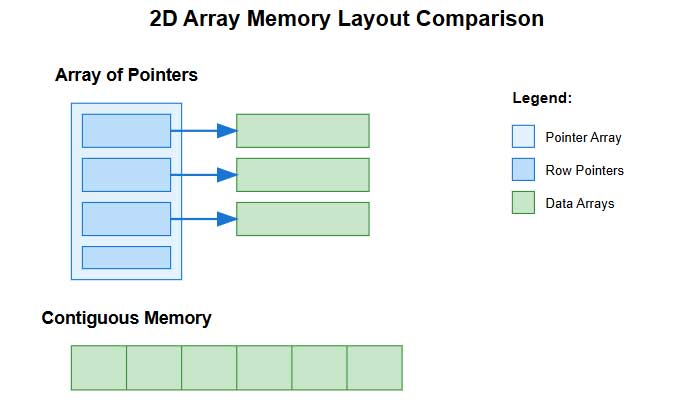
Let's break down each of these in detail.
Structure 1: The 2D Array (Contiguous Memory)
In C, a standard 2D array like int matrix[3][4]; is allocated as a single, contiguous block of memory. The C language standard specifies a row-major layout.
To understand what "row-major" means and see how it works visually, let's turn to a great article on the topic.
Memory layout of multi-dimensional arrays
This article by Eli Bendersky provides an excellent visualization and explanation of memory layouts. We'll focus on the row-major layout, which is what C uses.
Please read the section titled '2D row-major'. Pay close attention to the diagram showing how the 2D matrix is flattened into a 1D memory block. Also, note the formula for calculating an element's offset.
As you've just read, in a row-major layout, all elements of row 0 are stored first, followed by all elements of row 1, and so on. This has a critical consequence for how the compiler accesses an element.
Access Pattern: Direct Offset Calculation
To access matrix[i][j], the compiler doesn't need to perform multiple memory lookups. It can calculate the exact memory address directly from the base address of the array. Given an array type arr[ROWS][COLS], the address of element arr[i][j] is:
This is a single arithmetic calculation followed by one memory access. This process is extremely fast and efficient. The key takeaway is that accessing an element involves only one level of indirection from the computed address.
Performance: Cache Locality
The contiguous, row-major layout is highly beneficial for CPU cache performance. When you iterate through the array row by row (the natural way in C, with the column index in the inner loop), you are accessing adjacent memory locations.
for (int i = 0; i < ROWS; i++) {
    for (int j = 0; j < COLS; j++) {
        matrix[i][j] = 0; // Accessing memory sequentially
    }
}
This access pattern exhibits excellent spatial locality. Modern CPUs are designed to prefetch subsequent memory blocks into the cache when they detect sequential access, leading to very few cache misses and significant performance gains. We will revisit this with a concrete benchmark later in the lesson.
Structure 2: The Array of Pointers (Jagged Array)
Now let's analyze the second structure: an array of pointers, such as int *arr[3];. This creates what is often called a "jagged array" or an "array of arrays."
This structure involves two levels of memory:
- The Pointer Array: A contiguous block of memory containing
3elements, where each element is a pointer (int *). - The Data Blocks: Each pointer in the array points to a separate, independently allocated block of memory that holds the actual integer data for that row.
Critically, while the pointer array itself is contiguous, the data blocks it points to are not guaranteed to be contiguous with each other. They can be scattered throughout the heap, especially if they are allocated dynamically at different times.
Access Pattern: Double Indirection
To access an element like arr[i][j], the CPU must perform two memory lookups:
- First Lookup (Indirection 1): Go to the
i-th element of the pointer array to fetch the address of the desired row. Let's call thisrow_pointer = arr[i]. - Second Lookup (Indirection 2): Go to the
j-th element starting fromrow_pointerto fetch the actual data value.value = row_pointer[j].
This double-indirection process is inherently slower than the single offset calculation of a true 2D array.
Dynamic Allocation: A Practical View
This distinction becomes crystal clear when you dynamically allocate memory for a 2D structure on the heap. You have two main methods, which perfectly mirror the two structures we're discussing.
2.5.1. Single-Dimensional Arrays - Dive Into Systems
The 'Dive Into Systems' book provides a clear explanation of the two ways to dynamically allocate a 2D array. This directly illustrates the contiguous vs. array-of-pointers trade-off in a practical context.
Read the sections 'Method 1: Memory-Efficient Allocation' and 'Method 2: The Programmer-Friendly Way'. Pay close attention to the diagrams and the malloc calls. Notice how Method 1 results in a single contiguous block, while Method 2 creates a non-contiguous, two-level structure.
As you saw:
- Method 1 (Single
malloc) creates a contiguous block. It's memory-efficient and fast to access (if you do the index math yourself:i * COLS + j), but you lose the convenient[i][j]syntax. - Method 2 (
N+1mallocs) creates an array of pointers. It's programmer-friendly (you can use[i][j]), but it incurs the overhead of the pointer array and potential performance loss from non-contiguous rows and double indirection.
Head-to-Head Comparison
This table summarizes the key trade-offs, which are prime material for an interview discussion.
| Feature | 2D Array (type arr[R][C]) |
Array of Pointers (type *arr[R]) |
|---|---|---|
| Memory Layout | Single contiguous block of R * C elements. |
Array of R pointers, each pointing to a separate row. Rows are not necessarily contiguous. |
| Memory Overhead | Can waste space if rows have varying lengths (padding). | More memory-efficient for jagged data, but has overhead of the pointer array itself. |
| Flexibility | Inflexible. All rows must have the same, fixed length (C). |
Flexible. Rows can have different lengths ("jagged"). Rows can be easily swapped by swapping pointers. |
| Access Mechanism | Single indirection. Address computed via base + (i*C+j). |
Double indirection. First lookup gets the row pointer, second gets the data. |
| Performance | Faster access. Excellent cache locality for row-wise traversal. | Slower access due to double indirection and potential for cache misses if rows are scattered in memory. |
| Typical Use Case | Matrices, image data, fixed-size grids. | Command-line arguments (argv), lists of strings, jagged data structures. |
The Performance Impact: Why It Matters
You have a background in performance-sensitive automotive software, so you know that cache misses are expensive. Let's see just how dramatic the impact of choosing the right access pattern for a given memory layout can be.
Memory layout of multi-dimensional arrays
We'll return to Eli Bendersky's article to see a practical benchmark. This section demonstrates the massive performance difference between accessing a row-major array sequentially vs. non-sequentially.
Read the section 'Performance: why it's worth caring which layout your data is in'. Focus on the diagrams illustrating row vs. column access patterns and the final benchmark graph. The speedup numbers are compelling.
The key takeaway from the benchmark is staggering: accessing data in the order it's laid out in memory can be orders of magnitude faster than accessing it non-sequentially. In a contiguous 2D array, row-wise traversal is sequential, while column-wise traversal jumps around in memory, destroying cache locality.
This is precisely why, for tasks like image processing or matrix multiplication on large datasets, ensuring data contiguity is a primary optimization strategy.
Conclusion
You should now have a robust mental model to answer any interview question comparing these two fundamental C data structures.
Key Takeaways:
- 2D arrays (
type arr[R][C]) are single, contiguous memory blocks laid out in row-major order. They offer superior performance for fixed-size data due to direct address calculation and cache-friendly access patterns. - Arrays of pointers (
type *arr[R]) are two-level, non-contiguous structures. They provide flexibility for handling variable-sized or "jagged" data (like lists of strings) at the cost of an extra level of indirection and potential cache inefficiency. - The choice between them is a classic engineering trade-off: performance and memory predictability vs. flexibility. In your field, where performance and safety (e.g., avoiding heap fragmentation) are paramount, the preference often leans towards contiguous data structures.
In our next lesson, we'll tackle another advanced pointer topic that often appears in interviews: interpreting complex pointer declarations like const char *const *p using the "right-left rule". This will further solidify your mastery of C's type system.