Hello! Welcome back to your C interview preparation series.
In our last session, we dove into the memory layouts and access patterns of 2D arrays versus arrays of pointers. We established that the former is a contiguous block optimized for cache performance, while the latter is a more flexible, non-contiguous structure involving double indirection.
Building on that foundation, today we'll tackle another common and challenging interview topic: deciphering C's complex type declarations. Being able to fluently read and write declarations involving multiple pointers, const qualifiers, and arrays demonstrates a deep command of the C type system—a skill highly valued in low-level and systems programming roles.
Your learning outcome for this lesson is to: Interpret and write complex pointer declarations using the right-left rule (e.g., const char *const *p).
Why C Declarations Can Be Confusing
C's syntax for declarations can feel "inside-out." A simple declaration like int i; reads naturally as "i is an int." However, consider int *p[10];. Is p a single pointer to an array of 10 integers, or is it an array of 10 pointers to integers?
The answer lies in operator precedence ([] has higher precedence than *), so it's an array of 10 pointers to int. To navigate more complex cases without ambiguity, we need a systematic approach.
The Right-Left Rule: A Systematic Approach
The "right-left rule" is a simple algorithm for parsing any C declaration. It provides a consistent way to translate C's syntax into a plain English description.
Let's start by learning the rule from a classic and clear source.
To systematically decipher any C declaration, we can use the 'right-left rule'. This guide from UC San Diego's Computer Science and Engineering department provides a clear, step-by-step walkthrough.
Please read the introduction and the first two examples ('int *p[]' and 'int *(*func())()'). Focus on understanding the three main steps: 1. Find the identifier. 2. Look right for [] or (). 3. Look left for *. Pay close attention to how parentheses () are used to override the default precedence and group parts of the declaration.
As you've just read, the process is:
- Start at the variable name (the identifier).
- Spiral outwards, looking to the right first, then to the left.
- Translate as you go:
[]means "array of..."()means "function returning..."*means "pointer to..."
This process repeats until you've parsed all the symbols and are left with the base type.
Integrating the const Qualifier
The const keyword adds a crucial layer. It determines whether the data is read-only or the pointer itself is fixed. An interview question will almost certainly involve const.
The rule for const is simple: it applies to the item immediately to its left. If there is nothing to its left (i.e., it's at the beginning of the declaration), it applies to the item to its right.
Let's see the three fundamental pointer-and-const combinations.
Difference between const int*, const int * const, and int const *
The placement of const relative to the asterisk * is critical. This GeeksforGeeks article breaks down the three essential scenarios you must know.
Read the sections explaining 'int const*', 'int const', and 'const int const'. Notice the key difference: const before the * makes the pointed-to data constant, while const after the * makes the pointer address constant.
To summarize and visualize these common patterns:
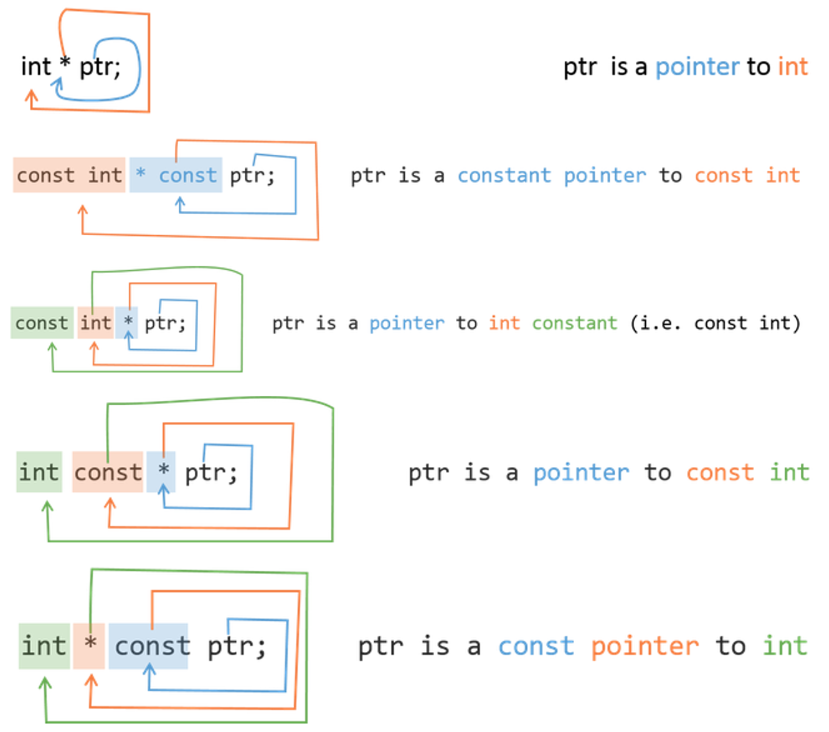
Here's the breakdown:
-
const int *porint const *p(Pointer to a constant integer)- You can change the pointer
pto point to another address. - You cannot change the integer value through the pointer
p(e.g.,*p = 10;is illegal).
- You can change the pointer
-
int * const p(Constant pointer to an integer)- You cannot change the pointer
pto point to another address (it must be initialized at declaration). - You can change the integer value it points to (e.g.,
*p = 10;is legal).
- You cannot change the pointer
-
const int * const p(Constant pointer to a constant integer)- You cannot change the pointer
pto point elsewhere. - You cannot change the value it points to.
- You cannot change the pointer
This distinction is vital in API design, especially in contexts like AUTOSAR where you pass pointers to modules but want to enforce read-only access to data or guarantee that a pointer to a hardware register doesn't get accidentally reassigned.
Putting It All Together: A Complex Example
Now, let's apply the full right-left rule to the declaration from our learning outcome: const char *const *p.
- Start with the identifier: "p is..."
- Move left (nothing on the right):
*. "...a pointer to..."pis a pointer to...
- Keep moving left:
const. "...a const..."pis a pointer to a const...
- Keep moving left:
*. "...pointer to..."pis a pointer to a const pointer to...
- Keep moving left:
const char. "...a const char."pis a pointer to a const pointer to aconst char.
Let's trace what's mutable:
pitself is a variable pointer. You can change whereppoints.*pis theconst pointerit points to. You cannot change this pointer.**pis theconst chardata. You cannot change this character.
This type of declaration might be used for a table of constant strings where the pointers to those strings are also fixed in a table. The p variable would be your cursor to iterate over this table of constant pointers.
The GeeksforGeeks article provides more examples of this.
Difference between const int*, const int * const, and int const *
Let's reinforce this with a few more examples of multi-level pointers combined with const.
Read the short section titled 'Memory Map'. Try to apply the rule yourself to int * const * and int const ** before reading the provided translation. This will be a good self-check.
From English to C: Writing Declarations
A strong interview candidate can not only read declarations but also write them. The process is simply the right-left rule in reverse.
Goal: Declare my_func as a pointer to a function that accepts an int and returns a pointer to a char.
- Start with the name and what it is:
my_funcis a pointer...
*my_func - Add the next part: ...to a function...
(*my_func)()(Parentheses are essential to bind the*tomy_funcbefore the()is applied.) - Add the function's parameters: ...that accepts an
int...
(*my_func)(int) - Add the return type: ...and returns a pointer to a
char.
char *(*my_func)(int);
This skill is directly applicable when working with function pointers for callbacks or driver architectures, a topic we will explore in detail in a future lesson.
Advanced Knowledge: Illegal Declarations
Finally, to demonstrate mastery, it's useful to know what is not allowed in C. The right-left rule can help you construct declarations that are syntactically plausible but semantically illegal.
Not every declaration you can construct is valid. Understanding the constraints of C's type system is a mark of an expert.
Read the final section of the page, beginning with the text 'Some final words:'. Focus on the three illegal combinations: array of functions, function returning a function, and function returning an array.
The core reason for these limitations is that arrays and functions are not "first-class citizens" in C. They cannot be returned by value from a function or stored directly by value in an array. You must use a pointer instead. For example, a function cannot return an array because the size of the returned item must be known, and arrays can be of any size. Therefore, you must return a pointer to an array.
int arr[5]();// Illegal: array of functionsint func()[5];// Illegal: function returning an arrayint func()();// Illegal: function returning a function
Recognizing these illegal patterns shows an understanding that goes beyond just mechanically applying a rule.
Conclusion
Mastering C declarations is like learning grammar—it allows you to read, write, and understand the language with precision and confidence. Today, we've equipped you with a robust method to handle even the most convoluted types.
Key Takeaways:
- The Right-Left Rule provides a systematic, "inside-out" method to parse any C declaration. Start at the identifier and spiral outwards, looking right then left.
constPlacement is Key:constbefore the*protects the data.constafter the*protects the pointer.- Practice Both Ways: Being able to both read a declaration into English and write one from an English description is the goal.
- Know the Limits: Understanding why arrays of functions or functions returning arrays are illegal demonstrates a deeper knowledge of the C type system.
In our next lesson, we will move on to dynamic memory allocation. We'll cover malloc, calloc, realloc, and free, and then apply this knowledge to revisit the topic of 2D arrays, contrasting a contiguous allocation with an array-of-pointers allocation on the heap.