Welcome back. The previous lesson showed why prepaid principal is not the same as cash you can readily retrieve. Now the comparison moves from access to rates: if you can either prepay a mortgage, keep money in savings, or invest it, the advertised rates are not yet on equal footing. Taxes can reduce savings and investment returns, while a mortgage interest deduction—if it actually reduces your tax bill—can reduce the value of interest avoided. Fees can change any of the three.
This lesson builds a one-year, after-tax comparison under supplied hypothetical tax rules. It is a rate calculation, not a recommendation to exchange a liquid, relatively stable asset for an illiquid or risky one.
Start with the amount you can actually keep
A useful common measure is the net benefit from committing a specified amount of money for one year, divided by the money committed. For this lesson, assume a household has $10,000 available after the reserves and obligations considered earlier. It faces these hypothetical choices:
| Choice | Quoted annual rate | Other assumptions |
|---|---|---|
| Prepay a mortgage | 4.0% interest rate | No prepayment fee |
| Use a savings account | 4.5% annual yield | No account fee; interest taxed at 20% |
| Buy an investment | 6.0% assumed gross return | Annual fee of 0.5% of the opening balance; net gain taxed at 20% |
For the first calculation, treat the $10,000 as outstanding for a full year and ignore changes in the scheduled mortgage balance. Likewise, charge the investment fee on its opening balance at year-end. These simplifying assumptions make the annual rates directly calculable; an amortizing mortgage and investments taxed at different times require a cash-flow comparison later in the course.
The key discipline is to specify what the tax applies to. Interest earned, investment gains, and interest avoided are not the same kind of cash flow. In particular, avoiding $400 of mortgage interest does not itself create $400 of taxable income.
Mortgage prepayment: did the avoided interest carry a deduction?
At 4%, a $10,000 reduction in principal avoids approximately $400 of interest over the illustrative year. If none of that interest would have produced a usable tax deduction, the annual after-tax benefit is still $400, or 4.0%. If it would all have produced a deduction worth 20% of the interest, prepayment also removes an $80 tax benefit. The net benefit is then $320, or 3.2%.
“Mortgage interest is deductible” is therefore not enough information. Eligibility depends on the loan and use of proceeds, applicable limits, and whether itemizing deductions actually lowers the household’s taxes. IRS Publication 936 (2025), Home Mortgage Interest Deduction provides the 2025 rules and a worksheet for interest subject to a loan limit. We will use its rules to understand the issues, then keep the numerical examples explicitly hypothetical rather than treating one publication year’s thresholds as permanent.
Publication 936 (2025), Home Mortgage Interest Deduction
Read the IRS explanation to distinguish interest that qualifies for a deduction from interest that produces a usable tax saving. Then inspect how its worksheet limits deductible interest when qualified debt exceeds the applicable limit.
In “Fully deductible interest,” begin with the qualification overview. Continue through the three dated mortgage categories, ending after the category for mortgages taken out after December 15, 2017. In Figure A immediately below, read Decision (1) and its footnote: itemizing matters. Then go to “Table 1 Instructions” and “Table 1. Worksheet To Figure Your Qualified Loan Limit and Deductible Home Mortgage Interest for the Current Year.” In Part I, locate the qualified loan limit at line 11. In Part II, follow lines 12–16, especially the limiting calculation. Focus on the fact that the permitted deduction must be calculated, not inferred from the mortgage rate alone.
For a particular prepayment, the most reliable question is: How much larger would the tax bill be with the prepayment than without it, under the supplied rules? If the prepayment avoids $400 of interest but increases tax by $80 because a deduction disappears, its net benefit is $320. If it does not change the tax bill, its net benefit is $400.
A compact way to calculate this, when one marginal tax rate applies, is:
Here, deduction lost means the usable deduction with no prepayment minus the usable deduction with prepayment. It is not automatically equal to all the interest avoided. Other itemized deductions, the standard deduction, and a loan limit can each make it smaller—or zero.
A limit changes the marginal benefit
Consider a deliberately simplified hypothetical rule: a qualifying, itemizing household may deduct interest attributable to at most $750,000 of qualifying principal. Assume a constant 4% rate, balances held for the full year, no other mortgages, and a 20% marginal tax rate. These assumptions are for calculating the effect of one prepayment; an actual return would require the applicable year’s rules and calculations.
- Entirely below the limit: A $10,000 prepayment reduces principal from $700,000 to $690,000. It avoids $400 of interest and loses a $400 usable deduction. Extra tax is $80, so the net benefit is $320: 3.2% of the $10,000 prepaid.
- Entirely above the limit: A $10,000 prepayment reduces principal from $800,000 to $790,000. It avoids $400 of interest, but under the assumed cap, deductible interest remains based on $750,000. No deduction is lost, so the net benefit is $400: 4.0%.
- Crossing the limit: A $20,000 prepayment reduces principal from $760,000 to $740,000. It avoids $800 of interest. Deductible interest falls from interest on $750,000 to interest on $740,000: a $400 deduction lost. Extra tax is $80, giving a $720 net benefit, or 3.6% of $20,000.
Notice why applying the average deductible share of the whole mortgage to a new prepayment can mislead. The last dollars paid down may be above the limit, below it, or straddle it. For a real capped mortgage, calculate the deductible interest both before and after the proposed prepayment using the applicable rules; Publication 936’s worksheet does not simply instruct you to label individual dollars of principal “deductible.”
Itemizing is a separate hurdle. Suppose hypothetical rules allow a $15,000 standard deduction, while a household has $12,000 of other itemized deductions. If mortgage interest falls from $2,000 to $1,600 after prepayment, itemized totals fall from $14,000 to $13,600. Both are below $15,000, so the household still takes the standard deduction. No usable deduction is lost, even though $400 less interest is paid. On these assumptions, that prepayment’s after-tax rate is 4.0%, not 3.2%.
Savings: tax the interest earned
Savings interest is a different calculation: the household receives interest, and the supplied tax rule charges tax on it. The short video What a High Yield Savings Account Means for Your Taxes, from Investing with Matt, explains the distinction between receiving a tax-reporting form and having reportable interest, then discusses taxation of account interest.
What a High Yield Savings Account Means for Your Taxes
Watch “What a High Yield Savings Account Means for Your Taxes” for the basic treatment of deposit-account interest. Use the lesson’s specified 20% rate for the calculation; a real household’s tax treatment may differ.
Watch reporting interest for why the absence of a reporting form is not, by itself, a tax exemption. Then watch taxing interest for the video’s discussion of income tax on savings interest.
Under our assumptions, $10,000 at 4.5% earns $450 in a year. Tax at 20% is $90, leaving $360. With no account fee, the after-tax annual rate is:
If a supplied example includes an account fee, deduct the fee as well, using the example’s stated tax treatment. Do not automatically subtract tax from the full quoted yield and tax the resulting interest again. Nor should you assume an account’s lack of a reporting form makes its interest tax-free.
The 3.6% here is a net rate, not a claim that savings and prepayment provide the same service. The savings balance remains available for spending, subject to the account’s terms; prepaid principal does not become an emergency fund.
Investing: identify what “before fees” means
An assumed 6% investment return is not necessarily a 6% return to the investor. Funds can charge recurring operating expenses from their assets; some products also have charges when shares are bought or sold. Investor.gov’s Mutual Fund and ETF Fees and Expenses bulletin distinguishes these costs. Read it before applying the example’s 0.5% annual fee, so the fee is counted once, rather than subtracted from a return that already reflects it.
Mutual Fund and ETF Fees and Expenses – Investor Bulletin | Investor.gov
Read Investor.gov’s bulletin to see how an annual expense ratio reduces investment value and how a purchase charge differs from a recurring fee.
At the beginning, find “Annual Fund Operating Expenses” and its “Total Annual Fund Operating Expenses” entry. Under “More About Operating Expenses,” read from the explanation that such expenses are regular costs through the asset effect. Then go to “More About Shareholder Fees,” followed by “Sales Loads.” In the “Front-end sales load” subsection, read the purchase charge and its $10,000 example. Stop before “Back-end, or deferred, sales load”; its detailed rules are not needed for this calculation.
In our one-year example, the 6% return is expressly before fees. On a $10,000 opening balance, that is $600 of assumed gain. The specified 0.5% fee on the opening balance is $50, leaving $550. For this example only, assume the entire $550 net gain is taxable this year at 20%, and that there are no other charges. Tax is $110, leaving a $440 gain: an assumed 4.4% after-tax, fee-adjusted return.
This calculation relies on its stated timing and tax rule. A real investment may distribute taxable income during ownership, incur tax when sold, receive a different tax rate, or sit in an account with different tax treatment. A reported fund return may already be after its operating expenses. Read what a quoted number includes before making another deduction.
The chart below illustrates why even a modest recurring fee matters beyond a single year. It holds the illustrated annual return and starting investment constant while varying the fee.
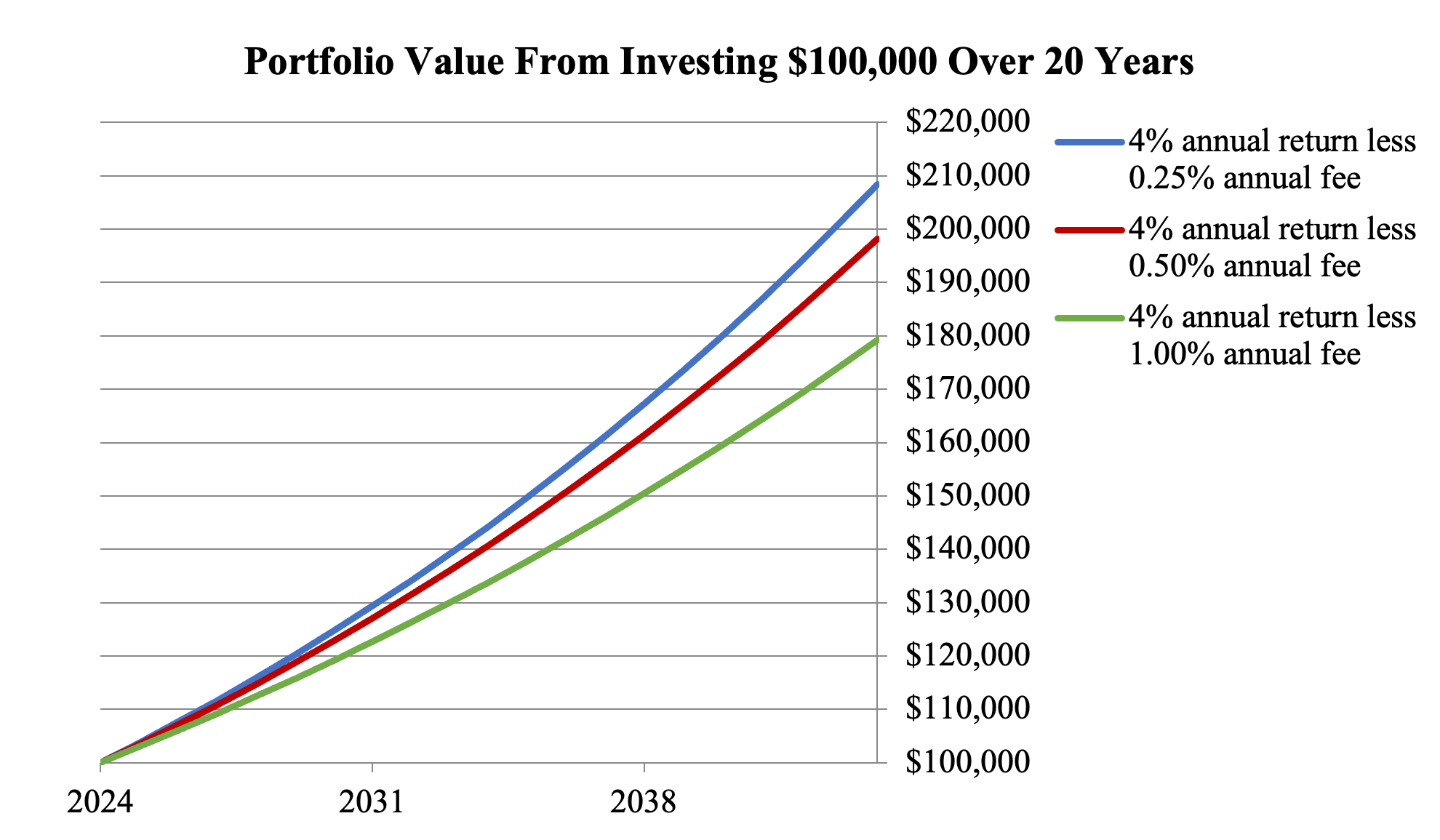
An up-front charge needs different handling from an annual expense ratio. If the same $10,000 budget instead includes a hypothetical $100 purchase fee, only $9,900 is invested. At the example’s 4.4% after-tax return on invested money, the year-end value is $10,335.60. Relative to the $10,000 actually spent, the one-year net return is 3.356%, not 4.4%. Spreading a one-time fee across a longer horizon requires stating that horizon rather than quietly treating it as a recurring annual percentage.
The mortgage side can have a fee too. If a lender instead charges a hypothetical $50 on top of a $10,000 prepayment, and no deduction is lost, the household commits $10,050 to save approximately $400 in first-year interest. Its first-year net benefit is $350, about 3.48% of the cash committed. This is distinct from the no-fee 4.0% case. Always check whether a quoted prepayment charge comes out of the amount applied to principal or must be paid in addition.
Put the rates side by side—without making them interchangeable
Under the original no-fee prepayment assumptions and the stated one-year tax treatment, the results are:
| Use of money | After-tax, fee-adjusted annual rate in this example |
|---|---|
| Mortgage prepayment; no usable interest deduction lost | 4.0% |
| Mortgage prepayment; half the avoided interest loses a usable deduction | 3.6% |
| Mortgage prepayment; all avoided interest loses a usable deduction | 3.2% |
| Savings at 4.5%; interest taxed at 20%; no fee | 3.6% |
| Investment with assumed 6% gross return, 0.5% fee, and specified tax | 4.4% if that return occurs |
The table answers a narrow question well: it removes the misleading comparison between a pretax savings or investment rate and an after-tax mortgage benefit. It does not establish that the investment will earn 4.4%, or that a 3.6% savings account and a 3.6% prepayment are equally useful. The former retains liquidity; the latter reduces debt. Investment outcomes also vary, while interest avoided on a fixed-rate loan follows its contractual terms, subject to the loan and tax assumptions.
For any supplied case, the calculation sequence is consistent: establish the same cash amount and time period; compute interest avoided or earnings; subtract fees according to when and how they are charged; apply the specified tax rule to the appropriate amount; and divide the net benefit by the money committed. For mortgage tax relief, compare the usable deductions with and without prepayment rather than assuming that either every dollar or no dollar of avoided interest was deductible.
Takeaway
The comparable rate is what remains after applicable tax effects and fees—not simply the largest quoted percentage. In this example, a 4% mortgage can yield a 4.0%, 3.6%, or 3.2% after-tax prepayment benefit depending on the deduction actually lost. Savings interest is reduced by its assumed tax; the investment’s assumed gross return is reduced by its specified fee and tax, with no guarantee that the gross return will occur.
The next module begins by calculating how lump sums and regular contributions grow over time. That will let you extend these one-year rates into a comparison that also respects payment timing, the remaining mortgage balance, and a shared end date.