Welcome back. The previous lesson found that, after setting aside money for obligations and reserves, one example household had at most $2,100 available for an optional mortgage prepayment. That was a cash-flow ceiling, not a recommendation. This lesson examines a separate question: if you prepay principal now, could you get that money back when you need it?
The answer depends on more than the equity shown on a statement. You may need a new loan, you may pay to obtain it, and the lender may assess your income and home value at precisely the time either has deteriorated.
Equity is not cash in an account
Suppose a home is worth $350,000 and its mortgage balance is $185,000. The homeowner has $165,000 of equity: the difference between the estimated home value and the debt secured against it. But that does not mean $165,000 is available to withdraw. To turn equity into spendable cash without selling the home, the homeowner generally has to borrow against it.
The Federal Trade Commission’s Home Equity Loans and Home Equity Lines of Credit explains this distinction and identifies the factors a lender considers.
Home Equity Loans and Home Equity Lines of Credit | Consumer Advice
Read the Federal Trade Commission’s explanation of home equity and borrowing against it. Focus on why owning equity is different from qualifying for a loan.
In “Using the Equity in Your Home To Borrow Money,” read from the opening definition of equity through the paragraph ending with the factors that affect how much you can borrow and your interest rate. The passage begins with the equity definition. Notice the roles of income, credit history, and market value, as well as the risk created by using the home as collateral.
A lender may also limit total borrowing secured by the home to a percentage of its appraised value. Here is an illustration using an assumed 80% limit and no other loans secured by the property:
This is a screening calculation, not an approval or a promise of cash. Different products and lenders have different limits; appraisal, eligibility, and costs still matter.
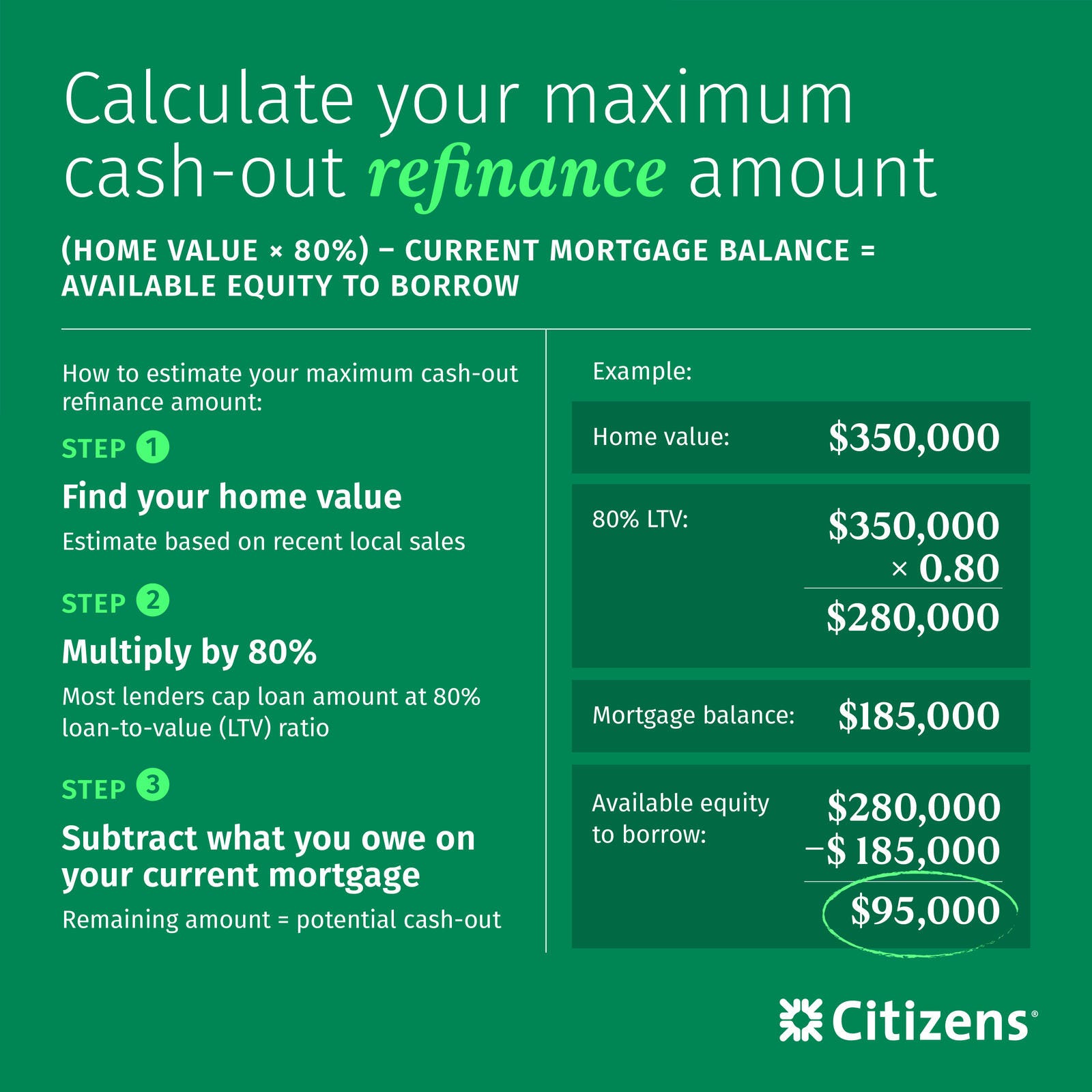
In that example, equity is $165,000, but headroom under the assumed limit is only $95,000. The lender’s limit leaves part of the equity in the home.
Now suppose this is a different household from the previous lesson’s $2,100 example, and it prepays $20,000. Holding the home value fixed for illustration, its balance falls to $165,000 and the calculated headroom rises from $95,000 to $115,000. The extra $20,000 of headroom is not a $20,000 cash reserve: accessing it still requires a suitable borrowing arrangement.
Getting cash back means taking on debt again
Three common routes have different consequences. A home equity loan is generally a separate loan that provides a lump sum. A home equity line of credit, or HELOC, is a separate line from which an approved borrower can draw during its draw period. A cash-out refinance replaces the existing mortgage with a larger new mortgage and pays out the difference, less applicable costs.
Watch NerdWallet’s Cash-Out Refinance vs HELOC: Which Is Right For You? for the distinction between replacing a mortgage and adding a credit line. Its rate discussion is especially relevant when the existing mortgage has a low fixed rate.
Cash-Out Refinance vs HELOC: Which Is Right For You? | NerdWallet
NerdWallet contrasts cash-out refinancing with a HELOC. Watch to understand what happens to the original mortgage under each option, rather than treating both as equivalent ways to retrieve a prepayment.
Watch cash-out refinancing for the new-loan and closing-cost implications, then HELOC mechanics for drawing from a separate line. Finish with the rate comparison; focus on why replacing a low-rate first mortgage can be costly. Treat product features and rates as terms to verify with a lender, not as guarantees.
The Consumer Financial Protection Bureau’s Home Equity Lines of Credit booklet adds two practical details: a HELOC can have up-front costs, and the ease of drawing funds applies only after a line has been approved and while draws are permitted.
home equity line of credit (HELOC) - files.consumerfinance.gov.
Read the Consumer Financial Protection Bureau’s comparison of borrowing options and its explanation of HELOC costs and repayment. Use it to identify what you would need to arrange before relying on home equity for emergency cash.
On pp. 3–5, under “Compare a HELOC to other money sources,” read the introductory explanation and the comparison-table entries for a HELOC, second mortgage or home equity loan, and cash-out refinance. Start where the booklet defines a HELOC as a secured borrowing option; stop at the cash-out refinance row’s disadvantages. Then, on pp. 7–8 under “How HELOCs work,” read “Prepare for up-front costs,” “Pull money from your line of credit,” “Make repayments during the draw period,” and “Enter the repayment period.” Begin with costs and repayment, and continue through the remainder of “Enter the repayment period.” Note the possible appraisal, application, and closing charges; when draws are allowed; and how payments can change later.
A useful cost check is to separate cash obtained from the cost of obtaining and using it. For example, suppose an approved homeowner draws $20,000 on a HELOC at a hypothetical 9% annual rate, keeps the full amount outstanding for one year, and pays a hypothetical $400 in up-front fees. Ignoring other charges and rate changes, one year’s interest is $1,800, bringing the first-year borrowing cost to $2,200. The homeowner has recovered spendable cash by creating a new debt with new costs. If the fees must come from the borrowed proceeds, the cash initially available for the emergency is less than $20,000.
A cash-out refinance has a different potential cost: it replaces the whole existing mortgage. Recovering $20,000 from a low-rate mortgage by refinancing could put not just that $20,000, but the remaining mortgage balance, under a new rate and terms. An available borrowing route is therefore not necessarily an economical one.
Approval today is not access during a setback
Consider when a household is most likely to need the prepaid money: after a job loss, a reduction in earnings, or an expensive emergency. Those circumstances can make fresh borrowing harder. As the FTC reading explains, lenders consider income, credit history, and market value. The home can provide collateral while the borrower still fails to qualify for an affordable loan.
Even an existing HELOC should not be counted as equivalent to cash. Its available credit may be restricted under certain conditions. The CFPB booklet describes what can happen if the property value falls or the borrower’s financial situation worsens.
home equity line of credit (HELOC) - files.consumerfinance.gov.
Return to the Consumer Financial Protection Bureau booklet for the risk that remains after a line has been established. Focus on the circumstances under which the lender may reduce access to future draws.
On p. 15, in “If something changes during the course of the loan,” read the paragraph beginning with the freeze warning through the end of the two suggested responses. Distinguish a reduction in the ability to make new draws from a cancellation of money already borrowed.
That timing creates a mismatch. A bank deposit can generally be spent without applying for credit. Prepaid principal reduces a debt immediately, but getting cash later may depend on a future lender decision or on a credit line that remains usable. Neither a planned future application nor an unused HELOC limit should replace the emergency reserve you deliberately set aside.
Stress-testing the same $20,000 prepayment
Return to the illustrative homeowner whose mortgage balance fell from $185,000 to $165,000 after prepaying $20,000. At the original $350,000 home value, the assumed 80% borrowing limit produced $115,000 of headroom. Keep the mortgage balance at $165,000 solely to isolate the effect of a change in home value.
| Hypothetical home value | Equity after prepayment | Headroom at an assumed 80% limit |
|---|---|---|
| $350,000 | $185,000 | $115,000 |
| $225,000 | $60,000 | $15,000 |
| $205,000 | $40,000 | $0 |
At a $225,000 value, the homeowner still has $60,000 of equity. Yet the assumed lending limit leaves only $15,000 of borrowing headroom before costs, less than the $20,000 prepaid. At $205,000, there is still positive equity but no headroom under this assumption. A real lender’s appraisal and rules could produce a different result, and approval is a separate hurdle in every row.
This is the right way to interpret “I can always borrow it back”: not as a fact, but as a claim to test against several conditions. At the time cash is needed, would the home support the required loan amount? Would income and credit support approval? Could the household afford the new payments, interest rate, and fees? Would an existing line still permit draws? If any essential condition fails, equity on paper may not solve the cash shortage.
Takeaway
Prepaying principal builds equity and reduces mortgage debt; it does not preserve the prepayment as readily accessible cash. Borrowing against that equity can require approval and incur fees, interest, and new repayment obligations. Reduced income can undermine eligibility, while a fall in home value can shrink borrowing headroom or restrict an existing line.
The next lesson turns to a different comparison: putting mortgage interest avoided, cash savings, and investment returns on a consistent after-tax, fee-adjusted basis. That calculation will be more useful when paired with the liquidity limits established here.