Hello. This module puts saving and investing on the same timeline as a mortgage decision. Before comparing alternatives, you need to calculate what money set aside today—or contributed regularly—would be worth at a chosen future date. This lesson covers that calculation for a lump sum and for equal recurring contributions. It does not yet decide whether either is preferable to mortgage prepayment.
Start with the deposits and the end date
A lump sum is one deposit made at a particular time. Regular contributions are repeated deposits of the same amount at equal intervals. Their future values differ because a deposit made today has more time to grow than one made later.
Read the OpenStax examples to see how one deposit and a series of deposits are treated differently. The examples use annual periods; the same reasoning will work for monthly periods.
Under “Future Value of $1,” read the lump-sum example, from its definition through the vacation-savings result. Then, under “Future Value of an Ordinary Annuity,” read the regular-contributions example, ending before “Your Turn.” Focus on when each deposit is made and the date at which its value is measured. The examples use rounded table factors, so a direct formula may differ slightly.
For a fair calculation, fix the end date first. A balance after five years cannot be compared directly with a balance after ten. Next, specify when each deposit occurs and how often the stated return compounds.
One deposit: future value of a lump sum
Suppose you set aside now at a stated return of per year, compounded annually, for five years. After the first year, the balance is the initial amount multiplied by . Each subsequent year multiplies the whole balance, including earlier growth, by . Thus,
Here is the deposit now, is the return per compounding period, and is the number of those periods. In this example,
The future balance includes the original ; the calculated growth is .
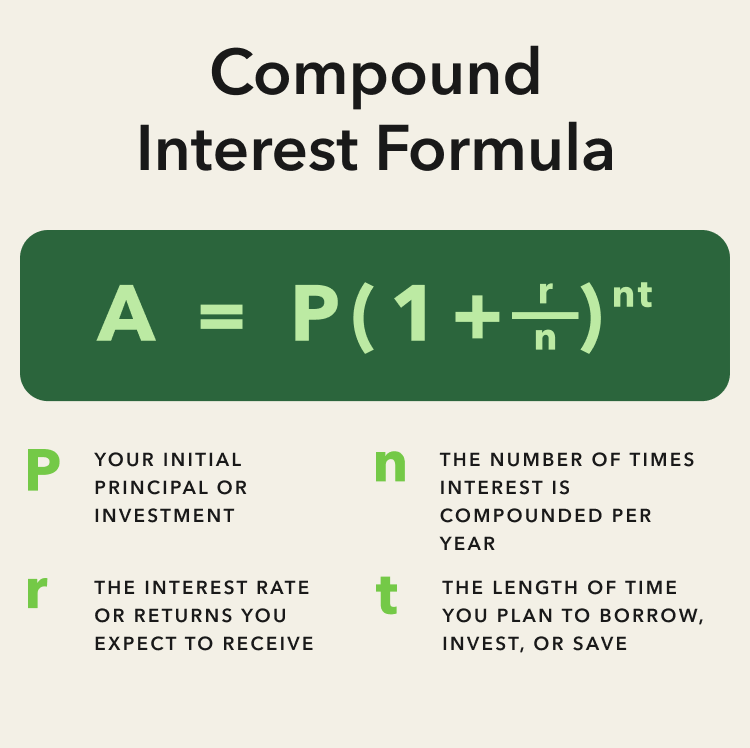
If an annual rate is nominal and compounded monthly, the image’s formula uses and . Do not divide an effective annual return by 12 in the same way: that would describe a different rate assumption. In every calculation, the rate and the number of periods must use matching units.
Equal contributions: future value of a series
Now consider depositing at the end of each year for five years at annually. The first deposit has four years to grow before the end-of-year-five measurement; the fifth is made on that measurement date and has no time to grow. The future balance is the sum of the five deposits after their respective periods of growth.
Watch the worked example before using the shortcut formula. The year-by-year portion is particularly useful for checking what the formula counts.
How To Calculate The Future Value of an Ordinary Annuity
Watch “How To Calculate The Future Value of an Ordinary Annuity” from The Organic Chemistry Tutor for an end-of-period deposit example and a year-by-year explanation of its result.
Watch deposit timing for the distinction between beginning- and end-of-period contributions. Continue with the formula example, using the five annual deposits of 1,200 at 6% to follow the substitution. Finish with the yearly balances to see why the last deposit earns no return before the final measurement.
Equal end-of-period contributions are called an ordinary annuity. Their future value is
where is each contribution, is the return per period, and is the number of contributions and periods. For the video’s figures,
The five deposits total ; the remaining is growth under the stated assumption.
Timing changes the result. If the same five deposits occur at the beginning of each year, each earns one additional year of return. Multiply the ordinary-annuity result by :
If the assumed return is zero, there is no growth to calculate: equal contributions simply total . That also avoids dividing by zero in the annuity formula.
Combine a starting balance with monthly deposits
A household might keep rather than make a one-time mortgage prepayment, and set aside at the end of every month. To project the combined account balance, calculate the starting deposit and the monthly deposits separately, then add their future values:
Suppose the stated return is nominal annually, compounded monthly, for one year. The monthly rate is , and . Applying those values gives
Of that total, is money deposited: initially and twelve deposits of . The remaining is projected growth. The monthly deposits do not all earn a full year of return.
A spreadsheet’s FV function provides a compact check. Watch how its inputs represent the rate, period count, deposits, starting balance, and deposit timing.
FV Future Value Function in Excel to Estimate Future Account Value with Initial Investment
Watch “FV Future Value Function in Excel to Estimate Future Account Value with Initial Investment” from Ralph Phillips to see a spreadsheet calculation with both a starting balance and monthly contributions.
Watch the FV inputs for the monthly rate, number of months, and negative signs on money deposited. Continue with the timing setting: a final argument of 0 means month-end deposits, while 1 means beginning-of-month deposits. The video's return is an illustration, not a promised investment result.
For the one-year example above, enter:
=FV(0.06/12,12,-200,-5000,0)
The result is approximately . The negative inputs record deposits as money paid into the account, so the resulting future balance is positive. With no monthly deposits, use 0 for the payment; with no starting balance, use 0 for the present value.
What this number does—and does not—tell you
Future value answers a narrow question: given these deposits, timing, horizon, and stated return, what is the projected balance at the end? It does not by itself establish that investing beats mortgage prepayment. In particular, a projected investment return may not occur, while a fixed-rate mortgage’s contractual interest calculation follows its loan terms.
Keep the return assumption clear. A result based on a stated gross return is a gross projection; it should not be described as after-tax or after-fee. Likewise, the account balance includes your deposits—it is not all investment gain. Those distinctions matter when the alternatives are compared.
Takeaways
Use for a deposit made now and the ordinary-annuity formula for equal end-of-period deposits. Match the rate to the deposit period, count the periods to a common end date, and adjust when contributions occur at the beginning instead. A spreadsheet FV calculation can check the arithmetic, but the result remains conditional on its return assumption.
The next lesson will place these projected balances alongside mortgage balances at the same horizon, using equal household budgets and accounting for payments freed after an early payoff.