In our last lesson, we explored how Frontier Molecular Orbital theory uses the HOMO and LUMO to explain chemical reactivity. We noted an energy hierarchy for different orbital types: σ < π < n < π* < σ*. Today, we will demystify these labels by taking a closer look at the two fundamental ways atomic orbitals combine to form covalent bonds: sigma (σ) and pi (π) interactions.
This lesson is crucial for our journey. The advanced concept of "d-p orbital hybridization" that you aim to master is, at its core, a sophisticated interplay of σ and π bonding between a metal's d-orbitals and a sulfur atom's p-orbitals. A solid grasp of these basic bond types now will make those complex interactions intuitive later. By the end of this lesson, you will be able to describe how σ and π bonds and their antibonding counterparts are formed, and you will understand their key differences, particularly in terms of strength and geometry.
Let's begin with a high-level overview.

Sigma (σ) Bonds: The Molecular Framework
The strongest and most common type of covalent bond is the sigma (σ) bond. It is formed by the direct, head-on overlap of atomic orbitals along the line connecting the two nuclei (the internuclear axis).
The defining characteristic of a σ bond is its cylindrical symmetry. If you were to look down the bond axis, the electron density would appear circular, much like looking down the length of a pipe. This symmetry allows for free rotation of the atoms around the bond axis without weakening the bond itself.
The simplest example is the formation of the H₂ molecule from two hydrogen atoms, where their spherical 1s orbitals overlap. This interaction, a linear combination of atomic orbitals (LCAO), results in two molecular orbitals:
- A bonding σ orbital: Formed by constructive interference (adding the wavefunctions) of the atomic orbitals. This concentrates electron density between the two positively charged nuclei, effectively shielding their repulsion and holding them together. This orbital is lower in energy than the original atomic orbitals, representing a stable, bonded state.
- An antibonding σ* orbital: Formed by destructive interference (subtracting the wavefunctions). This results in a nodal plane—a region of zero electron density—between the nuclei. The remaining electron density is pushed to the outside, increasing nuclear repulsion. This orbital is higher in energy and destabilizes the molecule if occupied.
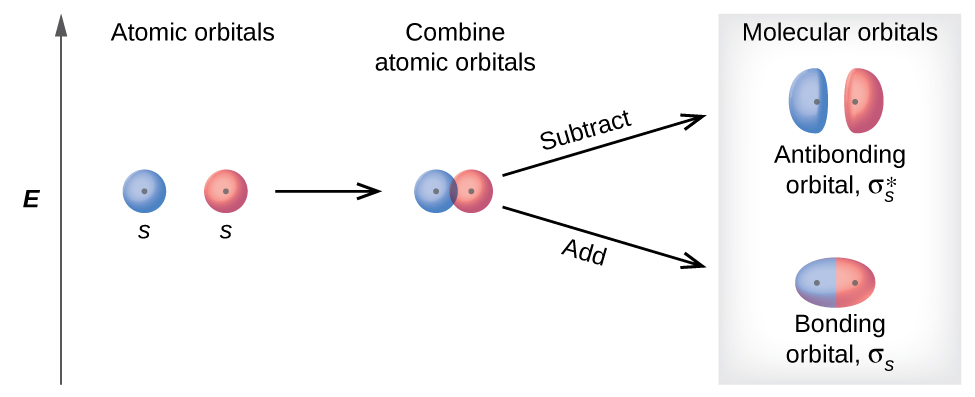
To formalize these ideas, let's turn to a more detailed explanation.
9.7: Molecular Orbitals - Chemistry LibreTexts
This article from Chemistry LibreTexts provides a clear, step-by-step introduction to forming molecular orbitals from atomic orbitals.
Please read the first two main subsections: Start at the beginning of the section "Molecular Orbitals Involving Only ns Atomic Orbitals". Focus on how the sum and difference of the 1s atomic orbitals in H₂ lead to constructive (bonding) and destructive (antibonding) interference. Then, read the following section on Energy-Level Diagrams. This part explains why a bonding MO is always more stable (lower energy) and an antibonding MO is always less stable (higher energy) than the parent atomic orbitals.
While we've used s-orbitals as our primary example, it's important to know that σ bonds can also be formed by the head-on overlap of other orbitals, such as two p-orbitals (specifically, the pz orbitals, if we define the z-axis as the bond axis) or an s-orbital and a p-orbital. All single bonds in molecules are σ bonds.
Pi (π) Bonds: The Sideways Overlap
What happens when a σ bond already exists between two atoms, and they both still have unhybridized p-orbitals? These p-orbitals are oriented perpendicular to the bond axis and cannot overlap head-on. Instead, they interact via sideways overlap. This type of interaction forms a pi (π) bond.
A π bond has a completely different shape. The electron density is concentrated in two lobes, one above and one below the internuclear axis. This means there is a nodal plane that passes directly through the nuclei.
Key characteristics of a π bond include:
- The sideways overlap is less effective than the head-on overlap of a σ bond.
- The electron density is further from the nuclei.
- Rotation around the bond axis is restricted, as it would break the sideways p-orbital overlap.
Just like with σ bonds, the sideways overlap of two p-orbitals creates both a bonding and an antibonding molecular orbital: a low-energy π orbital (constructive interference) and a high-energy π* orbital (destructive interference).
The following reading explains this process in detail.
9.7: Molecular Orbitals - Chemistry LibreTexts
We will continue with the same article from Chemistry LibreTexts to see how p-orbitals combine.
Please navigate to the subsection "Molecular Orbitals Formed from ns and np Atomic Orbitals". Focus on the figures and descriptions that show the side-to-side interaction of two npx or npy orbitals to form π and π* molecular orbitals. Note the shape of these orbitals and the location of their nodal planes.
Comparing σ and π Bonds: Strength and Combination
Now that we have seen how both bond types form, we can make a direct comparison.
Strength: The head-on overlap in a σ bond is more extensive and effective than the sideways overlap in a π bond. This leads to a greater lowering of energy for the bonding σ orbital compared to the bonding π orbital. Consequently, σ bonds are significantly stronger than π bonds. The article you just read highlights this: "The energy difference between the σ and σ* molecular orbitals is significantly greater than the difference between the two π and π* sets."
Combination: Bonds between atoms are built using a combination of σ and π bonds:
- A single bond consists of one σ bond.
- A double bond consists of one σ bond and one π bond.
- A triple bond consists of one σ bond and two π bonds (oriented at 90° to each other).
The σ bond always forms the primary connection, the strong "framework" of the bond. The weaker π bonds are then added. This is why a double bond is stronger than a single bond, but not twice as strong—you are adding a weaker π bond to an existing strong σ bond. The reactivity of molecules with multiple bonds, like the alkenes in organic chemistry or the sulfur species in your battery, is often dominated by the chemistry of the weaker, more exposed π bonds.
This short video provides an excellent summary and comparison of everything we've discussed.
This video from the "Chemistry Student" channel clearly explains and compares sigma and pi bonds.
Please watch the entire video. It's short and serves as a great consolidation of the key concepts. Pay close attention to the following parts: Sigma Bonds: This section defines sigma bonds, highlighting their strength and rotational freedom. Pi Bonds: This part explains their formation from sideways overlap, their weaker nature, and restricted rotation. Direct Comparison: A very useful summary of the key differences. Final Summary: This reinforces all the main points of the lesson.
Conclusion
In this lesson, we have dissected the fundamental building blocks of covalent bonds. Understanding the distinction between the strong, foundational σ bonds and the weaker, more reactive π bonds is essential for analyzing molecular structure and reactivity.
Here are the key takeaways:
- Sigma (σ) bonds are formed by head-on overlap of atomic orbitals, resulting in a strong bond with electron density concentrated along the internuclear axis. All single bonds are σ bonds.
- Pi (π) bonds are formed by the sideways overlap of parallel p-orbitals, resulting in a weaker bond with electron density above and below the internuclear axis.
- Every interaction creates a lower-energy bonding orbital (σ or π) and a higher-energy antibonding orbital (σ* or π*).
- Multiple bonds are combinations: a double bond is 1 σ + 1 π, and a triple bond is 1 σ + 2 π.
You have now completed the first module on chemical bonding! You have covered atomic orbitals, molecular orbital theory, hybridization, frontier orbitals, and now the specifics of σ and π bonding. You are well-equipped to tackle the main subject of this course: transition metals.
Our next lesson will begin the second module, "Crystal and Ligand Field Theory." We will start by examining what happens to the five d-orbitals of a transition metal atom when it is placed in the electrostatic field created by surrounding atoms or molecules (ligands). This is the first step toward understanding how to "engineer" the electronic states of catalytic centers.