Welcome to the final lesson in our first module on chemical bonding. In our previous lesson, we distinguished between sigma (σ) and pi (π) bonds based on their geometry of overlap. We saw that σ bonds result from direct, head-on overlap, while π bonds arise from sideways overlap of p-orbitals. We also established that this process creates both low-energy bonding orbitals and high-energy antibonding orbitals.
Today, we will move from the what to the how and why. We will establish the fundamental rules that govern whether two atomic orbitals can combine to form a stable chemical bond. You will learn that it's not enough for orbitals to simply be near each other; their interaction is governed by strict conditions of symmetry and energy. Mastering these principles is the final step in building our foundation and is absolutely critical for understanding the complex d-p orbital interactions at the heart of catalysis, which is the central goal of this course.
By the end of this lesson, you will be able to explain how orbital overlap is governed by symmetry and energy matching, the two key pillars of effective bond formation.
The Conditions for Covalent Bond Formation
In molecular orbital theory, forming a stable bond isn't arbitrary. For atomic orbitals to combine effectively into molecular orbitals, three essential conditions must be met. This short video provides a concise overview of these rules.
Molecular Orbital Theory: Formation and Symmetry
This clip from Professor Adam Teaches clearly lays out the three prerequisites for forming molecular orbitals.
Please watch the clip from the beginning until the end. Listen for the three distinct rules mentioned.
As the video states, the three conditions are:
- The atomic orbitals must be close enough in space to achieve significant overlap.
- The atomic orbitals must have similar energy.
- The atomic orbitals must have matching symmetry.
The first condition is intuitive and was the basis of our last lesson—atoms must be at an appropriate distance for their orbitals to interact. The other two conditions, symmetry and energy, are more nuanced and are the key focus of today's lesson.
Let's use a chapter from a standard inorganic chemistry textbook to explore these rules in more detail.
[PDF] M olecular Orbitals - For College
This text formalizes the three conditions we've just introduced.
In the first section of the chapter, 5.1, please read the paragraph that begins here. It summarizes the criteria for effective overlap.
Now, let's dissect the concepts of symmetry and energy matching.
Condition 1: Symmetry Matching
Symmetry matching means that the overlapping parts of the atomic orbitals must have the same phase (sign of the wavefunction, often represented by +/- or color). If the positive lobe of one orbital overlaps equally with both the positive and negative lobes of another, the bonding and antibonding effects cancel out, and no net interaction occurs.
More formally, we classify orbitals based on their symmetry with respect to the internuclear axis (the line connecting the two atoms).
- Sigma (σ) symmetry: The orbital is symmetric to rotation around the internuclear axis. It looks the same after any amount of rotation. All s-orbitals and the p-orbital aligned with the axis (p_z) have σ symmetry.
- Pi (π) symmetry: The orbital is anti-symmetric to a 180° rotation around the internuclear axis, meaning its phase flips. The p-orbitals perpendicular to the axis (p_x, p_y) have π symmetry.
The fundamental rule is that only orbitals with the same symmetry can combine. A σ-symmetric orbital can only combine with another σ-symmetric orbital. A π-symmetric orbital can only combine with another π-symmetric orbital.
The following video provides an excellent intuitive and visual explanation of this principle.
Molecular Orbitals: Exploring Linear Combinations of Atomic Orbitals (LCAOs)
This video from RojasLab gives a clear definition of sigma and pi symmetry based on rotation around the internuclear axis.
Watch the following segments: Sigma symmetry: This part explains why s-orbital and head-on p-orbital overlaps are classified as sigma. Notice the key idea: rotating along the internuclear axis doesn't cause a phase change or cross a node. Pi symmetry: This part defines pi symmetry. Note the crucial difference: a node exists along the internuclear axis, and rotation causes the phases to switch.
This symmetry requirement explains why, for example, an s-orbital (σ symmetry) can overlap with a p_z orbital (σ symmetry) but cannot form a bond with a p_x orbital (π symmetry) if the bond is along the z-axis. The positive s-orbital would overlap with both the positive and negative lobes of the p_x orbital, resulting in zero net interaction.

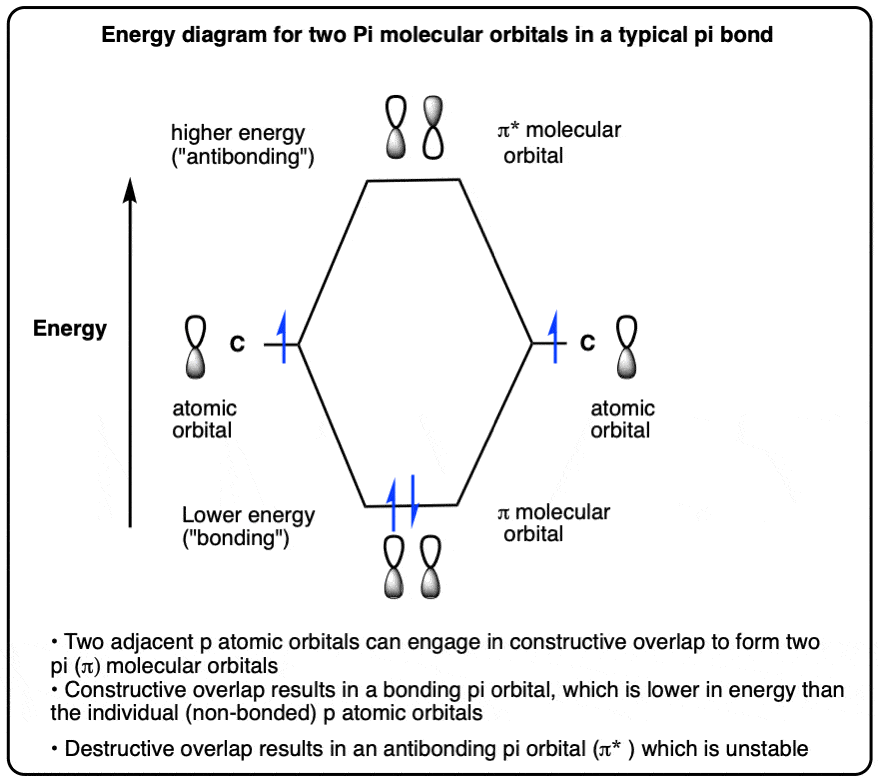
Condition 2: Energy Matching
The second major rule is that interacting atomic orbitals must have similar energies. The strength of the interaction and the stability of the resulting bond are directly related to how closely the energies of the parent atomic orbitals match.
- Good Energy Match: When two orbitals with similar energy combine, they produce a low-energy bonding MO and a high-energy antibonding MO. The energy stabilization of the bonding orbital is large, leading to a strong bond.
- Poor Energy Match: When two orbitals with very different energies combine, the resulting bonding MO is only slightly lower in energy than the more stable parent AO, and the antibonding MO is only slightly higher than the less stable parent AO. The stabilization energy is minimal, so the interaction is very weak and often considered nonbonding.
The following reading explains this principle and its consequences.
[PDF] M olecular Orbitals - For College
We return to the textbook chapter to explore the consequences of energy matching.
First, read the section "Nonbonding Orbitals and Other Factors" (Section 5.1.4). Pay close attention to Figure 5.4, which is an excellent visual representation of this concept. Next, read the first two paragraphs of Section 5.3.1, "Polar Bonds". This section shows how the principle applies to heteronuclear molecules, where the atoms' orbitals naturally have different energies. Notice in Table 5.2 how orbital energies change across the periodic table. For example, the 2p orbital of Oxygen (-15.85 eV) has a very different energy from the 1s orbital of Hydrogen (-13.61 eV), but it is a better match than, for instance, the 2p orbital of Fluorine (-18.65 eV).
Case Study: The Interplay of Symmetry and Energy in N₂ vs. O₂
Now, let's see how these two rules work together to explain a classic chemical phenomenon: s-p mixing.
In diatomic molecules of the second period (like N₂ and O₂), the 2s and 2p_z orbitals of both atoms all have σ symmetry. According to the symmetry rule, they can interact. Whether they do interact effectively depends on the energy rule.
- In N₂: The energy gap between the 2s and 2p orbitals is relatively small. Therefore, the σ-symmetric molecular orbitals formed from the 2s and 2p_z atomic orbitals mix. This mixing pushes the bonding σ_2s down in energy and, more importantly, pushes the bonding σ_2p up in energy, above the π_2p orbitals.
- In O₂: The energy gap between the 2s and 2p orbitals is larger. The energy match is poor, so s-p mixing is negligible. The orbital ordering remains "unmixed," with the σ_2p orbital staying below the π_2p orbitals.
This is a perfect example showing that matching symmetry is a prerequisite, but the energy match determines the extent of the interaction.
This final video beautifully illustrates this exact point, solidifying the concepts of the lesson.
Molecular Orbitals: Exploring Linear Combinations of Atomic Orbitals (LCAOs)
This clip brings together the concepts of symmetry and energy matching using the N₂ and O₂ examples.
Please watch the segment from 07:40 to 09:05. The video explains precisely why s-p mixing occurs in nitrogen but not in oxygen, referencing both the symmetry and the energy gap between the orbitals.
This phenomenon of orbital mixing is not just a theoretical curiosity; it correctly predicts the magnetic properties of molecules like B₂ and C₂ and is a direct consequence of the fundamental rules we have studied today.
Conclusion
In this lesson, we have established the three fundamental rules that govern the formation of covalent bonds from atomic orbitals. These principles provide a powerful framework for predicting and understanding chemical bonding.
Here are the key takeaways:
- Three Conditions for Bonding: For atomic orbitals to form a bond, they must have sufficient overlap, matching symmetry, and similar energy.
- Symmetry Matching: Orbitals are classified by their symmetry (e.g., σ or π) with respect to the internuclear axis. Only orbitals of the same symmetry can combine.
- Energy Matching: The strength of the interaction depends on the energy difference between the atomic orbitals. A small energy gap leads to strong interaction and significant stabilization, while a large energy gap leads to a weak, or nonbonding, interaction.
- Nonbonding Orbitals: If an orbital finds no other orbitals with matching symmetry or a reasonable energy match, it remains largely unchanged in the molecule and is termed a nonbonding orbital.
This lesson concludes our first module on the essentials of chemical bonding. You are now equipped with the core concepts of molecular orbital theory, from the shapes of atomic orbitals to the rules governing their interaction.
In our next lesson, we will begin Module 2, "Crystal and Ligand Field Theory." We will apply the principles of symmetry and energy directly to the d-orbitals of transition metals, investigating how their energies split and change when placed in the environment of a catalyst. This is the first major step from fundamental theory toward engineering the electronic states you aim to master.