Welcome to the fourth lesson of our module on chemical bonding. In our previous lessons, we built a picture of how atoms form molecules, first using the comprehensive Molecular Orbital (MO) theory and then the intuitive hybridization model. We saw how hybridization explains the geometry of carbon frameworks like graphene, and how MO theory explains the electronic structure of the entire molecule.
Today, we will build on the MO framework to introduce one of the most powerful concepts for predicting chemical reactivity: Frontier Molecular Orbital (FMO) theory. This theory simplifies the complex landscape of molecular orbitals by focusing on just two: the Highest Occupied Molecular Orbital (HOMO) and the Lowest Unoccupied Molecular Orbital (LUMO). By the end of this lesson, you will be able to identify the HOMO and LUMO of a molecule and explain their central role in dictating the course of chemical reactions—a concept that is fundamental to understanding catalysis.
The Frontier of Reactivity: HOMO and LUMO
In any molecule, electrons fill the available molecular orbitals from the lowest energy level upwards. The HOMO is, as the name suggests, the molecular orbital of the highest energy that contains electrons. The LUMO is the molecular orbital of the lowest energy that is empty (or unoccupied). These two orbitals lie at the "frontier" between the occupied and unoccupied electronic states.
Why are they so important?
- The electrons in the HOMO are the most weakly held and thus the most easily donated. They are the first to participate in a reaction.
- The LUMO is the most accessible "landing spot" for incoming electrons from another molecule.
Essentially, a vast majority of chemical reactions can be understood as an interaction where electrons flow from the HOMO of one molecule to the LUMO of another.
The following article from Ossila provides an excellent introduction.
Understanding HOMO and LUMO in Chemistry | Ossila
This article introduces the core concepts of HOMO and LUMO and their basis in molecular orbital theory.
Please read the first two main sections: The introduction, which defines HOMO, LUMO, and the term "frontier orbitals." The section on Molecular Orbital Theory. This part recaps how atomic orbitals combine to form bonding (stabilizing) and antibonding (destabilizing) molecular orbitals. Pay attention to how the HOMO is typically a bonding or non-bonding orbital, while the LUMO is often an antibonding orbital.
Given your physics background, you can think of the HOMO and LUMO in a molecule as being analogous to the valence band maximum and the conduction band minimum in a solid-state semiconductor. The HOMO-LUMO gap is conceptually similar to the material's bandgap. In fact, the article you just reviewed makes this exact comparison in a later section, which we will revisit when we discuss solid-state catalysts.
The Dance of Orbitals: HOMO-LUMO Interactions
The core principle of FMO theory is that a chemical bond is formed when the HOMO of one species overlaps with the LUMO of another.
- The species that donates electrons from its HOMO is called the nucleophile (literally, "nucleus-loving," as it seeks a region of positive charge) or a Lewis base.
- The species that accepts electrons into its LUMO is called the electrophile ("electron-loving") or a Lewis acid.
The following short video explains this fundamental interaction very clearly.
MO Theory 6: Frontier Molecular Orbitals (FMOs) in Reactions
This video from Oxford College Chemistry Courses provides a concise and clear explanation of how HOMO-LUMO interactions drive chemical reactions.
Please watch the first three sections: The introductory part explains the core idea that reactions involve electron motion from a donor's HOMO to an acceptor's LUMO, linking these roles to nucleophiles and electrophiles. The NH₃ + BH₃ example provides an excellent demonstration of identifying the HOMO (lone pair on NH₃) and LUMO (empty p-orbital on BH₃) to predict which molecule acts as the donor and which as the acceptor. The final segment shows how the original HOMO and LUMO combine to form new bonding and antibonding orbitals, resulting in a new chemical bond.
The key to a favorable reaction is not just orbital overlap, but also a good energy match. The reaction is more favorable (i.e., has a lower activation energy) when the energy difference between the donor's HOMO and the acceptor's LUMO is small.
How to Spot the HOMO and LUMO
For most organic and simple inorganic molecules, we can identify the likely HOMO and LUMO by following a general energy hierarchy for different types of orbitals. This is a powerful shortcut that avoids the need to calculate the full MO diagram for every molecule.
The general energy trend is:
σ < π < n < π < σ**
- σ (sigma) and π (pi) orbitals are bonding orbitals. Since σ bonds are generally stronger than π bonds, σ orbitals are lower in energy.
- n (non-bonding) orbitals hold lone pair electrons. They do not directly participate in bonding, so their energy is often similar to the atomic orbitals from which they came. They are typically higher in energy than π bonding orbitals.
- π* (pi-star) and σ* (sigma-star) orbitals are the corresponding antibonding orbitals. They are always higher in energy than their bonding counterparts.
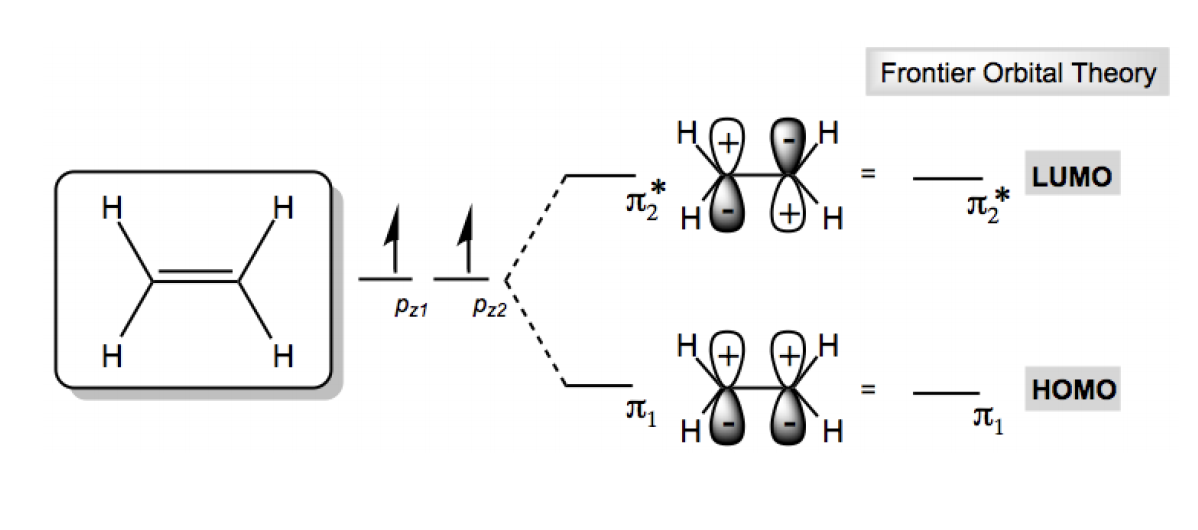
From this energy ordering, we can deduce the most likely candidates for frontier orbitals:
- HOMO: The highest energy electrons will be in the highest available orbitals. Therefore, the HOMO is usually a non-bonding orbital (n) if one exists, or a π bonding orbital if the molecule has double or triple bonds. It is rarely a σ orbital.
- LUMO: The lowest energy empty orbital is the first one available above the HOMO. This is typically a π* antibonding orbital in molecules with multiple bonds, or a σ* antibonding orbital in molecules with only single bonds.
The following video provides an excellent walkthrough of this logic and applies it to several common reaction types.
Introduction to HOMO LUMO Interactions in Organic Chemistry
This video from "Organic Chemistry with Victor" gives a practical guide to identifying HOMO and LUMO based on orbital types and using them to understand reaction mechanisms.
Watch these key segments: Orbital Energy Levels: This part establishes the crucial energy hierarchy: σ < π < n < π* < σ*. Defining HOMO and LUMO: This provides a clear definition and shows where they typically fall in the energy diagram. HOMO-LUMO Interactions: This section explains the central rule: all reactions are HOMO-LUMO interactions. Examples: The narrator analyzes acid-base, substitution, and addition reactions, identifying the specific HOMO and LUMO for each step (e.g., n → σ*, or π → σ*). This is a great way to see the theory in action.
Application to Catalysis and a Look Ahead
How does this relate to your goal of engineering catalysts for Li-S batteries? The reactions you want to accelerate—the conversion of sulfur (S₈) to lithium polysulfides (LiPSs) and finally to Li₂S—are all governed by HOMO-LUMO interactions.
- Breaking Bonds: To break the S-S bond in S₈ or a long-chain polysulfide, the catalyst must donate electron density from its HOMO into the σ* (S-S) antibonding orbital (the LUMO) of the sulfur species. Populating this antibonding orbital weakens and eventually breaks the bond.
- Forming Bonds: To anchor a polysulfide to the catalyst surface, an interaction occurs between the HOMO of the polysulfide (typically a lone pair on a sulfur atom, an 'n' orbital) and the LUMO of the catalyst (an empty d-orbital on the transition metal).

The entire purpose of "d-p orbital hybridization engineering" and "spin-state regulation" is to precisely control the energy levels of the catalyst's d-orbitals, which function as its frontier orbitals (both HOMO and LUMO). By tuning the catalyst's HOMO to be high enough in energy and its LUMO to be low enough, we create a minimal energy gap with the LUMO and HOMO of the sulfur species, respectively. This perfect energy alignment dramatically lowers the activation energy, making the catalytic conversion fast and efficient.
In the next module, we will dive deep into the behavior of these crucial d-orbitals using Crystal Field and Ligand Field Theory. You will see exactly how the surrounding atoms (like the nitrogen in an M-N₄ site) split the d-orbitals into different energy levels, creating the specific HOMO and LUMO needed for catalysis.
Conclusion
In this lesson, we've unlocked a fundamental principle of chemical reactivity. By focusing on the two orbitals at the electronic frontier, we can gain profound insight into why and how reactions occur.
Here are the key takeaways:
- Frontier Molecular Orbital (FMO) theory simplifies reactivity by focusing on the HOMO (Highest Occupied Molecular Orbital) and LUMO (Lowest Unoccupied Molecular Orbital).
- Chemical reactions are predominantly interactions where electrons flow from the HOMO of a nucleophile to the LUMO of an electrophile.
- The energy gap between the HOMO and LUMO determines the favorability of a reaction: a smaller gap leads to a faster reaction.
- We can often identify the HOMO and LUMO by considering the general energy ordering of orbital types: σ < π < n < π < σ**.
This lesson completes our module on the fundamentals of chemical bonding. You now possess the essential conceptual toolkit—atomic orbitals, MO theory, hybridization, and FMO theory—to analyze the electronic structure of the advanced catalytic materials central to your research.
In our next module, "Crystal and Ligand Field Theory," we will shift our focus to transition metals. We will begin by exploring how a simple electrostatic model can explain the splitting of d-orbital energies, which is the first step toward understanding and controlling their catalytic power.