Welcome to your first lesson. Your goal is to master the electronic and spin-state properties of catalysts for lithium-sulfur batteries, a topic that sits at the intersection of materials science, electrochemistry, and quantum chemistry. To get there, we must start with the absolute fundamentals: the nature of the electrons we aim to control.
This first module, "Chemical Bonding Essentials for Catalysis," will build your foundation in the quantum mechanical description of electrons in atoms and molecules. In this introductory lesson, we will address the shapes, nodal structures, and energy ordering of the atomic orbitals—specifically the s, p, and d orbitals—that are the building blocks of chemical bonds and the key players in catalysis. We'll move beyond the simplified planetary model of the atom, which you may have encountered in introductory physics, and construct a more powerful and accurate picture based on quantum mechanics.
From Orbits to Orbitals: A Quantum View
In classical physics, we can describe the trajectory of a particle like a planet with certainty. However, for an electron in an atom, the Heisenberg Uncertainty Principle forbids us from knowing both its position and momentum simultaneously. Instead, the Schrödinger equation gives us a wavefunction, , which describes the electron's behavior. While the wavefunction itself is a mathematical abstraction, its square, , has a direct physical meaning: it represents the probability density of finding the electron at a particular point in space.
The regions in space where the electron is most likely to be found are called atomic orbitals. These are not planetary orbits but rather three-dimensional probability maps. The shape, energy, and orientation of these orbitals are not arbitrary; they are quantized, arising as solutions to the Schrödinger equation for an electron under the influence of the nuclear potential.
To build an intuition for why these quantized orbitals and their specific shapes emerge, let's start with a powerful analogy: standing waves on a string. Confining a wave leads to discrete modes of vibration, each with a specific number of nodes (points of zero amplitude) and a corresponding energy. The more nodes, the higher the energy. This same principle applies to the electron's wavefunction confined in the 3D space around a nucleus.
The following video provides an excellent intuitive journey, building the shapes of atomic orbitals from this very concept. It connects the number of nodes to the energy of the electron and explains how different types of nodes (radial vs. angular) give rise to different orbital shapes.
I finally understood orbital shapes intuitively! (My mind is blown)
Watch the video "We finally understood orbital shapes intuitively!" from the FloatHeadPhysics channel. It will guide you from the concept of a standing wave to the shapes of s, p, and d orbitals.
Please watch the following segments: Standing Wave Analogy: Pay close attention to how confining a wave leads to discrete energy levels and how nodes correspond to higher energy states. Building the 1s Orbital: See how the simplest standing wave in 3D creates a spherical probability distribution, the 1s orbital. The segment from "What is an orbital?" provides a crucial clarification that these are probability maps, not paths. The 2s Orbital and Radial Nodes: Understand how the first excited state introduces a spherical, or "radial," node. The p Orbitals and Angular Nodes: This is a key part. See how a planar, or "angular," node can be introduced by symmetrically "slicing" the sphere, leading to the dumbbell shape of p orbitals and their three possible orientations. Radial vs. Angular Nodes: This section summarizes the two types of nodes. The d Orbitals: See how introducing two angular nodes leads to the four-lobed shape characteristic of d orbitals. This intuitive approach will provide a strong conceptual framework before we formalize these ideas with quantum numbers.
A Systematic Description: Quantum Numbers
The video gave us an intuitive feel for why orbitals have specific shapes and energies. Now, let's formalize this using the language of quantum mechanics. Each electron in an atom is described by a unique set of four quantum numbers, which arise from the solution of the Schrödinger equation. For this lesson, we will focus on the first three, which define a specific orbital.
Matter - Electron Shells and Orbitals - TechnologyUK
This article from TechnologyUK provides a clear, systematic introduction to quantum numbers. It explains how these numbers govern the properties of orbitals.
Please read the section titled Quantum Numbers. As you read, focus on how the first three quantum numbers—n, ℓ, and m—define an orbital's size, shape, and orientation. We will cover the fourth (spin) quantum number in a later lesson.
To summarize and reinforce these definitions:
-
Principal Quantum Number (n):
- Can be any positive integer ().
- Determines the electron's primary energy level and its average distance from the nucleus (the size of the orbital). Higher n values mean higher energy and larger orbitals.
-
Angular Momentum Quantum Number (ℓ):
- Can be any integer from 0 up to .
- Determines the shape of the orbital. This number is directly related to the number of angular nodes you saw in the video.
- By convention, we use letters instead of the number ℓ:
- ℓ = 0 corresponds to an s orbital (spherical shape, 0 angular nodes).
- ℓ = 1 corresponds to a p orbital (dumbbell shape, 1 angular node).
- ℓ = 2 corresponds to a d orbital (cloverleaf/complex shape, 2 angular nodes).
-
Magnetic Quantum Number (m_ℓ):
- Can be any integer from to , including 0.
- Determines the orientation of the orbital in space.
- The number of possible values for a given ℓ () tells you how many orbitals of that shape exist at a given energy level.
- For an s orbital (ℓ=0), (1 orientation).
- For p orbitals (ℓ=1), (3 orientations: ).
- For d orbitals (ℓ=2), (5 orientations).
Orbital Atlas: Shapes and Nodes of s, p, and d Orbitals
With the quantum numbers as our guide, let's examine the specific shapes and nodal structures of the orbitals that are most relevant to your goal. The technologyuk.net article provides a great overview.
Matter - Electron Shells and Orbitals - TechnologyUK
Now, let's use the same article to explore the shapes of the orbitals themselves.
Read the sections on s orbitals, p orbitals, and d orbitals. Pay close attention to the descriptions of their geometry and orientation relative to the Cartesian axes.
s Orbitals (ℓ=0)
These are spherically symmetric. The 1s orbital is the ground state and has no nodes. The 2s orbital has one radial node—a spherical shell where the probability of finding the electron is zero. The 3s orbital has two radial nodes, and so on.
p Orbitals (ℓ=1)
These exist for . They have a characteristic dumbbell shape with two lobes of opposite phase ( and ) separated by an angular node at the nucleus. This nodal plane is what gives p orbitals their directionality. The three p orbitals () are degenerate (have the same energy) and are oriented along the x, y, and z axes, respectively.
d Orbitals (ℓ=2)
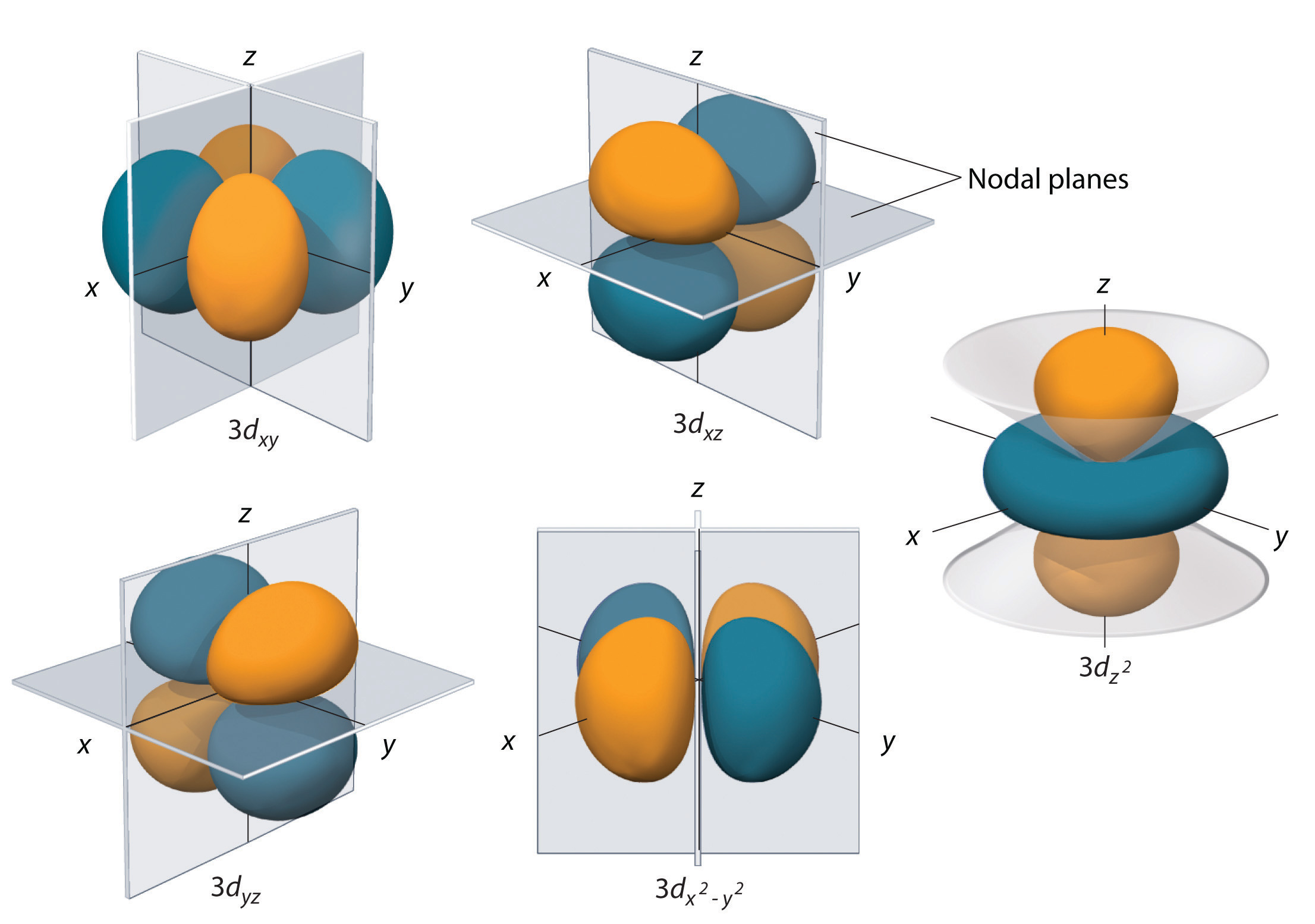
These are the heart of transition metal chemistry and are critical to your goal of understanding catalysis. They exist for . They have more complex shapes with two angular nodes. There are five degenerate d orbitals:
- , , and : These three orbitals have four lobes that lie in the xy, xz, and yz planes, respectively, between the coordinate axes.
- : This orbital also has four lobes, but they are aligned directly along the x and y axes.
- : This orbital has a unique shape: two main lobes along the z-axis and a torus (or "doughnut") of electron density in the xy plane. Its two angular nodes are conical surfaces.
The precise shapes and orientations of these five d orbitals are essential, as they will determine how a transition metal atom interacts with other atoms, like the sulfur in polysulfides.
A simple set of rules can help you determine the nodal structure of any orbital:
- Total nodes =
- Angular nodes = ℓ
- Radial nodes =
For example, a 3d orbital () has a total of nodes. Since , both of these are angular nodes, which is consistent with the shapes shown above. A 4s orbital () has total nodes, all of which are radial.
Energy Ordering and the Aufbau Principle
Now that we know the shapes of the orbitals, we need to know the order in which they are filled with electrons. This is governed by their relative energies. In a multi-electron atom, orbital energies depend on both n and ℓ.
The general order of filling is dictated by the Aufbau principle (German for "building up"). Electrons fill the lowest energy orbitals available first.
Quantum Numbers, Atomic Orbitals, and Electron Configurations
The video "Quantum Numbers, Atomic Orbitals, and Electron Configurations" from Professor Dave Explains provides a quick summary of the Aufbau principle.
Watch the segment from the discussion of energy levels to see the general filling order.
The energy ordering is generally:
1s < 2s < 2p < 3s < 3p < 4s < 3d < 4p < 5s < 4d ...
An important feature for transition metals is the energy crossover between shells. Notice that the 4s orbital is filled before the 3d orbitals. Why does this happen?
Although the 3d orbitals have a smaller principal quantum number (n=3) and are on average closer to the nucleus, the 4s orbital is more "penetrating." It has a small region of probability density very close to the nucleus, inside the main lobes of the 3d orbitals. This penetration allows the 4s electron to experience a greater effective nuclear charge, which lowers its energy, making it slightly more stable than the 3d orbitals in potassium (K) and calcium (Ca).
This effect is visualized in the following radial distribution plot, which shows the probability of finding an electron at a certain distance (radius) from the nucleus.

Once the 3d orbitals begin to fill (starting with Scandium, Sc), their energy drops below that of the 4s orbital. This subtle interplay of energies is fundamental to the chemistry of transition metals, which we will explore throughout this course.
Conclusion
In this lesson, we established the fundamental quantum mechanical description of electrons in atoms. We have moved from a simple planetary picture to a probabilistic model of orbitals defined by a set of quantum numbers.
Here are the key takeaways:
- Atomic orbitals are three-dimensional regions of probability () that describe where an electron is likely to be found.
- The principal quantum number (n) determines the orbital's size and main energy level.
- The angular momentum quantum number (ℓ) determines the orbital's shape (s, p, d) and the number of angular nodes.
- The magnetic quantum number (m_ℓ) determines the orbital's spatial orientation.
- s, p, and d orbitals have distinct shapes (spherical, dumbbell, and cloverleaf/torus, respectively) and nodal structures that govern their properties. The five d orbitals are particularly important for transition metal chemistry.
- The Aufbau principle describes the energy ordering for filling orbitals, with key crossovers like the 4s orbital filling before the 3d.
You now have the basic vocabulary and conceptual framework to discuss the electronic structure of atoms. In the next lesson, we will see what happens when these atomic orbitals from different atoms interact. We will build molecular orbitals and begin to understand the nature of the chemical bond, bringing us one step closer to your goal of engineering the crucial d-p orbital interactions in battery catalysts.