Introduction
Welcome to the first lesson of our final module on "Ethics, Regulation, and the Future of Dental AI." In the last module, you became adept at evaluating a commercial AI product's claims by looking at its validation studies. We established that being "Lawful"—having regulatory clearance—is a foundational pillar of a trustworthy AI system. You even saw specific FDA clearance codes for products like Overjet.
In this lesson, we will build directly on that foundation. Our learning outcome is to explain the main regulatory pathways for AI medical devices in dentistry. We'll demystify what terms like "FDA clearance," "510(k)," and "Class II device" actually mean. We'll explore the primary frameworks in the United States and Europe that govern how an AI tool gets from the developer's lab to your clinical workflow.
Understanding these pathways is crucial for you as a future clinician. The level of regulatory scrutiny a device has undergone is a direct indicator of the evidence that supports its safety and effectiveness, empowering you to make more informed decisions about the tools you adopt in your practice.
The Regulatory Landscape: What Is a "Medical Device"?
When we think of a medical device, we often picture a physical object like a dental implant or a curing light. However, when AI is used for a medical purpose—such as diagnosing disease—the software itself is considered a Software as a Medical Device (SaMD).
Regulatory bodies like the U.S. Food and Drug Administration (FDA) don't regulate all software, but they step in when it's intended for medical purposes. The level of regulation depends on the risk the software poses to a patient.
To understand this, let's look at a white paper from the American Dental Association (ADA) that explains this concept with a perfect dental example.
Artificial and Augmented Intelligence: Uses in Dentistry
The ADA's 'Artificial and Augmented Intelligence: Uses in Dentistry' paper provides an excellent overview of the regulatory environment. We'll focus on how the FDA views risk.
Please read the subsection 'The U.S. Regulatory Landscape (Jan 2022)' on page 28. Focus on the example given about a caries detection tool. Notice how the same tool used for different purposes (back-office quality control vs. chair-side diagnosis) carries different risk profiles and would be subject to different levels of scrutiny.
As you saw, the context of use is everything. An AI tool that helps a billing clerk check if a radiograph was attached to a claim is low-risk. The same AI, when used by a dentist to help find caries, is higher-risk because a missed or incorrect finding could directly impact patient care. This risk-based approach is the core principle of medical device regulation.
While there are many regulatory bodies worldwide, we will focus on the two most influential frameworks for the dental market: the FDA in the United States and the CE marking process in the European Union.
The U.S. FDA Pathway: Classes and Pathways
The FDA categorizes all medical devices, including SaMD, into three classes based on their level of risk. This classification determines the regulatory path a device must take to be legally marketed.
To start, let's get a clear definition of these classes and their corresponding regulatory requirements.
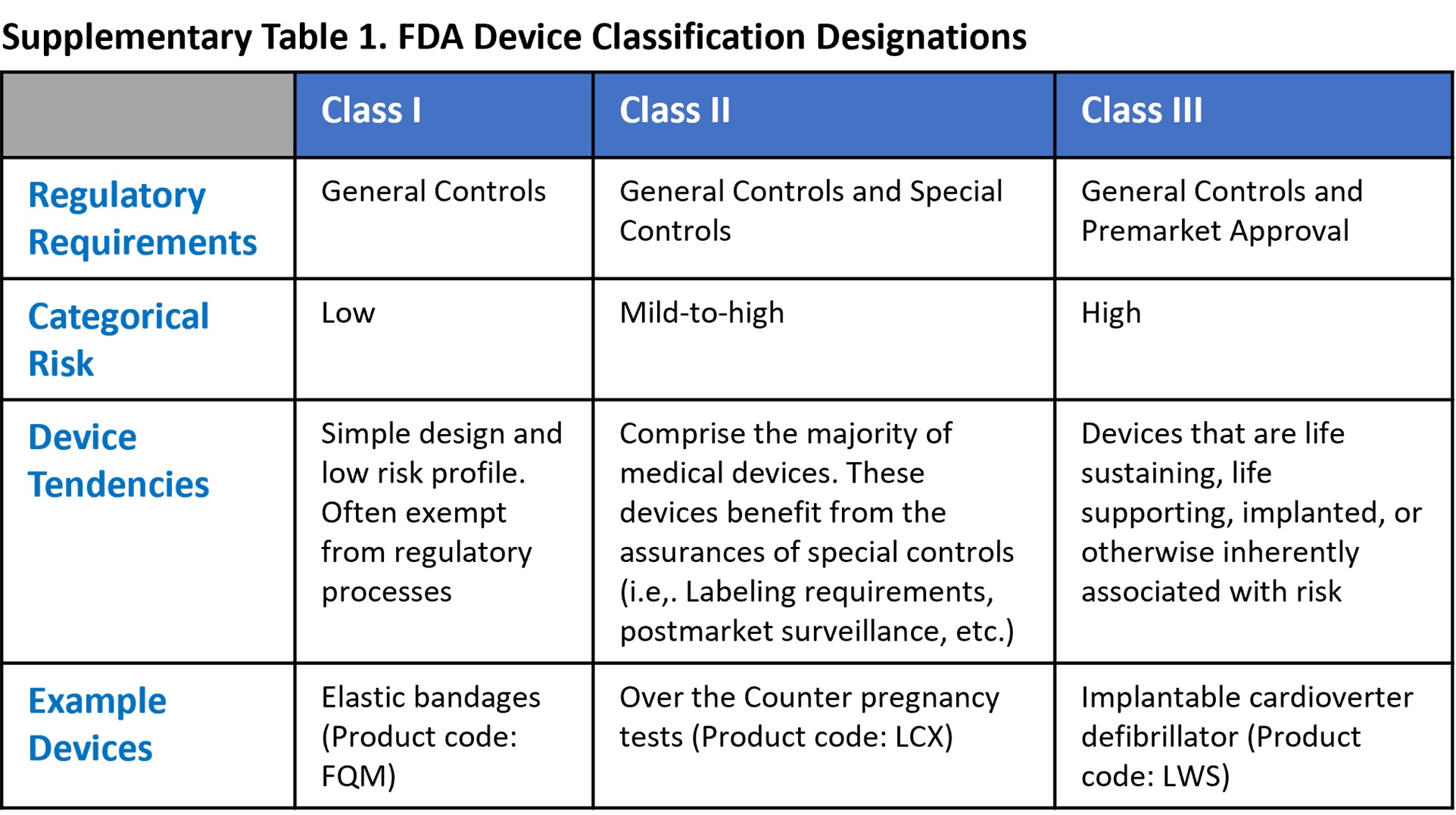
As the table shows:
- Class I (Low Risk): Subject to "General Controls" like good manufacturing practices. Most are exempt from premarket review.
- Class II (Moderate Risk): Subject to General Controls and "Special Controls" (e.g., performance standards, specific labeling). This is where most dental AI for diagnostics falls.
- Class III (High Risk): Devices that support or sustain life, or present a high risk of illness or injury. They require the most stringent review.
Now, let's connect these classes to the specific submission pathways.
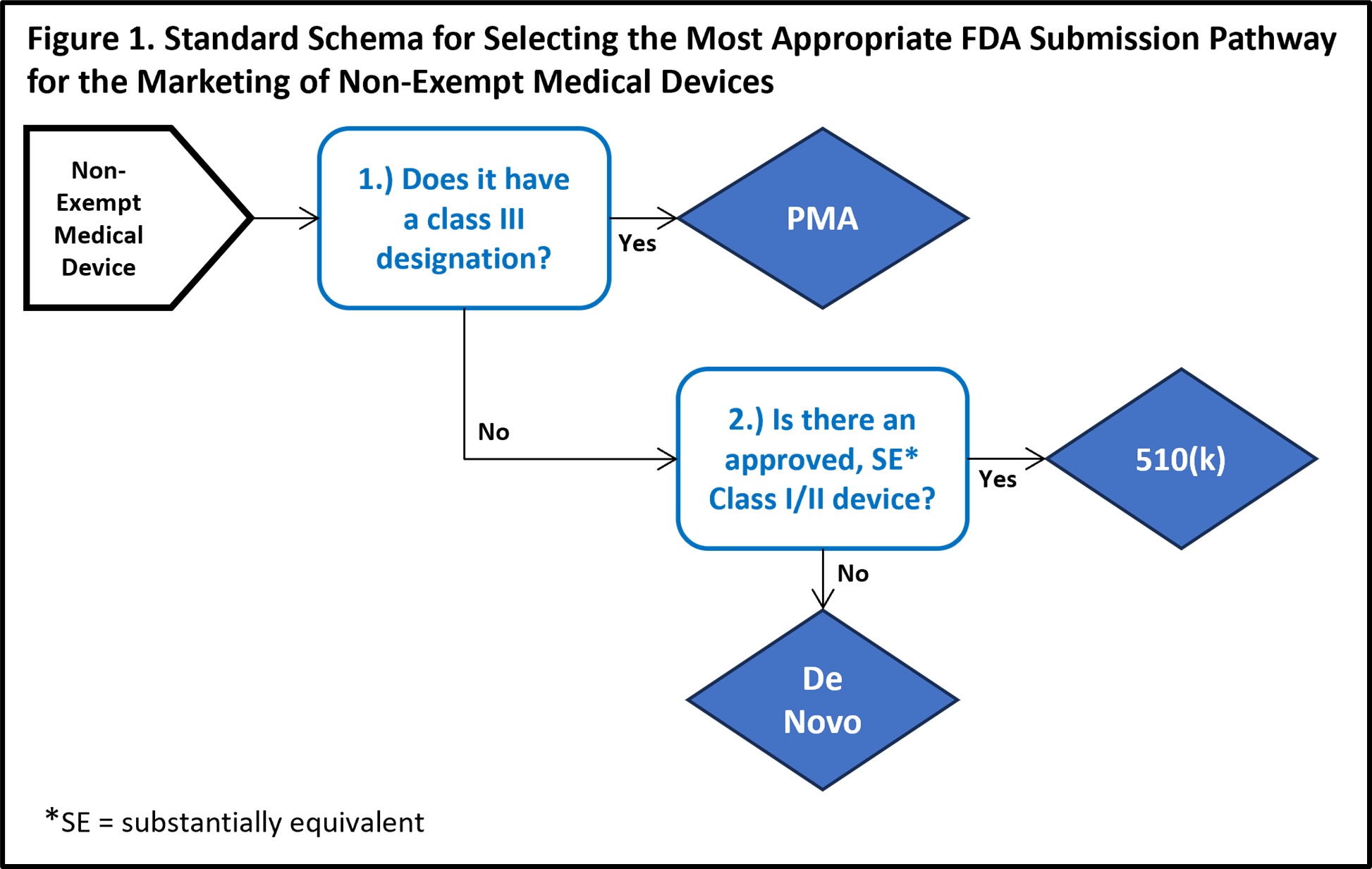
The flowchart shows the main routes to market:
- Premarket Approval (PMA): The required path for Class III devices. Manufacturers must provide extensive scientific evidence to the FDA proving the device's safety and effectiveness. This is a very high bar.
- 510(k) Premarket Notification: The most common pathway for Class II devices. A manufacturer must demonstrate that their new device is "substantially equivalent" to a legally marketed device that is already on the market (a "predicate device"). It's about showing the device is at least as safe and effective as its predecessor, not necessarily proving its effectiveness from scratch.
- De Novo Classification: A pathway for novel low-to-moderate risk devices that don't have a predicate device. If successful, the FDA creates a new classification, and this device can then serve as a predicate for future 510(k) submissions.
- Exempt: Most Class I devices are exempt from premarket submission requirements.
Let's ground these concepts in the context of dental AI by reading a short introduction from a recent research paper.
Development trend of Artificial Intelligence (AI) in dentistry - PMC - NIH
The paper 'Development trend of Artificial Intelligence (AI) in dentistry' provides a concise summary of how these FDA rules apply specifically to dental AI.
Please read the 'Introduction' section of the article. It clearly defines the risk classes (I, II, III) and links them to the PMA and 510(k) pathways, confirming that most dental AI is considered Class II.
The Challenge of AI: Regulating a Moving Target
The 510(k) pathway was designed for static hardware and software. But what happens when an AI algorithm is designed to learn and improve from new data over time? An algorithm that changes after its "clearance" poses a major challenge to this traditional regulatory model.
The FDA recognizes this and has been working on a new approach for these adaptive algorithms. Let's watch an expert from Stanford explain the FDA's thinking.
Zach Harned - FDA, AI/ML, and Medical Devices
In this segment from a Stanford AIMI seminar, attorney Zach Harned explains the problem with 'locked' algorithms and discusses the FDA's proposed solution for regulating AI that is designed to change.
Please watch the clip from 05:37 to 11:42. Focus on these key concepts: Locked Algorithms: The current solution where the model is fixed at the time of approval. Total Product Life Cycle (TPLC): The FDA's new, holistic approach. Predetermined Change Control Plan (PCCP): This is the most important part. Understand how this plan allows a manufacturer to get pre-approval for future modifications, streamlining the process. The flowchart shown at 09:12 provides an excellent visual summary of how the PCCP works in practice.
The Predetermined Change Control Plan (PCCP) is a critical concept for the future of medical AI. It represents a shift from regulating a fixed product to regulating the process by which a product is safely managed and updated. This allows for innovation while maintaining robust oversight, letting models improve without requiring a full new 510(k) submission for every minor update, as long as the changes stay within the pre-agreed "guardrails."
The European (EU) Pathway: CE Marking and Notified Bodies
The regulatory system in the European Union operates on a different principle from the FDA's centralized gatekeeper model. Instead of applying to a government agency for approval, manufacturers must ensure their product conforms to the EU's Medical Device Regulation (MDR) and then affix a CE mark to it.
For anything other than the lowest-risk devices, this process isn't done alone. It involves being audited by an independent commercial entity known as a "Notified Body."
Let's watch a short video that explains this process.
The 5 most important steps to CE certification - The EU medical device approval process
This video from the Johner Institute outlines the EU's conformity assessment process for medical devices.
Please watch from 01:13 to 04:12. Focus on the key differences from the FDA system: The manufacturer is the one who declares conformity and affixes the CE mark. The role of the Notified Body as an independent auditor for devices in Class I* (sterile/measuring), IIa, IIb, and III. The requirement for a technical documentation file and a robust Quality Management System (QMS), which is what the Notified Body audits.
To summarize the key distinction:
- FDA (U.S.): A government agency acts as a direct gatekeeper, reviewing submissions (like a 510(k) or PMA) and granting clearance or approval.
- CE Mark (E.U.): The manufacturer takes responsibility for ensuring conformity, but for moderate-to-high-risk devices, their processes and documentation are audited by a private, accredited Notified Body.
Conclusion
In this lesson, we have unpacked the complex world of medical device regulation as it applies to dental AI. You now have the conceptual tools to understand what it means when a product is marketed as "FDA-cleared" or "CE-marked."
Key Takeaways:
- AI tools for medical purposes are regulated as Software as a Medical Device (SaMD), with oversight based on the risk they pose to patients.
- In the U.S., the FDA uses a three-tiered risk classification (Class I, II, III) that determines the regulatory pathway. Most diagnostic dental AI is Class II and uses the 510(k) pathway, which requires demonstrating "substantial equivalence" to a predicate device.
- The FDA is developing new adaptive frameworks, like the Predetermined Change Control Plan (PCCP), to safely regulate AI algorithms that are designed to evolve over time.
- In the E.U., manufacturers declare conformity with the Medical Device Regulation (MDR) and affix a CE mark. For all but the lowest-risk devices, this process requires an audit from an independent Notified Body.
Preview of the Next Lesson
Understanding the rules of the road is the first step. But what happens when, despite these regulations, something goes wrong? Who is responsible if an AI-assisted diagnosis is incorrect and leads to patient harm? Is it the dentist, the hospital, or the software developer?
In our next lesson, we will tackle these crucial questions as we discuss liability and accountability when an AI contributes to a clinical decision or error. We will explore how these new technologies are challenging traditional legal and ethical frameworks in healthcare.