Introduction
Welcome to the final lesson in our module on evaluating commercial AI products. In the past few lessons, we've built a powerful skillset. You learned how to cut through marketing hype to find a manufacturer's actual evidence in FDA filings, and you've mastered how to critically assess that evidence for common methodological weaknesses like bias and limited generalizability.
This lesson is where we bring it all together. Our learning outcome is to formulate a summary judgment on the trustworthiness of a specific product claim based on available evidence. This is the capstone skill of this module, moving you from a critic to a judge. You'll learn to weigh the strengths and weaknesses of a product's evidence to arrive at a nuanced, practical conclusion about its reliability in a clinical setting.
Ultimately, "trustworthiness" isn't a simple yes-or-no question. It's a professional judgment based on the evidence, the context of your practice, and a healthy dose of clinical skepticism.
A Framework for Trustworthiness
To structure our evaluation, we can think of a trustworthy AI system as needing to satisfy three fundamental pillars, which are often described in AI ethics guidelines.
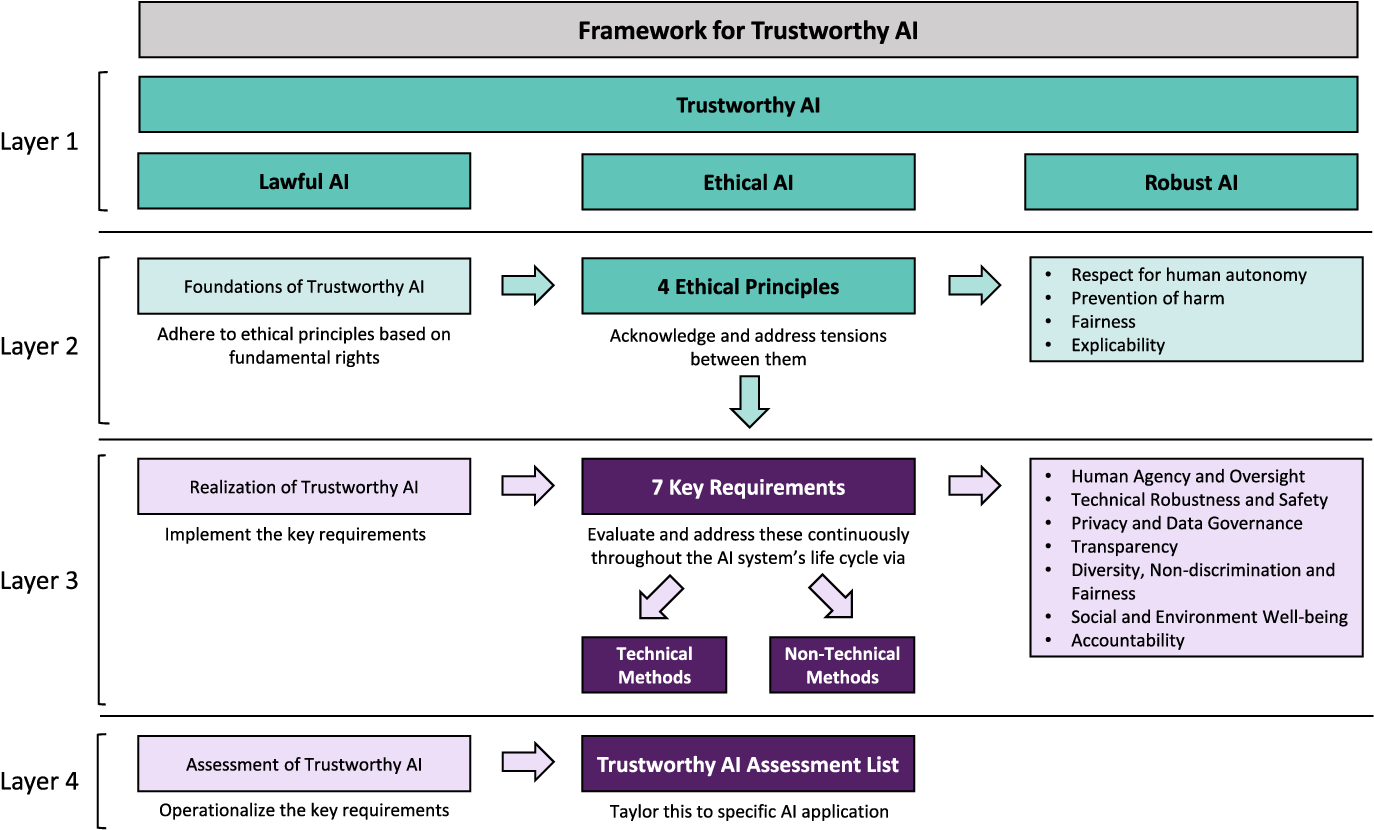
For our purposes as clinicians evaluating a commercial product, we can translate this into a practical, three-step assessment:
- Is it Lawful? Does the product have regulatory clearance (e.g., from the FDA) for the specific claim it's making? This is our first gate.
- Is it Robust? Is the evidence of its performance strong? Was it tested on diverse data? Has it been validated in real-world settings beyond the manufacturer's lab?
- Is it Ethical? Does the evidence address potential biases (e.g., related to patient demographics)? Is the manufacturer transparent about the model's limitations?
Let's walk through this process.
Step 1: The Foundation — Regulatory Clearance vs. Peer-Reviewed Evidence
As we've learned, the first step is to verify a product's regulatory status. However, a crucial part of your judgment is understanding the difference between the evidence submitted for regulatory clearance and evidence published in independent, peer-reviewed scientific literature. FDA clearance demonstrates safety and effectiveness against a benchmark, but independent studies are what build broad clinical confidence.
A recent review of dental AI products did this work for us, cataloging FDA-cleared platforms and searching for corresponding peer-reviewed studies. The results are very revealing.
FDA-Approved AI Solutions in Dental Imaging: A Narrative Review ...
We will examine the paper 'FDA-Approved AI Solutions in Dental Imaging: A Narrative Review...' by Ghotbi et al. It provides a comprehensive list of FDA-cleared dental AI products and cross-references them with published research.
Please open the paper and compare two key tables: Table 1 (Regulatory and product details...): Skim this table to see the list of companies and their products that have received FDA clearance. Table 4 (Evidence assessing performance...): Now, look at this table. It shows the number of peer-reviewed publications found for each of those same products. What do you notice when you compare the two tables? Pay special attention to major platforms like Overjet or VideaHealth. What does the discrepancy between having FDA clearance and having peer-reviewed publications tell you about the evidence landscape?
You likely noticed a significant gap. Many products with multiple FDA clearances had zero or very few independent, peer-reviewed publications at the time of the review. This doesn't mean the products don't work. It means that for many of them, the only available performance evidence is what the manufacturer themselves provided to the FDA. This makes our next step—critically assessing the quality of that evidence—even more important.
Step 2: The Reality Check — Why Clearance Isn't the Final Word
Even with FDA approval, a model’s performance in the controlled environment of a validation study can differ dramatically from its performance in the messy reality of a clinical practice. This happens for reasons we discussed in the last lesson: hidden biases in the training data, lack of testing on diverse populations, and over-reliance on retrospective data.
Let's watch a segment from a Stanford seminar that provides a powerful real-world example of this phenomenon in healthcare.
Stanford Seminar - Lessons from evaluating and debugging healthcare AI in deployment
In this video, 'Stanford Seminar - Lessons from evaluating and debugging healthcare AI in deployment', Dr. James Zou discusses what happened when his team tested state-of-the-art, high-performing AI systems in a real hospital setting.
Please watch the following three clips: The Problem (03:30 - 06:47): Listen for the dramatic performance drop when AI models were applied to real Stanford patients. The Detective Story (07:59 - 12:07): Pay close attention to the three reasons they found for the performance drop: issues with test data, different patient populations (distribution shift), and bias against dark-skinned patients due to a lack of representative training data. The Broader Issue (12:07 - 14:52): The speaker reveals that over 90% of FDA-approved medical AI algorithms were evaluated at only one location and were based on retrospective data. Consider how these exact issues could manifest in a dental AI for caries detection.
This seminar drives home a critical point: regulatory approval is the starting line, not the finish line. The fact that most approved AIs are validated retrospectively at a single site means that questions of robustness and ethical fairness often remain unanswered by the initial regulatory filing. As a future clinician, you must maintain a healthy skepticism and actively look for evidence of external, multi-center validation.
Step 3: Formulating Your Judgment — A Case Study
Now, let's synthesize these steps to form a summary judgment. We'll use the 30-item checklist from our previous lesson as our mental guide to ensure we cover the key domains of a good study.
Case: Overjet's Caries Assist
Let's evaluate the trustworthiness of a claim like: "Overjet's Caries Assist is a reliable tool for detecting interproximal caries."
Here is a structured thought process:
1. Is it Lawful?
- Check: We look at
Table 1in the "FDA-Approved AI Solutions" paper (LINK). - Finding: Yes, Overjet has multiple 510(k) clearances for "Caries Assist" (K212519, K222746) and even a pediatric version. The product is lawfully marketed in the US for this purpose.
2. Is it Robust?
- Check Evidence Source 1: FDA Submission Data. We look at
Table 3in the same paper (LINK), which summarizes the performance data Overjet submitted to the FDA.- Findings: The data shows standalone sensitivity between 72-79% and specificity over 98%. Critically, in reader studies, it shows a statistically significant improvement in clinicians' detection ability (e.g., sensitivity improved from ~65% to ~79%) with only a minor drop in specificity. This is strong evidence that the tool helps, rather than hinders, clinicians.
- Check Evidence Source 2: Independent, Peer-Reviewed Studies. We look at
Table 4.- Finding: At the time of the review, there were no peer-reviewed publications listed for Overjet's Caries Assist modules.
- Check for Weaknesses (applying the checklist from LINK and lessons from the Stanford video LINK):
- External Validation (Checklist item #21): The FDA summaries are likely based on data from a limited number of sites. As the Stanford video warned, performance could vary at other sites with different equipment or patient populations. This is a key limitation.
- Population Demographics (Checklist item #7): The FDA summary may not detail the demographics of the validation set. Was it diverse in terms of age, ethnicity, and caries risk? Unreported demographics are a red flag for potential bias.
- Ground Truth (Checklist item #8): How was the "true" presence of caries determined? Was it histology, or a consensus of expert radiologists? The quality of this ground truth is fundamental to the model's validity.
3. Is it Ethical?
- Check: This relates to fairness and transparency.
- Finding: The lack of data on performance across different demographic groups or imaging equipment raises a potential fairness issue. If the model works better for one group than another, it could exacerbate health disparities. The lack of independent publications also reduces transparency for the broader clinical community.
The Summary Judgment
Now, we combine these findings into a balanced, professional judgment.
Summary Judgment for Overjet Caries Assist:
"Based on available evidence, Overjet's Caries Assist is a trustworthy adjunctive tool for caries detection, supported by multiple FDA clearances. The evidence submitted to the FDA demonstrates that it can significantly improve a clinician's diagnostic sensitivity with a minimal trade-off in specificity.
However, its trustworthiness should be considered in context. The primary evidence comes from the manufacturer's own regulatory submissions, with a lack of independent, peer-reviewed, multi-center validation studies to date. Therefore, its generalizability to all clinical settings, patient populations, and imaging hardware is not fully established.
Clinical Recommendation: The product can be responsibly adopted as a 'second reader' to augment clinical judgment, but it should not replace it. Clinicians should be mindful of its performance on their specific patient base and equipment and report any perceived discrepancies."
This judgment is not a simple "yes" or "no." It acknowledges the strengths (FDA clearance, positive reader study) while clearly stating the limitations (lack of independent validation, unknown generalizability) and providing a safe, practical recommendation for its use.
The Final Check: Your Clinical Judgment
Even after the most rigorous evidence-based evaluation, the final check remains your own clinical expertise. An AI is a tool, not an oracle. If its output starkly contradicts your clinical findings and experience, you should trust your judgment and investigate further.
Module 4 - AI in Medical Education : Unstructured & Missing Data -What Clinicians Must Know
To conclude, let's hear a clinician's perspective on this from the video 'AI in Medical Education: Unstructured & Missing Data'.
Please watch the short Q&A clip from 54:32 to 55:53. The speaker gives a direct and powerful answer to the question of how to know if you can rely on an AI's output. This is a crucial takeaway for your future practice.
The speaker’s message is clear: your clinical intuition is an indispensable part of the process. Questioning the AI when its findings seem illogical is not unscientific; it is the very definition of responsible, human-in-the-loop oversight.
Conclusion
Congratulations on completing this module! You have developed a sophisticated, evidence-based approach to evaluating commercial AI claims.
Key Takeaways:
- Formulating a judgment on trustworthiness is a multi-step process: verifying regulatory status (Lawful), weighing the quality and breadth of performance evidence (Robust), and considering fairness and transparency (Ethical).
- A significant gap often exists between FDA clearance and independent, peer-reviewed validation. A trustworthy judgment must acknowledge this gap.
- The goal is not to find a "perfect," flawless product, but to understand a product's limitations to define a safe and effective way to use it.
- Your final judgment should be a nuanced summary that balances strengths and weaknesses and concludes with a practical clinical recommendation.
- Ultimately, the most important safeguard is your own clinical expertise. The AI is a tool to assist you, the clinician, who remains the ultimate decision-maker.
Preview of the Next Lesson
Having mastered how to evaluate individual products, we will now broaden our perspective in the final module of the course, "Ethics, Regulation, and the Future of Dental AI." In the first lesson, we will explore the regulatory pathways for AI medical devices in more detail, building directly on the foundation of FDA clearance we've discussed here. We'll delve into what it really means for a device to be Class I, II, or III and how that impacts the level of scrutiny a product receives.