Introduction
Welcome back. In our last lesson, you mastered the crucial skill of finding a manufacturer's evidence by navigating the FDA's public databases and locating the 510(k) summaries that underpin their regulatory clearance. You learned to distinguish between marketing language and the formally stated "intended use" and performance data.
Now that you know where to find the evidence, it's time to learn how to critique it. This lesson addresses the learning outcome: Assess a manufacturer's provided evidence for methodological weaknesses, such as bias or limited generalizability.
Simply having a study is not enough. The quality of that study determines whether an AI product is truly trustworthy. We will explore the most common pitfalls in AI validation—namely, bias in the data and a failure to prove the model works on diverse patient populations. By the end of this lesson, you will have a systematic framework for spotting these weaknesses, enabling you to judge not just if a product has evidence, but if that evidence is good enough for your clinical practice.
1. The Core Weaknesses: Bias and Limited Generalizability
When an AI model performs exceptionally well in the lab but disappoints in a real-world clinic, the culprits are often bias and limited generalizability. These two concepts are deeply intertwined.
- Bias occurs when an AI system produces results that are systematically prejudiced due to flawed assumptions in the machine learning process. Most often, this comes from the data used to train it.
- Generalizability refers to an AI model's ability to maintain its performance when applied to new, unseen data from different populations, settings, or equipment.
A model trained with biased data will almost certainly have poor generalizability. To see why this is so critical in healthcare, let's watch a short segment from a TEDx talk that explains this problem with a clear, powerful example.
Artificial intelligence in healthcare: opportunities and challenges | Navid Toosi Saidy | TEDxQUT
In this clip from 'Artificial intelligence in healthcare: opportunities and challenges' by Navid Toosi Saidy, the speaker explains how unrepresentative training data can lead to biased AI models that fail on certain populations. The example is about skin cancer, but the principle applies directly to dentistry.
Please watch the segment from 05:59 to 07:34. As you watch, consider the dental equivalent of this problem. What would happen if a caries detection AI was trained only on radiographs from a single demographic or from one type of X-ray sensor?
As the video illustrates, if the training data isn't diverse, the model learns a narrow view of the world. In dentistry, this could mean an AI trained predominantly on adult radiographs might struggle to interpret the unique features of pediatric teeth, or a model trained on images from one brand of sensor might be confused by the different image properties of another.
A Vocabulary of Bias
Bias isn't just one single problem. It can creep into the AI development process in several ways. The following video introduces a few common types of bias that are useful to know.
AI Bias | AI Bias And Ethics | AI Bias Examples | Algorithmic Bias | Gen AI | Simplilearn
This video from Simplilearn, 'AI Bias,' provides a quick overview of different forms of algorithmic bias. Knowing these terms will help you more precisely identify weaknesses in a study.
Please watch the section from 03:31 to 04:41, which defines several forms of AI bias. Pay particular attention to: Measurement bias: This happens when the data used doesn't represent the entire population—exactly the problem from the TEDx talk. Execution bias: This occurs when important data is left out, perhaps because developers overlook key factors.
Understanding these terms gives you a more precise lens through which to examine a manufacturer's evidence. Instead of just saying a study "seems weak," you can start to identify specific potential issues, like "the study may suffer from measurement bias because the patient demographics were not reported."
2. A Clinician's Toolkit for Evaluating Evidence
As a clinician, you don't need to be a data scientist to spot these flaws. You just need to know which questions to ask. The American Dental Association (ADA) has published guidance on this very topic.
Let's start with the foundational concepts of AI validation from the ADA's perspective.
Appendix 1: Imaging and Algorithms
We'll now turn to a white paper from the ADA Standards Committee on Dental Informatics titled 'Overview of Artificial and Augmented Intelligence Uses in Dentistry'. Appendix 1 is an excellent primer on how imaging AI is trained and validated.
Please read two key sections within Appendix 1: Start by reading the subsection titled 'System Validation' (page 31). This part explains critical concepts like 'intended use,' 'ground truth,' and why the 'Validation Dataset' must be high-quality and kept separate (sequestered) from the training data. Next, read the subsection 'Current Challenges for Machine Learning Systems' (page 33). This part is extremely important, as it highlights the exact weaknesses you should be looking for, such as poor establishment of 'ground truth' and insufficient 'Validation Scope and Quality'. Focus on how the quality of the validation process directly impacts your confidence in an AI's performance.
The ADA paper makes it clear: the burden of proof is on the manufacturer to demonstrate their validation was robust. The "Current Challenges" section shows that even in published, FDA-cleared products, you are likely to find limitations like small validation datasets or a lack of transparency about the data's diversity.
This naturally leads to a set of key questions you should ask when reviewing any evidence, whether it's in a 510(k) summary or a research paper.
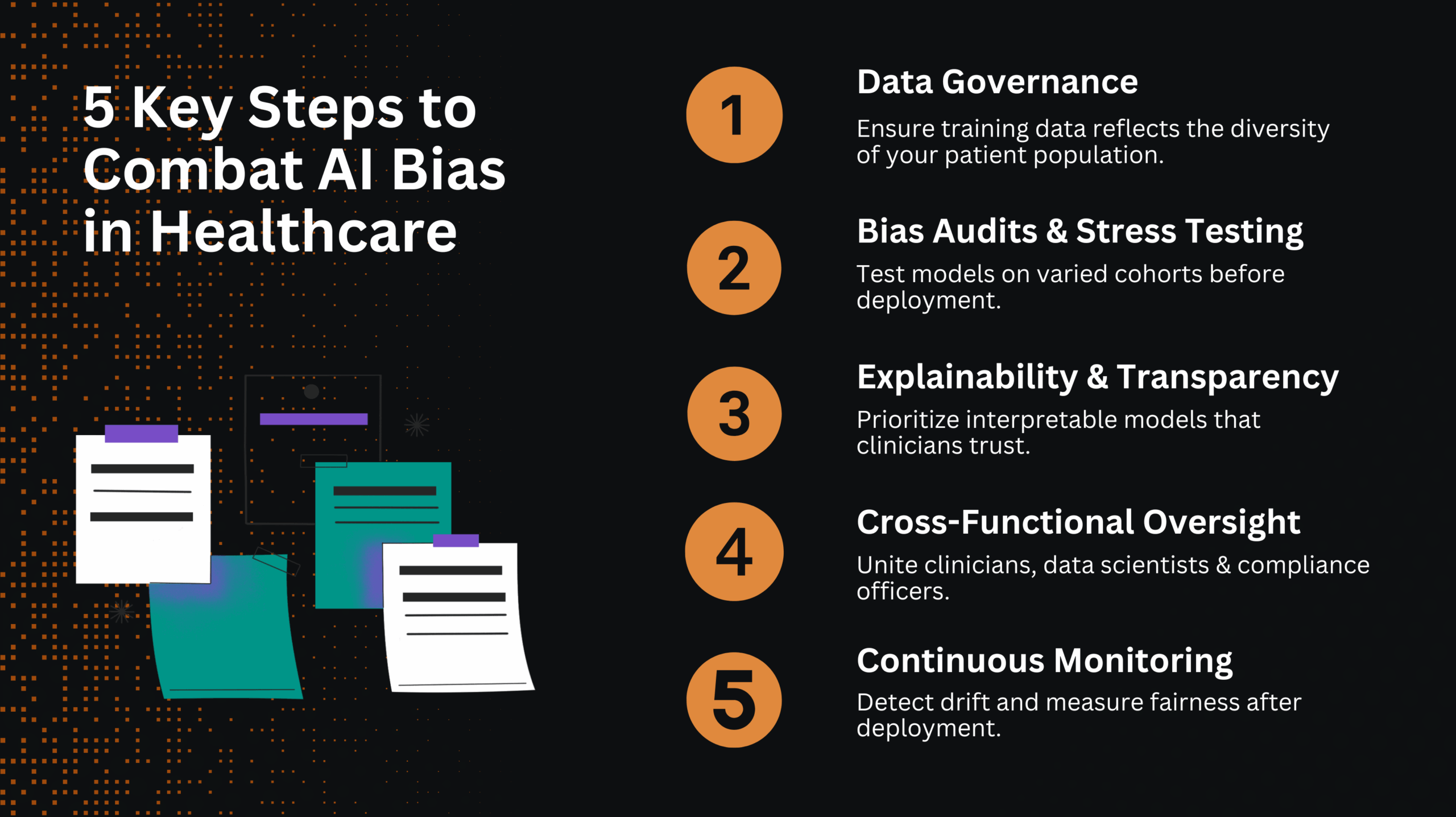
3. Your Systematic Checklist for Critical Appraisal
To make this process systematic, researchers have developed checklists to guide clinicians through the evaluation of AI studies. We will use a comprehensive 30-item checklist as our primary tool. You don't need to memorize all 30 items, but knowing the key categories will empower you to perform a thorough and efficient review.
Checklist for assessing AI and ML articles for clinicians
Let's examine a practical tool from the article 'Comprehensive guide and checklist for clinicians to evaluate...'. This checklist operationalizes the principles we've discussed into a series of straightforward 'yes/no' questions.
Please open the article and go to Table 4: Checklist for assessing AI and ML articles for clinicians. Familiarize yourself with the questions. We will focus on a few key items that directly relate to bias and generalizability: Study Population & Setting (Items 1-7): How well is the study population described? Do they report demographics like age, gender, and ethnicity? A lack of detail here is a major red flag for generalizability. Gold Standard / Ground Truth (Item 8): How was the 'correct answer' determined for the training and test data? Was it a single person, or a consensus of expert radiologists? How much did they agree (inter-rater agreement)? Weak ground truth leads to a weak model. Data Imbalance (Item 13): Did the study account for the fact that some conditions (e.g., caries) are less common than healthy states? If not, the model might be biased towards predicting the most common outcome (e.g., 'no caries'). External Validation (Item 21): This is a critical question for generalizability. Was the model tested on data from a completely different source (e.g., a different clinic, city, or country) than it was trained on? A model that has only been internally validated has not truly proven it can generalize. Discussion of Bias (Item 27): Did the authors proactively discuss the potential for bias in their model? Acknowledging limitations is a sign of a high-quality, transparent study.
Putting It All Together: A Thought Experiment
Imagine you are reviewing the 510(k) summary for a new AI product, "PerioMeasure AI," which claims to measure alveolar bone loss. The performance section states:
"The model was tested on a validation set of 500 periapical radiographs from our partner dental school, achieving a mean absolute error of 0.3 mm compared to measurements by three faculty periodontists."
Using the checklist and concepts we've discussed, what methodological questions immediately come to mind?
Click to reveal some key questions.
-
Generalizability (Checklist Items 1-7, 21):
- What were the demographics of the patients at that one dental school? Does it reflect the diversity of my patient population?
- What brand of X-ray sensors were used? Will it work with my equipment?
- Since it was only tested on data from one school, it has not been externally validated. How do I know it will work in a private practice setting?
-
Ground Truth (Checklist Item 8):
- How much did the three periodontists agree with each other on the initial measurements? If their own measurements varied significantly, the "ground truth" is less reliable.
-
Bias (Checklist Item 27):
- Did the study only include "textbook" cases of bone loss, or did it include complex cases with artifacts, challenging anatomy, or other concurrent diseases?
- Did the authors discuss any potential biases?
Asking these pointed questions is the essence of critically assessing evidence. It's not about finding a "perfect" study, but about understanding a product's limitations so you can use it wisely and safely.
Conclusion
In this lesson, you have moved from being a passive recipient of a manufacturer's claims to an active, critical evaluator of their evidence. You now possess a mental toolkit to dissect a study and identify its potential weak points.
Key Takeaways:
- AI models are highly sensitive to the data they are trained on. Biased or unrepresentative data is a primary source of methodological weakness.
- Limited generalizability is a major risk, where a model that performs well in a lab setting fails to work in diverse, real-world clinical environments.
- As a clinician, you can assess for these weaknesses by asking targeted questions about the study's population, the quality of its ground truth, and whether it has undergone external validation.
- Tools like the ADA's guidance and the 30-item research checklist provide a systematic way to evaluate the evidence behind any AI product.
Preview of the Next Lesson
You have now learned how to find the evidence (Lesson 2) and how to critique it (this lesson). In the final lesson of this module, "Formulate a summary judgment on the trustworthiness of a specific product claim," you will synthesize these skills. We will bring everything together to make a final, all-things-considered judgment about whether a commercial AI product's claims are trustworthy enough for you to consider adopting it in your practice.