Introduction
Welcome to our second lesson in the "Ethics, Regulation, and the Future of Dental AI" module. In our previous lesson, we demystified the regulatory pathways that AI medical devices must navigate to get to the market, such as the FDA's 510(k) clearance and the EU's CE marking process. We established that these regulations are designed to ensure a baseline of safety and effectiveness.
This raises a critical question: What happens when, despite these regulations, an AI system contributes to a clinical error? Who is responsible? Is it the clinician who used the tool, the company that made it, or the institution that implemented it?
Today's lesson directly addresses this complex issue. Our learning outcome is to discuss liability and accountability when an AI contributes to a clinical decision or error. We will move from the pre-market world of regulation to the post-market reality of clinical practice, exploring the principles that guide professional responsibility in this new technological era.
The Clinician's Enduring Responsibility
The most fundamental principle, and the one most consistently reinforced by dental regulatory bodies, is that the clinician remains the ultimate authority and bears the primary responsibility for patient care. The AI is a powerful tool, but it is just that—a tool to assist, not replace, your professional judgment.
Let's examine the guidance from a major dental regulatory authority, the Royal College of Dental Surgeons of Ontario (RCDSO), which provides a very clear stance on this.
Information on Artificial Intelligence - RCDSO
This FAQ page from the RCDSO directly addresses dentist responsibility when using AI. It lays out the professional expectation in no uncertain terms.
Please read the answers to the following three questions: "What happens if dentists disagree with an AI-generated output?" "Are dentists responsible if using AI leads to an error?" "What kind of education and training do dentists need to use AI?" Focus on the recurring theme of the dentist's obligation to exercise professional judgment and to oversee and critically review any AI output.
As the RCDSO makes clear, from a professional conduct standpoint, accountability is not ambiguous. You, the dentist, are responsible for the decisions made in the care of your patient. Relying solely on an AI's output without critical review would be inappropriate and could even be considered professional misconduct.
This principle is visually represented in the very nature of clinical decision support systems.

Think of the AI as an incredibly advanced consultant or a highly sensitive instrument. It can highlight areas of concern you might have missed or provide quantitative data (like bone loss percentage) with great precision. However, you must still integrate that information with your own examination, the patient's history, and your clinical experience to arrive at a diagnosis and treatment plan.
Shared Responsibility and the "Legal Gray Area"
While your professional accountability to your patient and your regulatory college is clear, the question of legal liability in a civil lawsuit (i.e., malpractice) can be more complex. In the event of patient harm, a legal case could argue that responsibility is shared among several parties.
This concept is often referred to as a "legal gray area" because it challenges traditional models of medical liability. Let's explore the different parties who might share this responsibility.
AI in dentistry: Strategies for managing risks and potential for malpractice claims
This article from the California Dental Association (CDA) discusses the key risks of AI in dentistry and touches upon the nuances of liability.
Please read the section 'Key risks of AI in dentistry'. Pay close attention to the subsections on 'Diagnostic errors' and 'Ethical and legal implications,' which note that liability in cases of malpractice involving AI is a 'legal gray area.'
The CDA article highlights that while you must ensure the AI's recommendations meet the standard of care, the situation isn't always simple. Liability in a civil suit could potentially be distributed:
- The Clinician: Held liable for failing to exercise professional judgment, using the tool improperly (e.g., for a purpose it wasn't cleared for), or ignoring an obvious AI error.
- The AI Developer/Manufacturer: Could be held liable if the error was caused by a faulty algorithm, biased training data that led to systematically poor performance for certain patient demographics, or a failure to adequately warn users about the device's limitations.
- The Healthcare Institution: A dental practice or hospital could be implicated for failing to provide adequate training on the AI system, not having proper protocols for its use, or creating an environment where clinicians are pressured to over-rely on the technology to save time.
This distribution of accountability is a key ethical consideration in the deployment of AI.
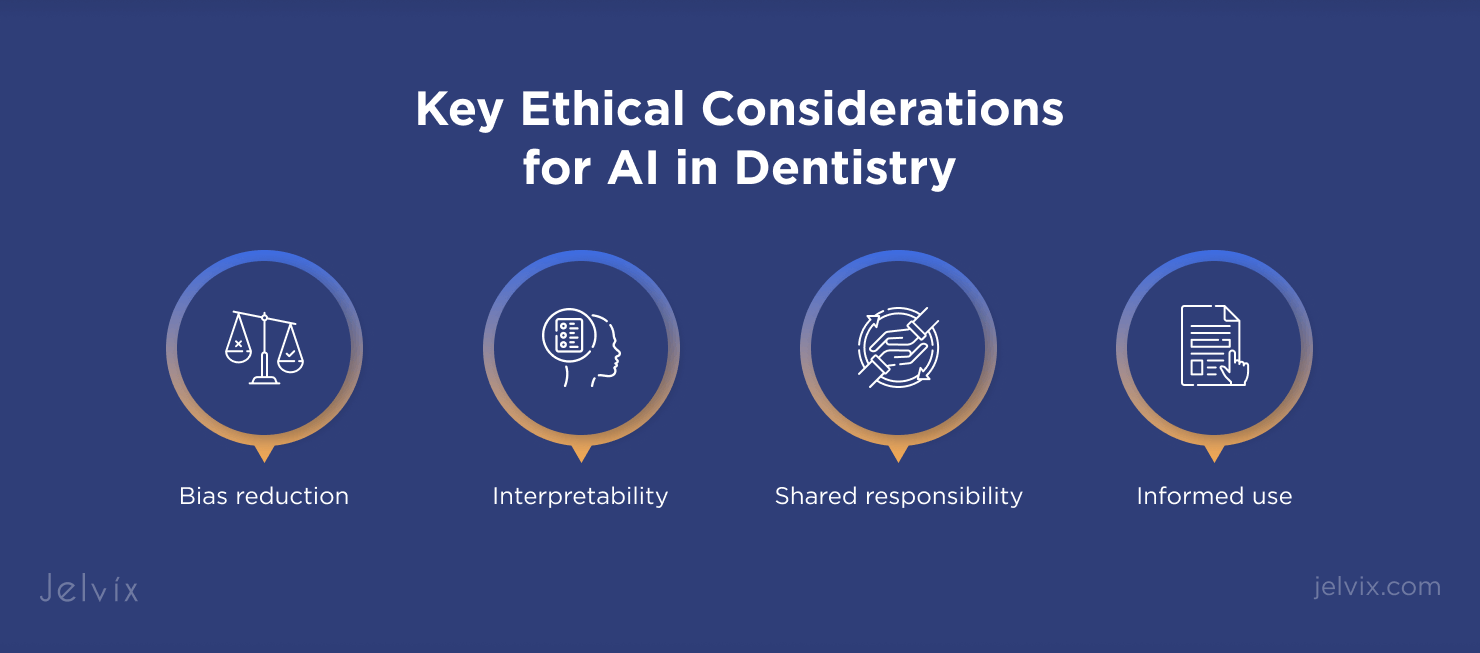
The concept of "Shared responsibility" acknowledges that safe and effective use of AI is a team effort, involving developers who build robust tools, institutions that implement them wisely, and clinicians who use them judiciously.
Practical Strategies to Uphold Accountability
Given this complex landscape, how can you, as a future clinician, navigate your responsibilities and mitigate risks? The key is to demonstrate that you have consistently and conscientiously applied your professional judgment. Here are some actionable strategies drawn from the RCDSO and CDA guidance.
-
Never Defer Your Judgment: The final decision is always yours. Use AI to inform, not to dictate. If the AI's finding seems clinically incorrect, trust your training and investigate further.
-
Document Your Rationale: This is perhaps the most critical risk management strategy. As advised by the RCDSO in the article you read, your patient records should reflect your thought process.
- If you agree with the AI, you might note: "AI detected potential incipient caries on #36-D. Finding confirmed on clinical review of radiograph."
- If you disagree, it's even more important to document why: "AI flagged radiolucency on #25-M. On review, determined to be cervical burnout, not caries. Patient reports no symptoms, area is non-cavitated on explorer exam."
This documentation provides a clear record that you actively engaged with the AI's output and did not follow it blindly.
-
Know Your Tool: You have a professional obligation to understand the capabilities and limitations of the tools you use. This connects back to our earlier modules on evaluating performance metrics (sensitivity, specificity) and appraising commercial products. A tool with high sensitivity might flag many false positives; knowing this is part of using it wisely.
-
Embrace Continuous Learning: As the RCDSO suggests, stay current with peer-reviewed literature and continuing education on the AI systems you implement. Technology evolves, and so must your knowledge of it.
By adopting these practices, you position the AI as a valuable assistant under your expert supervision, fulfilling your ethical and professional obligations.
Conclusion
In this lesson, we have confronted the critical issue of liability and accountability in AI-assisted dentistry. While the prospect of a "legal gray area" may seem daunting, the guiding principles for the clinician remain firmly anchored in traditional professional ethics.
Key Takeaways:
- Primary Accountability: Dental regulatory bodies are clear that the clinician retains ultimate responsibility for patient care and clinical decision-making. AI is a tool to augment, not replace, your professional judgment.
- Shared Legal Liability: In the event of a civil malpractice case, legal liability could be distributed among the clinician, the AI developer, and the healthcare institution, creating a complex legal situation.
- Risk Mitigation through Diligence: You can uphold your professional responsibility and mitigate liability by exercising critical oversight, thoroughly documenting your clinical reasoning (especially when disagreeing with an AI), and maintaining a deep understanding of the tools you use.
Preview of the Next Lesson
Our discussion today touched on the various stakeholders involved in AI use. This naturally leads to another crucial consideration: the patient's data. When you use a cloud-based AI tool to analyze a radiograph, where does that patient's data go? Who has access to it? How is it protected?
In our next lesson, we will delve into these questions as we explore patient privacy and data protection considerations specific to AI systems. We will examine the unique challenges that AI poses to traditional health privacy frameworks and what you need to know to ensure your patients' information remains secure.