Introduction
Hello and welcome to our penultimate lesson. In our previous discussion, we delved into the critical topic of patient privacy and data protection, establishing the principles of HIPAA, GDPR, and the importance of anonymization. We concluded that a cornerstone of ethical data handling is ensuring the patient is fully aware and agrees to how their information is used.
This brings us directly to today's focus, which addresses the learning outcome: Discuss the concept of informed consent in the context of using AI-assisted diagnostic tools.
Informed consent is a concept you are already familiar with as a fundamental pillar of ethical dental practice. However, when an AI system enters the clinical picture—assisting with diagnosis, recommending treatments, or just taking notes—the nature of that consent conversation evolves. Today, we will explore what stays the same, what changes, and how you can navigate these discussions to uphold patient trust and autonomy.
The Bedrock: Core Principles of Informed Consent
Before we examine the specifics of AI, let's briefly revisit the universal principles of informed consent. These are the pillars upon which any consent conversation is built, whether for a routine filling or an AI-assisted analysis.
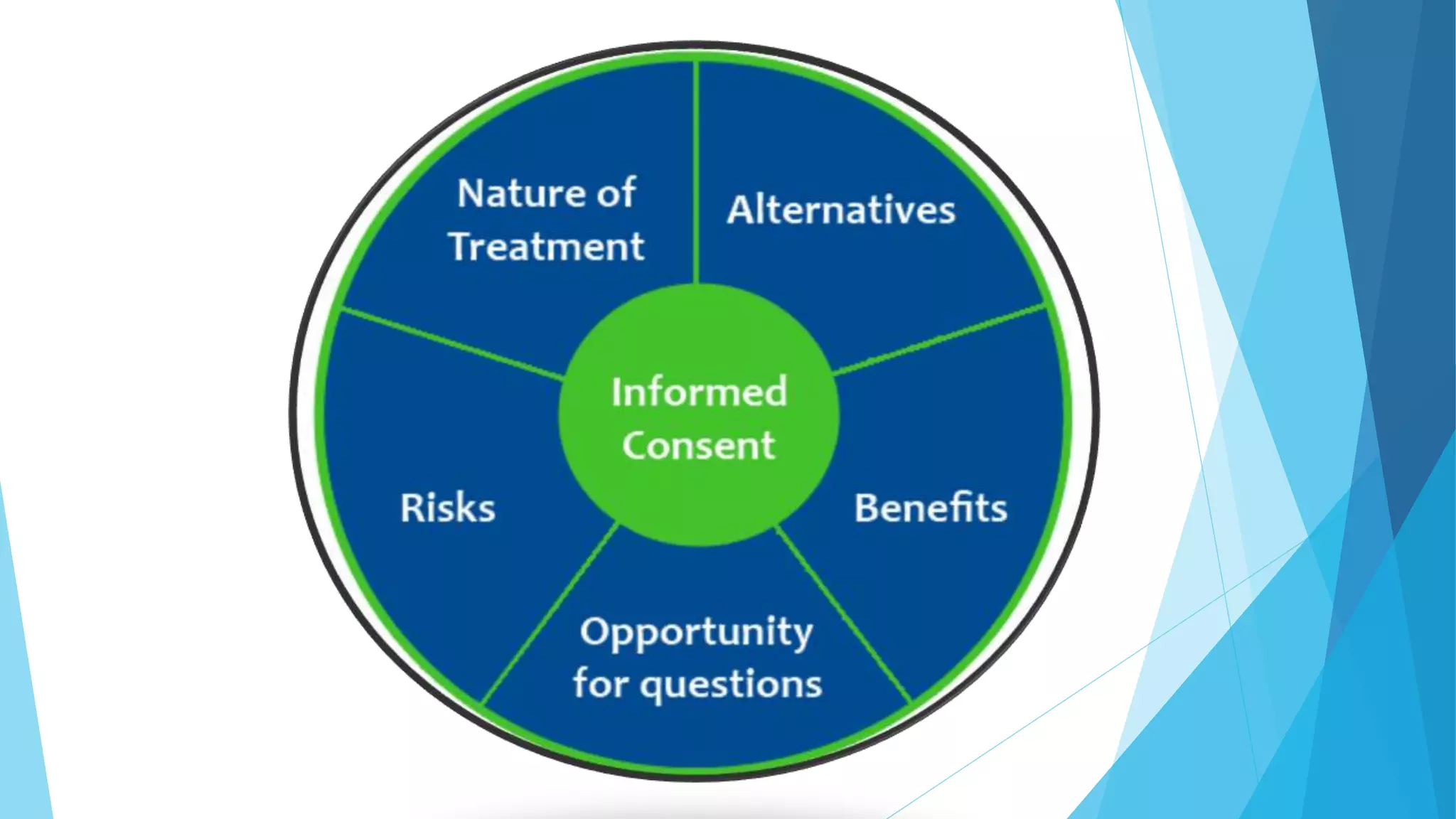
As a dental student, these five elements should be familiar:
- Nature of the Procedure: What is being done?
- Risks: What are the potential negative outcomes?
- Benefits: What are the potential positive outcomes?
- Alternatives: What other options are available, including doing nothing?
- Opportunity for Questions: Ensuring the patient can clarify any doubts.
When we introduce AI, we aren't replacing these principles; we are adding a new layer of detail to them.
Why AI Changes the Consent Conversation
Using an AI diagnostic tool is different from using a new type of digital X-ray sensor or intraoral camera. While all are tools, AI has the unique ability to influence your clinical reasoning, and it often involves sending patient data outside your clinic. This makes transparency essential.
The Royal College of Dental Surgeons of Ontario (RCDSO) provides excellent guidance on this. Let's start by understanding their rationale for why disclosure is so important.
Information on Artificial Intelligence - RCDSO
This section from the RCDSO's FAQ explains why being proactive and transparent about AI use is crucial for maintaining patient trust and supporting their decision-making rights.
Please read the short section titled 'Why is it important for dentists to disclose the use of AI to patients?'. Pay close attention to the three core reasons provided.
As the RCDSO points out, disclosing AI use is not just a formality. It serves to:
- Foster Trust: Proactive transparency shows respect for the patient.
- Support Autonomy: Patients have a right to know what tools are contributing to their care plan so they can make truly informed decisions.
- Acknowledge Impact: Since AI can directly influence diagnoses and treatment plans, its role must be made clear.
What, How, and When: The Practice of AI-Informed Consent
Knowing why we need to talk about AI is the first step. The next is knowing what to say, how to say it, and when an in-depth conversation is necessary.
What to Discuss with Your Patient
Let's turn back to the RCDSO guidance for a practical list of discussion points.
Information on Artificial Intelligence - RCDSO
This section outlines the key topics you should be prepared to discuss with a patient when using an AI tool in their care.
Please read the section titled 'What can dentists discuss with patients when using AI?'. Note the different ways you can inform patients and the specific elements you can share.
To build on this, a recent research paper developed a comprehensive checklist specifically for AI in dentistry. It translates these general ideas into concrete questions and answers.
Developing a consent checklist for AI in dentistry: Thematic analysis ...
This research paper offers a structured framework for the consent process. We'll focus on its practical checklist, which you could adapt for your future practice.
Please review 'Table 2. Patient consent checklist in AI-enhanced dentistry.' This table provides an excellent script for covering all the necessary bases with a patient.
Here is a summary of the key elements from both resources that you should integrate into your patient conversation:
| Element of Consent | What to Explain to the Patient |
|---|---|
| Purpose | What the AI tool does (e.g., "This tool helps me double-check your X-ray for any early signs of cavities I might miss.") |
| Benefits, Risks, Limitations | The pros and cons (e.g., "It can improve accuracy, but it's not perfect and sometimes flags things that aren't a concern. I will always make the final call.") |
| Transparency & Oversight | How it works and your role (e.g., "It compares your X-ray to millions of others to find patterns. Think of it as a second opinion that I will carefully review.") |
| Data & Privacy | How their data is handled (e.g., "Your X-ray is sent securely to the AI company for analysis. All your personal information is removed.") |
| Alternatives & Rights | Their choice in the matter (e.g., "We don't have to use it. I can rely solely on my own reading of the X-ray. You can also change your mind at any time.") |
This is what it can look like in practice. Notice how this sample form addresses privacy, voluntariness, and the purpose of the AI.
When is Explicit Consent Required? Implied vs. Explicit
You don't necessarily need a separate, signed consent form every time you use a piece of software. The key distinction lies in implied vs. explicit consent.
- Implied Consent: Consent that is assumed from a patient's actions. For example, when a patient sits in the chair for an exam, they are giving implied consent for you to use standard diagnostic tools like an explorer or a mirror.
- Explicit Consent: A clear, direct agreement (oral or written) given after a detailed explanation. This is required for more invasive procedures or when there are significant risks, alternatives, or data privacy implications.
So, where do AI tools fall? It depends on their function.
Developing a consent checklist for AI in dentistry: Thematic analysis ...
This section from the research paper explains the critical difference between AI tools that assist and those that decide, and how that impacts the type of consent needed.
Please read the first paragraph of the 'Discussion' section. It starts with 'As most regulatory-approved dental AI tools...'. Focus on the distinction it makes between AI for image interpretation and AI for autonomous recommendations.
The flowchart below, from the same paper, provides a brilliant decision-making guide to help you determine when explicit consent is necessary.
Decision Flowchart for Patient Consent
This flowchart guides a clinician through a series of questions to determine if explicit consent is required for using an AI tool. It considers the tool's function (supportive vs. autonomous) and its data use (clinical care vs. research).
How to read this flowchart:
- Start at the top: "Is the AI tool used for clinical care?"
- Follow the path:
- If the AI is purely supportive (e.g., highlighting potential caries on an X-ray for you to review) and the data stays within the clinical context, you might only need to notify the patient. This often falls under implied consent for diagnostics.
- However, if the AI is autonomous (making a decision on its own), makes treatment recommendations, or if the patient's data will be used for research or algorithm training, you must obtain explicit informed consent.
Handling Patient Concerns and Refusals
Finally, what happens if a patient is uncomfortable and says "no" to AI? This is a core part of respecting patient autonomy.
Information on Artificial Intelligence - RCDSO
The RCDSO provides clear, actionable advice on how to respond when a patient expresses concern or refuses the use of AI.
Please read the section 'What if a patient does not want their dentist to use AI?'.
The key is to explore their concerns, not dismiss them. You can offer reassurance by explaining that you remain in charge of all final decisions. In their paper, the researchers suggest a simple analogy you could use:
"The AI tool is based on a huge number of data, like thousands of books, and then AI found a pattern between patient data, symptoms, dental treatment he/she receives and treatment success. Thus, when AI tool looks at your health data... it compares it with the patterns it has learned and based on it, predict will the dental treatment be optimal for you."
Ultimately, if a patient still refuses, you must respect their wishes and proceed with conventional methods, documenting the conversation in their record.
Conclusion
Today, we've integrated the foundational principles of informed consent with the specific challenges and opportunities presented by AI in dentistry. You've learned that while the core tenets of patient autonomy remain unchanged, the conversation must expand to include the role of technology, its limitations, and its impact on patient data.
Key Takeaways:
- Build on the Basics: Informed consent for AI is an extension of the classic principles: explaining the nature, risks, benefits, and alternatives of care.
- Transparency is Key: You should be prepared to discuss the AI tool's purpose, its risks and benefits, how data is protected, and that your clinical judgment is always the final authority.
- Know When to Get Explicit Consent: While simple assistive AI may fall under implied consent, tools that are autonomous, make treatment recommendations, or use data for research require explicit, documented consent.
- Respect Patient Autonomy: Always be prepared to explore patient concerns and respect their decision if they decline the use of AI in their care.
Preview of the Next Lesson
We have now covered the major ethical and regulatory pillars of using AI in your practice: liability, data privacy, and informed consent. In our final lesson of the course, we will cast our eyes to the horizon. We will move beyond the tools of today to identify emerging trends and future directions for AI in dental practice, exploring what the next decade of innovation might hold for our profession.