Introduction
Welcome to our final lesson in the course on AI in dentistry. Throughout our journey, we have built a solid foundation, starting from the basic definitions of AI, machine learning, and deep learning. We've explored how AI models are trained for dental vision, how to interpret their performance metrics, and examined their application in diagnostics and treatment planning. Most recently, we tackled the crucial ethical and regulatory aspects, culminating in our last discussion on the importance of informed consent.
This final lesson serves as our capstone, looking to the future to address the learning outcome: Identify emerging trends and future directions for AI in dental practice.
We will synthesize everything we've learned to understand where the field is heading. We'll move beyond the tools available today and explore the innovations on the horizon that are set to transform diagnostic capabilities, patient experiences, and even the physical act of performing dental procedures.
1. From Detection to Prediction: The Next Diagnostic Frontier
So far, we've focused on how AI can match or exceed human ability in detecting existing pathologies like caries or bone loss. The next major leap is not just seeing what is already there, but accurately predicting what will happen in the future. This shifts the paradigm from reactive treatment to proactive and preventive care.
Florian Hillen, the CEO of an AI company, gives a compelling overview of this vision.
Eradicating the Dental Divide with AI: new era of preventive care | Florian Hillen | TEDxBoston
In this TEDx talk, Florian Hillen describes a future where AI moves beyond simple detection to become a predictive tool, fundamentally changing the nature of a dental check-up.
Please watch the segment from 09:00 to 11:02. Pay close attention to his examples of identifying cavities years in advance and predicting the outcomes of different treatment paths.
This idea of a "crystal ball" for dental health isn't just speculation; it's an active area of research. For example, a recent study highlighted in the research paper "Artificial intelligence (AI) in restorative dentistry" demonstrates this trend.
Artificial intelligence (AI) in restorative dentistry: current trends ... - PMC
This research paper consolidates recent findings in dental AI. We'll look at a specific section that validates the trend towards predictive analytics.
Please read the subsection 'Emerging Trends in AI for Restorative Dentistry (2024–2025)' under the 'Discussion' part of the paper. Focus on the paragraph that begins, 'A 2025 study explored the use of AI in predicting patient-specific risks...'
As the paper notes, researchers are developing AI that can predict a patient's specific risk for periodontal disease progression. This would allow clinicians to create truly personalized preventive plans long before irreversible damage occurs. We see similar trends in other specialties, like orthodontics, where AI is being used to predict treatment outcomes and optimize timelines.
2. The Hyper-Personalized Patient Journey
Another significant trend is the use of AI to create a more personalized, efficient, and engaging experience for the patient, both inside and outside the clinic. This involves AI-powered tools that handle everything from scheduling to patient education and remote monitoring.
An article in Dental Economics provides an excellent summary of these near-future applications.
5 ways AI is on track to reshape dentistry in 2025 | Dental Economics
This article outlines five practical ways AI is expected to reshape dental practices by 2025. We will focus on the trends directly related to the patient experience and practice efficiency.
Please read sections 3, 4, and 5, titled 'Enhancing efficiency,' 'Remote monitoring and tele-orthodontics,' and 'Personalizing patient experiences.' Note how these tools aim to improve patient understanding and access to care.
These trends point to a future where:
- Patient Education is Automated: AI assistants and chatbots can provide patients with tailored explanations of their conditions and proposed treatments, answering their questions 24/7. This reinforces your chairside conversation and improves treatment acceptance.
- Care Extends Beyond the Clinic: Tele-orthodontics and remote monitoring tools, powered by AI analysis of patient-submitted photos, can track progress without requiring an office visit. This increases convenience and access to care.
- The Practice Runs Smoother: AI is optimizing administrative tasks like scheduling and billing, freeing up the clinical team to focus entirely on patient care.
3. Automation and Robotics: The Future of the Operatory
Perhaps the most striking future direction for dental AI is its integration with robotics to automate clinical procedures. While the idea of a robot performing a filling or crown preparation might seem like science fiction, the foundational technology is already being demonstrated.
This short news segment showcases an early example of this technology in action.
The future of A.I. in dentistry
This news report discusses an AI-guided robot performing a crown preparation, highlighting the potential for immense gains in speed and precision.
Watch the first minute and a half of this video (00:00 - 01:36). Observe the concept of an autonomous procedure being supervised by a dentist.
As the dentist in the video notes, this is the next evolution of the CAD/CAM technology (like CEREC) that is already common in many practices. Instead of just designing the restoration, the AI is now guiding the physical preparation of the tooth.
The research paper we looked at earlier confirms that this is a serious direction for the field. The authors highlight these "AI-driven robotic systems" as a key emerging trend, leveraging real-time imaging to perform procedures with high precision. This has the potential to reduce chair time and improve consistency.
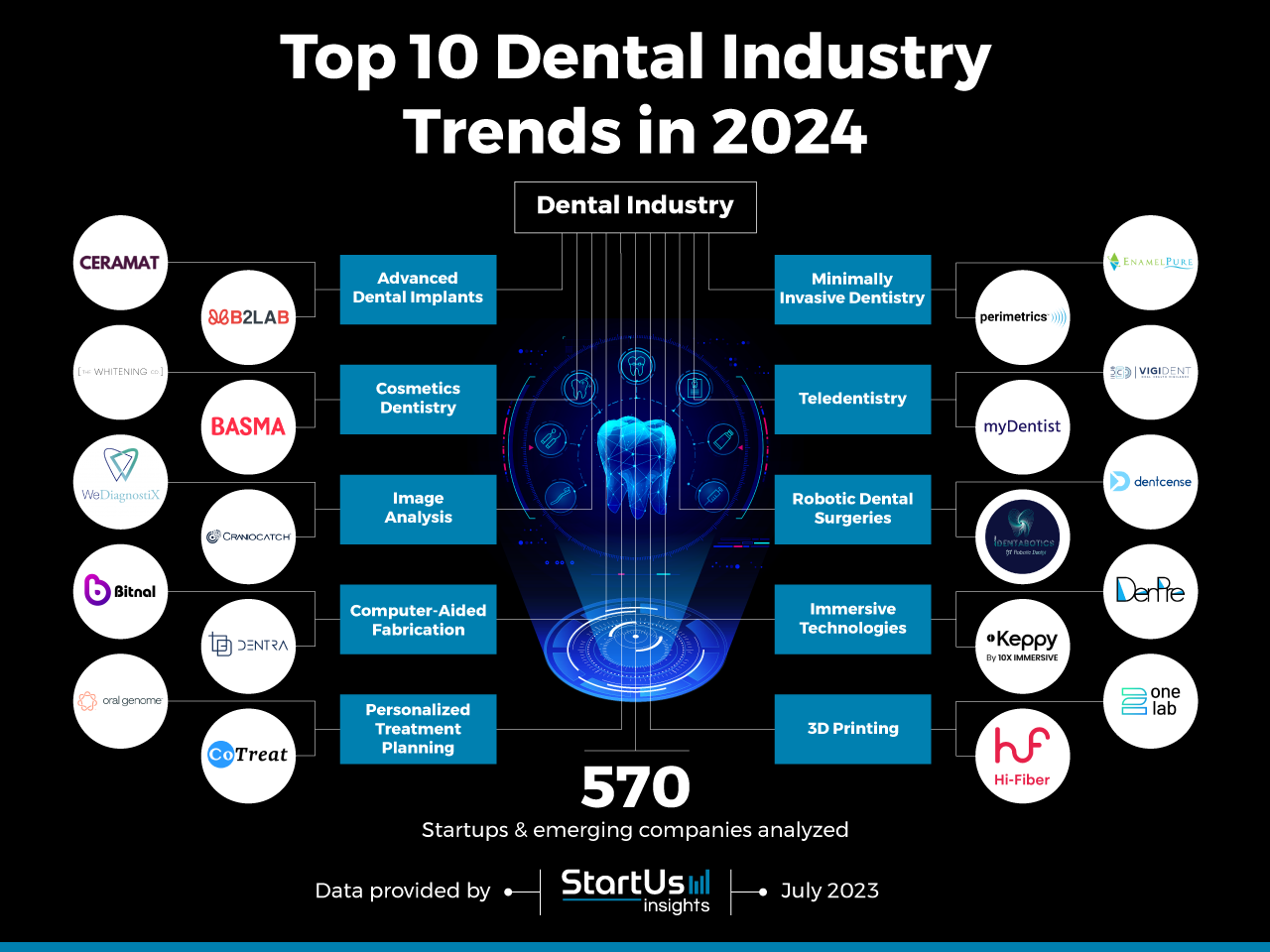
The infographic below places robotic surgery within the broader landscape of dental innovation.
4. A Synthesis of Future Applications
We've covered some of the most significant trends on the horizon. Many of these, and others, are summarized in the following graphic, which provides a holistic overview of where AI is headed in dentistry.

As you can see, the future applications of AI are diverse and touch nearly every aspect of the profession:
- Clinical Practice: From predictive diagnostics and robotic assistance to personalized treatment plans.
- Practice Management: Streamlining operations and patient communication.
- Dental Education: AI can be used to create advanced training simulations and personalized learning paths for students like yourself.
- Research: Accelerating the discovery of new drugs and biomaterials.
This vision of the future is not one where technology replaces the clinician. Instead, it is one where AI acts as a powerful co-pilot, augmenting your skills, managing routine tasks, and providing data-driven insights to help you deliver the best possible care to your patients.
Conclusion
Congratulations on completing the course! We have journeyed from the fundamental question of "What is AI?" to a nuanced understanding of its practical, ethical, and future implications for dentistry.
Key Takeaways from Today's Lesson:
- The Future is Predictive: AI is moving beyond detecting disease to predicting it, enabling a new era of preventive, personalized dental medicine.
- The Patient Experience is Evolving: AI-powered chatbots, educational tools, and remote monitoring will create a more continuous and engaging relationship between patients and their dental care team.
- Automation is Accelerating: Robotic systems guided by AI are poised to bring new levels of precision and efficiency to clinical procedures.
- The Clinician is Central: Across all these trends, the dentist's role is not diminished but elevated. You will be the one to interpret the data, make the final clinical judgments, and maintain the vital human connection with the patient.
As you move forward in your dental career, you are now equipped with the conceptual framework to understand, evaluate, and responsibly adopt the AI innovations that will undoubtedly shape our profession. You are part of the first generation of dentists for whom AI will be a standard, indispensable part of the clinical toolkit. The future of dentistry is in your hands, and it will be an exciting one.