Hello! Welcome to your third lesson in the "Training AI for Dental Vision" module.
In our last lesson, we conceptually opened up the "black box" of a Convolutional Neural Network (CNN). We saw how it uses layers of filters to build a hierarchical understanding of an image, moving from simple edges and textures to complex objects like a tooth or a restoration.
Now that you know what a CNN is, today we'll focus on how one is created for a specific dental task. We will trace the entire workflow, from a folder of anonymous radiographs to a functional AI model ready for testing. This lesson directly addresses the learning outcome: Outline the process of creating a dental AI model, from data collection and expert annotation to model training.
The AI Development Life Cycle: Our Roadmap
Creating a medical AI model isn't a single event; it's a structured, cyclical process. The diagram below shows a general overview of the stages involved.
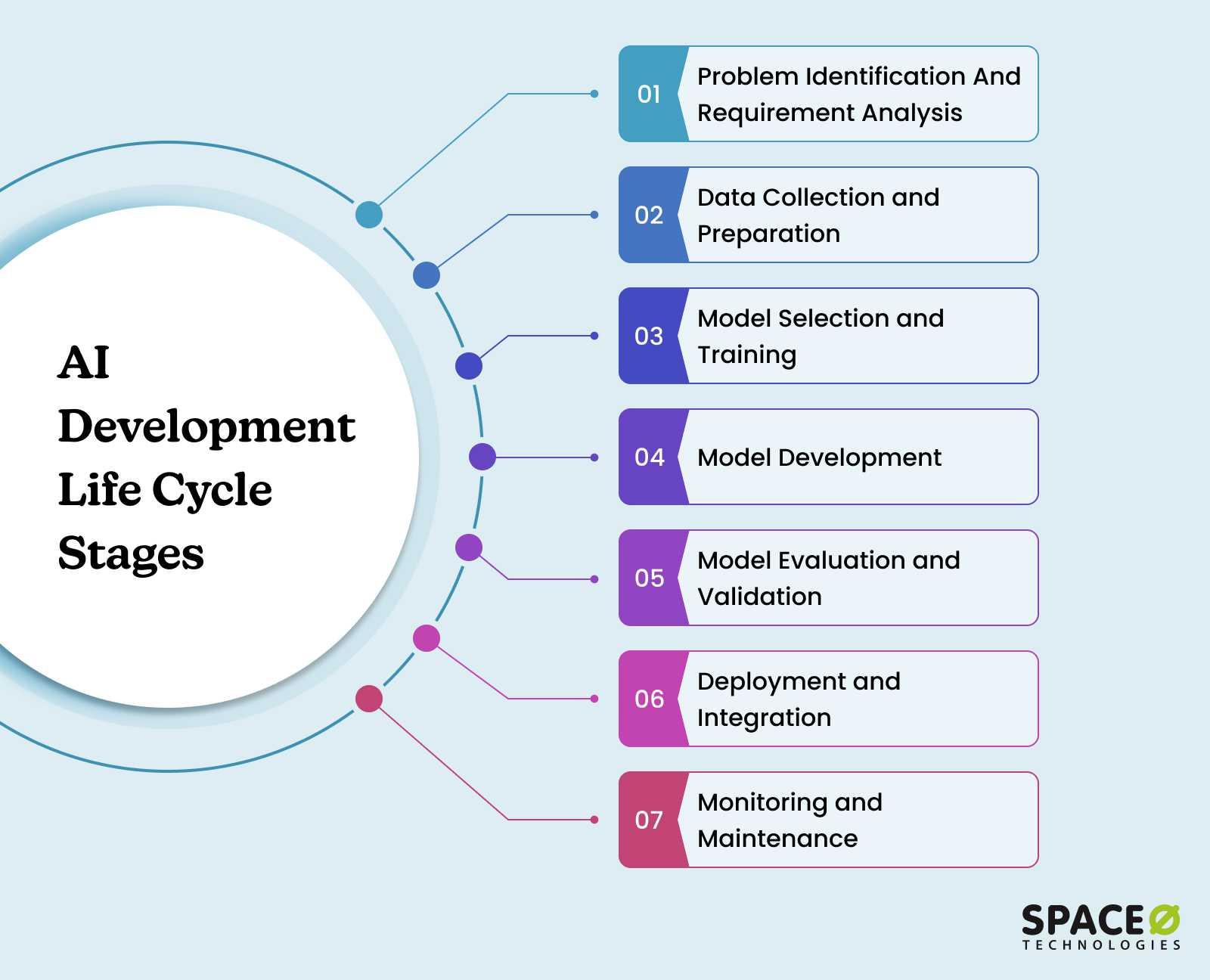
Today, we'll focus on the heart of this process: Data Collection, Annotation (part of Data Preparation), and Model Training.
Stage 1: Data Collection — The Foundation
Every AI model begins with data. For deep learning models, it needs a lot of data. In dentistry, this means collecting thousands, or even hundreds of thousands, of digital images, such as:
- Intraoral radiographs (bitewings, periapicals)
- Panoramic radiographs (OPGs)
- Cone-Beam Computed Tomography (CBCT) scans
- Intraoral and extraoral clinical photographs
To see a real-world example of this, let's look at how a dental AI company, Boneprox, describes their first step.
Building Our Dental AI: A Behind-the-Scenes Look
This short blog post, 'Building Our Dental AI: A Behind-the-Scenes Look,' provides a great, non-technical overview of the model creation process. We'll refer to it throughout the lesson.
Please read just the first section, 'Step 1: Data Collection and Annotation.' Notice the emphasis on both a large dataset and meticulous annotation by experienced dentists.
Quality Over Quantity
As the Boneprox article mentions, a large dataset is crucial. However, a common misconception is that more data is always the only thing that matters. In healthcare, the quality and representativeness of the data are often far more important than sheer quantity.
This video from Google's TensorFlow team provides an excellent explanation of this principle, using the example of detecting diabetic retinopathy.
Building AI models for healthcare (ML Tech Talks)
This video, 'Building AI models for healthcare,' discusses some of the myths and realities of creating medical AI. It highlights why a smaller, high-quality dataset can sometimes outperform a massive, 'noisy' one.
Watch from 01:42 to 06:55. Pay close attention to how they discovered that the quality of the labels (the ground truth) had a huge impact on the model's performance, sometimes more so than the number of images.
Pitfalls in Data Collection
The process of gathering data is filled with potential traps that can lead to a flawed or "cheating" AI model. A model will always take the easiest path to a correct answer, even if it's for the wrong reason.
Let's look at some fascinating—and cautionary—examples of this.
Building AI models for healthcare (ML Tech Talks)
We'll continue with the 'Building AI models for healthcare' video. In this segment, an ML lead shares three critical rules for building models, illustrated with powerful real-world examples of how things can go wrong.
Watch the segment from 35:35 to 42:45. Focus on the first two rules: 'Visualize your data' and 'Question the construction of your data set.' The stories about the 'circle detector' for lung cancer and the 'hospital detector' for tuberculosis are classic examples of data contamination and confounding variables.
These examples highlight why developers must be incredibly careful. In a dental context, a similar issue could arise if, for example, all radiographs showing severe caries came from an older, lower-resolution scanner, while healthy radiographs came from a new, high-resolution one. The AI might simply learn to identify the scanner type instead of the clinical signs of caries.
The FDI World Dental Federation's white paper summarizes these risks, noting that biased or non-representative data is a primary limitation of current AI systems.
Stage 2: Expert Annotation — Creating the "Ground Truth"
Once a high-quality dataset is collected, it needs to be annotated (or labeled). This is the process where clinical experts manually mark up the images to create the ground truth—the correct answers that the AI will learn from. This is the "supervised" part of supervised learning.
The annotation process turns a raw image into a training example. For example, a dentist would:
- Draw a bounding box around a carious lesion.
- Trace the outline of a periapical cyst, creating a segmentation mask.
- Place a single point on the apex of a tooth root.
Here is a simple visual example of what bounding box annotation looks like in a different domain:

This step is arguably the most critical and labor-intensive part of creating a dental AI model. The model's performance is fundamentally limited by the quality of its ground truth. As the saying goes, "garbage in, garbage out."
The quality of annotation depends on:
- Expertise: Annotators must be qualified dentists or specialists.
- Clear Guidelines: A precise protocol must be defined (e.g., "Only label enamel caries," or "Outline the entire area of bone loss").
- Handling Disagreement: What happens when two expert radiologists disagree on a subtle finding? This is a common challenge. Solutions often involve a third senior expert acting as a tie-breaker or a consensus panel discussion to establish the final ground truth for that image.
This is why the Boneprox article highlights their collaboration with specialists.
Building Our Dental AI: A Behind-the-Scenes Look
Let's revisit the Boneprox article to see how they emphasize the role of human expertise.
Please read 'Step 3: Integration of Specialist Knowledge.' This shows that annotation isn't just a mechanical task; it's about embedding deep clinical knowledge into the AI's training process.
Stage 3: Model Training — The Learning Loop
With a large, well-annotated dataset, we can finally begin training the model. The process you learned about in the last lesson—where a CNN uses filters to find features—is now put into a learning loop:
- Prediction: The untrained CNN is given an annotated image. It makes a guess (a prediction) based on its initial, random internal parameters. For example, it might output "3% chance of caries."
- Comparison: The model's prediction is compared to the expert's ground truth label for that image (which says "caries is present").
- Error Calculation: A "loss function" calculates the error or "loss"—the difference between the model's prediction and the ground truth. In this case, the error is large.
- Adjustment: An algorithm called an optimizer adjusts the millions of internal parameters within the CNN (the values in the filters and the weights in the final layers) ever so slightly in a direction that would reduce the error.
- Iteration: The process repeats with the next image in the dataset.
This loop is performed hundreds of thousands or even millions of times, with the model seeing all the images in the training dataset repeatedly. With each iteration, the model gets progressively better at minimizing its error, effectively "learning" the visual patterns that correlate with the expert labels.
Building Our Dental AI: A Behind-the-Scenes Look
The Boneprox article summarizes this training phase nicely.
Now, read 'Step 2: Model Development and Training.' This concisely describes the iterative training and refinement process.
Beyond Training: The Importance of Testing
Once the training process is complete, how do we know if the model actually learned to detect disease, rather than just memorizing the training images? We must test it on data it has never seen before.
This is why the initial dataset is always split into separate parts. At a minimum, it's split into:
- A Training Set: Used for the iterative learning process described above.
- A Testing Set: Held back and used only once at the very end to evaluate the final model's performance on completely new images.
This final validation on unseen data is non-negotiable for building a trustworthy medical device.
Machine Learning For Medical Image Analysis - How It Works
This short clip from a JAMA Network video on medical AI underscores the importance of rigorous validation.
Please watch from 08:39 to 09:40. Focus on the core message: the need to validate the model 'again and again and again' on different kinds of images and patient populations to ensure it's reliable in the real world.
Conclusion
You have now walked through the fundamental workflow for creating a dental AI model. It is a meticulous, resource-intensive process that relies on a symbiotic relationship between data, computer science, and deep clinical expertise.
Key Takeaways:
- The Process: Creating a dental AI model follows a clear path: collecting a high-quality dataset, having clinical experts annotate it to create a "ground truth," and then iteratively training the model to match that ground truth.
- Data is Foundational: The performance and fairness of an AI model are determined by the quality, size, and representativeness of the data it was trained on. Poor data collection can lead to "cheating" models that fail in real-world practice.
- Annotation is Critical: Expert annotation is the process of embedding human intelligence into the dataset. The quality of these labels forms the ceiling for the model's potential performance.
- Training is Iterative Learning: The model learns by repeatedly guessing, comparing its guess to the ground truth, and adjusting itself to reduce the error.
- Testing is Essential: A model's true performance can only be known by evaluating it on a separate set of unseen data.
In this lesson, we briefly mentioned splitting data into training and testing sets. In our next lesson, we will explore this crucial concept in more detail, explaining the distinct roles of training, validation, and testing datasets and why this separation is fundamental to developing a reliable AI model.